No one saw the moment he arrived, which was strange, because he didn’t belong anywhere quietly.
The street was a mouth that never closed—engines growling, vendors calling, music bleeding from open doors. It should have noticed him the way it noticed sirens and shouting. But he simply appeared at the center of it, as if the city blinked and forgot to finish the frame.
He didn’t do what he used to do. He didn’t circle the overflowing bins behind the takeaway place, lifting lids with careful fingers. He didn’t keep his shoulders rounded and his gaze low, wearing invisibility like a coat. Today his spine was straight. His shoes were still split at the toes, his hoodie still thin as paper, but the way he stood made space around him—space people stepped through without understanding why they slowed.
Cars rushed past. Buses exhaled heat. People skimmed his shoulders with shopping bags and polished briefcases and cheap perfume. Nobody cared. Nobody looked long enough to see that his eyes weren’t on the chaos. They were locked on a single moving point: a black luxury sedan inching through traffic, paint so glossy it reflected the sky like water.
He knew that car. Not because he’d ever ridden in it. Because it was the last thing he had watched from the curb the day his father didn’t come home.
Two years ago, he had stood near this same intersection holding a plastic grocery bag full of bread rolls and a bruised apple his mother had pressed into his hands—something to make his father smile when he returned from the early shift. They were supposed to meet by the pharmacy sign. His father had promised, tapping the boy’s forehead with a knuckle: I’ll be there. Don’t let the city swallow you.
The black sedan had paused in the lane closest to the curb, window half-lowered. A woman inside had turned her head as if listening to someone beside her, though the seat had been empty. His father had stepped off the sidewalk to speak to the driver. It wasn’t a handshake. It wasn’t a conversation that belonged on the street. It was an exchange done with bodies angled to block sight, with urgency in the man’s shoulders.
Then the sedan had rolled on, and his father had vanished into the crowd like a coin dropped into a fountain. An hour later, an envelope had arrived at their apartment—no return address, no signature. Inside: a written dismissal notice on crisp letterhead, and a wristwatch with cracked glass and rust along the edges. The watch had belonged to his father since before the boy was born. It had been the only thing that ticked reliably in their home.
The boy had kept it. Not as comfort. As a nail driven into memory.
Now the same sedan crawled forward, caught by a red light. The boy’s breathing thickened, loud in his own ears. His fingers tightened around something behind his back—something small enough to conceal in a fist, heavy enough to change how he held himself.
He stepped into the lane.
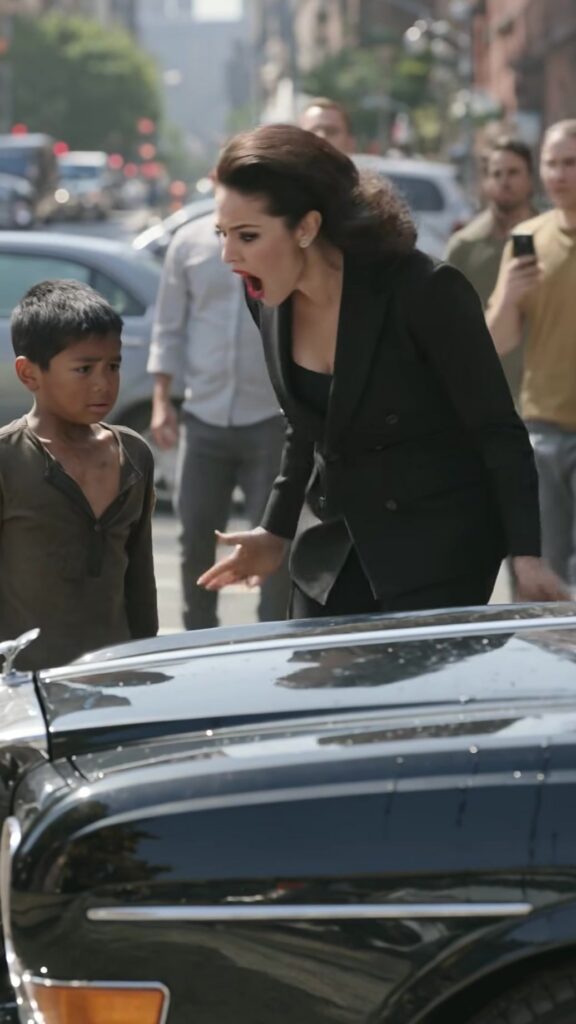
A horn blared. Someone shouted. The sedan drifted closer, its front grille a black smile. The boy lifted his hand and slammed it down onto the hood.
The sound was pure metal—sharp, emphatic, a bell rung in the middle of noise. For a moment the street’s mouth stopped chewing.
Heads turned. Phones rose, reflexive as hands shielding eyes from sun. The driver froze, knuckles whitening on the wheel. And then, with a mechanical softness, the rear door clicked.
She stepped out like she had all the time the city could offer her. Elegant, controlled, a pillar of calm in high heels. Her coat was charcoal, tailored to the millimeter. Her hair was pulled back so tightly it seemed to pull her thoughts with it. Her face could have belonged on billboards. It was the kind of face that said consequence was for other people.
The boy recognized her anyway—not from posters, not from rumors, but from that one sideways glance he’d caught through the half-open window years ago. The look of someone measuring a problem.
This time she didn’t look irritated at being delayed. Her eyes landed on him and, for an instant, her composure wavered. Not fear—not yet. Something closer to calculation colliding with surprise.
The boy brought his hand from behind his back.
People expected a weapon. A knife. A stone. Something the hungry and angry carry when the world offers them no other leverage. But what he held was smaller than a threat and heavier than an accusation: a wristwatch, worn-out and wrong against his palm, its glass crazed with cracks like a spiderweb. Rust ran along the seam where metal met time.
He raised it to her face like evidence in a courtroom.
“Do you remember this?” he asked.
His voice wasn’t loud. It didn’t need to be. The street leaned in despite itself. Even the busker on the corner let his chord die out.
She didn’t answer. Her lips parted as if words were an expensive thing, rationed. Her eyes, however, answered with a flicker—recognition sharp enough to make her blink.
“This was the last thing my father owned,” the boy continued, the sentence trembling on its own weight. “The day he disappeared, this is what they gave me.”
A ripple of whispers traveled through the small crowd that had formed. Names floated—her name, his father’s workplace, the word scandal like a spark looking for tinder.
She took one careful step back, heel clicking against asphalt. The driver said something through the open window, but she didn’t look at him.
“He didn’t get fired,” the boy said. His hands were steady now, because anger had welded them in place. “He vanished.”
More phones lifted higher. People moved closer, hungry for a story they could carry away. The boy could see his own face reflected in screen-glass—too thin, eyes too old.
Her chin lifted, an old instinct rising: deny, deflect, dissolve. “That isn’t true,” she murmured, but the words sounded like rehearsal.
The boy stepped forward until he could smell her perfume—something clean and cold, like cut flowers in a room without windows.
“Then say it,” he snapped, and the sound of it shocked even him. “Say what really happened.”
The air thickened. Traffic lights changed without anyone moving. A cyclist put a foot down. Even the engines seemed to idle quieter, as if the city wanted to listen.
She looked around—cameras everywhere, eyes everywhere, strangers ready to turn her silence into guilt. The polished world she lived in depended on distance. Here, distance was impossible.
For the first time, she let the mask slip enough to show something raw beneath it: not remorse, not compassion—panic at being cornered by a boy with nothing left to lose.
Then she did something no one expected. She stepped closer until her shadow covered his shoes. She leaned down, lips near his ear, shielding the movement with her hair and the angle of her shoulder, as if sharing a secret with a child.
Her words were so soft the phones couldn’t catch them. The street couldn’t take them. Only the boy received them, syllables sliding into him like a blade finding an old wound.
His face drained of color.
For a heartbeat, the boy’s eyes went distant, as if he was watching a memory play on the inside of his skull. His fingers loosened. The watch slipped from his hand and struck the pavement.
The sound of it breaking—glass finally surrendering, metal clinking—was smaller than the earlier slam, but it carried farther. It was the sound of something that could never be repaired.
He didn’t cry. He didn’t shout. His mouth opened, then closed again, and the silence that came out of him was worse than any scream. He took a step back as if the truth had weight and it had knocked him off balance.
The crowd, starved for resolution, erupted into demands.
“What did she say?”
“Where is your father?”
“Call the police!”
But the boy didn’t look at the cameras. He didn’t look at the woman. He stared at the shattered watch on the asphalt—its hands stopped forever between minutes—and then he turned away.
He walked through the gap the street made for him, moving not like someone fleeing but like someone leaving a room he would never enter again. People tried to follow, but something about his back—straight, empty—made them hesitate.
Behind him, the woman remained by the open car door, one hand gripping the edge as if it were the only solid thing left. Her face had lost its polish. It was bare now, exposed to the witnessing eyes, and her breath came too fast.
For the first time in her life, she looked afraid—not of the cameras, not of the crowd, but of what had been set in motion by a boy who had arrived unseen and left carrying a secret no one else could touch.
The traffic began to move again. The street resumed its roar. Yet the place where the watch had broken seemed to hold a different kind of silence, like a bruise under the skin of the city.
And somewhere in that noise, the boy walked on, the moment of his arrival already forgotten by everyone except the one person who now knew he would come back.