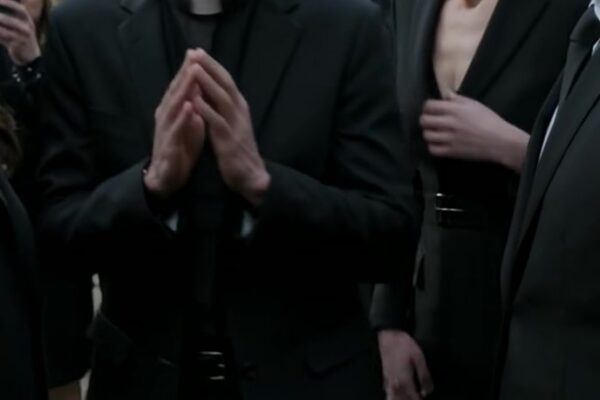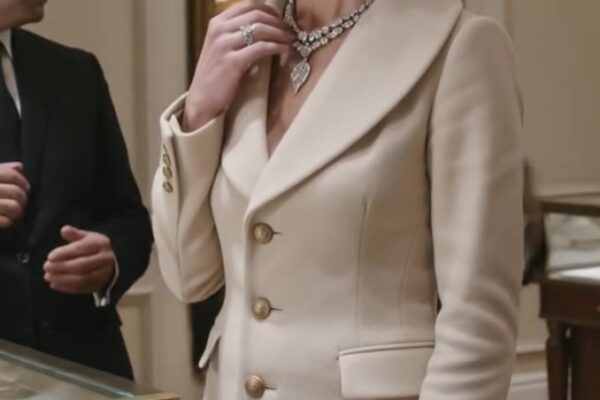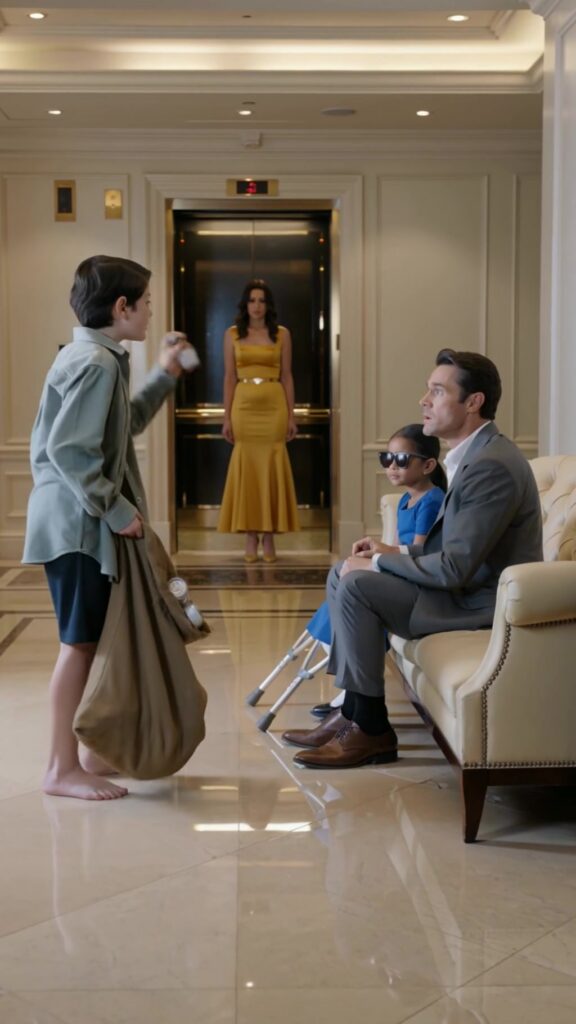
The worst part was that the father could see all three of them at once.
From the cream sofa he could take in the entire lobby as if it had been designed for an audience—marble floor polished to a mirror, a fountain that made a quiet, constant hush, the concierge desk like a judge’s bench, and the elevator bay framed by gold trim. The boy stood barefoot in the center aisle, his toes blackened from the street, a stained sack hanging from his hand. His daughter sat beside him, prim and small, dark glasses covering half her face, her crutch laid across her lap the way a violin rests across an arm. His wife waited near the elevators in a yellow dress that looked like it belonged in sunlight, not in this cold, gleaming place.
No one was hidden. No one could slip away behind a corner. No one could later claim they had been out of earshot.
“She is not blind!”
The shout cut clean through the fountain’s murmur and the faint music piped in from the ceiling. Heads turned. The concierge stiffened. A bellman paused with a luggage cart halfway through a push.
Daniel Voss—father, financier, man trained to measure risk in percentages—felt his body react before his mind did. He jerked upright, a small violence of movement against the plush sofa, and his hand found the edge of the cushion as if he needed to anchor himself. His daughter, Mira, stayed still for one heartbeat too long. Not startled. Not confused. Just… waiting, like a child who’d been told not to move.
His wife, Celeste, stood near the elevator with her fingers curling around the strap of her handbag. For a second she looked like she was about to step forward and smooth the scene with charm. Then she didn’t. Her posture tightened. Her smile did not arrive.
The boy took one pace closer. The sack in his hand gave a shy clink—cans and glass, collected from gutters and bins. His hair was cropped close, as if someone had cut it in a hurry, and his ribs showed through a thin shirt. His eyes, though, were steady and unafraid in a way that made Daniel’s throat go dry.
“Your wife did it.”
The sentence didn’t sound like gossip. It sounded like a verdict.
Daniel’s instinct, the instinct of a husband, told him to look at Celeste. To demand an explanation, to read the small flickers of her face and confirm what he already believed—that this was a misunderstanding, a con, a cruel attempt at blackmail.
He did not look at Celeste.
He looked at Mira.
Mira’s chin lifted, subtly, as if drawn by a string. Behind the dark lenses, her face aimed toward the boy’s voice. Then, as if she forgot the instruction that had ruled her for months, her head tilted a fraction more—precise, almost surgical. She turned to the exact point where the boy stood, not a degree off, not the searching angle of someone guided by sound alone. Her body knew where to look because her eyes knew.
Daniel’s stomach dropped with an unfamiliar sensation, like a door opening beneath him. He heard his own pulse loud as the fountain.
“Mira,” he said, and the name came out too softly, not a command, not a question, just an ache.
Celeste’s voice arrived from the elevator bay, crisp and bright as shattered ice. “Daniel, don’t entertain this. He’s a street kid. He’s trying to get money.”
The boy’s shoulders didn’t flinch. He reached into the sack and pulled out a tiny bottle, no label, the kind sold in bulk and filled by hands that didn’t want receipts. It looked harmless, almost laughably small to hold any power at all. He held it out as if offering a coin.
Daniel crossed the distance without remembering he’d stood. His hand snapped around the bottle. The plastic crinkled. His fingers shook against it like his body was rejecting what his mind had begun to accept.
It was warm from the boy’s palm.
Mira’s lips parted. A whisper slipped out, thin as breath on glass. “It tastes bitter…”
The words took the lobby and turned it into a courtroom. Daniel stared at his daughter—at the tiny tremble in her mouth, at the way her fingers tightened on the crutch as if it were the only thing keeping her in place.
“Mira,” he said again, louder, and finally the weight of a father’s authority returned. “Tell me what that means.”
The girl’s shoulders rose. She seemed, in that moment, both six and sixty. “It’s… for my eyes,” she murmured. “Mom said it would help them rest.”
“And did it?” Daniel asked.
Mira’s head bobbed a tiny yes, then stopped. The movement wasn’t confident; it was obedience. “I couldn’t see after,” she said. “Everything went… white.”
Celeste made a sound that was almost a laugh. “This is insane. You’re letting a stranger—”
Daniel finally looked at her. In that single turn of his head he felt the old world shift. Celeste’s face was composed, but her throat worked as she swallowed. Her eyes flicked, not toward Daniel, but toward Mira, as if checking whether the child might say too much.
The boy spoke again, lower now, and because he had already shouted once, his quiet voice carried like a blade. “I heard her in the service corridor. She was talking to the nanny. She said it only had to last until you signed.”
Daniel’s free hand closed into a fist. “Signed what,” he asked, though his mind was already flipping through documents, timelines, meetings. The trust restructure. The guardianship clause. The pen in his hand while Celeste smiled and brought him coffee, urging him gently, telling him he was exhausted, telling him it was just paperwork.
Celeste took one slow step backward. Behind her the elevator doors slid open with a chime, revealing mirrored walls that reflected the lobby in fragments: the boy’s bare feet, Mira’s crutch, Daniel’s pale knuckles around the bottle. A neat little triptych of a life tearing.
“Daniel,” Celeste said, and now her voice shook, “you’re not thinking clearly. That child—he could have stolen that bottle from anywhere.”
Daniel held the bottle up to the light. Inside was a clear liquid with a faint shimmer, as if something didn’t want to dissolve fully. He remembered Mira’s first complaint—how she’d rubbed her eyes at breakfast and said the sun hurt. He remembered the doctor Celeste had chosen, the private clinic, the swift diagnosis, the talk of rare nerve damage, the dark glasses, the crutch added later as if disability could be arranged like furniture.
He turned to the concierge, whose gaze had flattened into professional neutrality, the kind that tried to survive scandal. “Call security,” Daniel said. “And call the police.”
Celeste’s mouth opened, but no sound came. Her hand moved toward her bag, too quickly, too practiced. Daniel saw it—not the object yet, but the intention, the panic route.
“Don’t,” he warned.
Celeste froze with her fingers inside the bag. The elevator behind her waited patiently, doors open like a throat.
Daniel crouched beside Mira until he was level with her. He wanted to rip the sunglasses off, to force the truth into daylight. He didn’t. He reached for her small hand instead, and felt how cold it was.
“Mira,” he said, his voice breaking on the edge of control, “can you see me?”
The girl’s head turned toward him, that same too-perfect precision. Behind the lenses, her gaze landed squarely on his face. “Yes,” she whispered. Then, as if the word itself unlocked a door, she added, “I didn’t want to lie. Mom said… Mom said you’d leave us if I didn’t. She said it was just for a little while.”
Daniel’s eyes burned. Not from anger alone, but from the shape of the betrayal: his child turned into a prop, his marriage into an arrangement of shadows and signatures.
He stood. In his hand, the bottle felt heavier than any contract. “Celeste,” he said, and there was no softness left in the name. “What did you put in this?”
Celeste’s gaze darted to the boy, sharp with hatred now. “Who are you?” she hissed at him. “Why are you doing this?”
The boy swallowed, and for the first time his confidence wavered. “Because my sister cleaned your apartment,” he said. “Because she got sick after. Because nobody listens when you’re not wearing nice shoes.”
Daniel looked at the boy’s feet on the marble—dirty, unprotected, impossibly brave. He looked at Mira, small and trembling beside the crutch that was never hers. He looked at Celeste framed by the open elevator, a woman poised between escape and exposure.
The lobby stayed silent, but it was not the polite silence from before. It was a new silence, heavy with witnesses. The kind that made lies impossible to lift.
And with all three of them caught in his line of sight—boy, daughter, wife—Daniel realized the cruelest part wasn’t the accusation or the bottle or the signatures waiting in his briefcase.
It was that there would be no way, ever again, to pretend this moment hadn’t happened. No angle from which he could tell himself he hadn’t seen it all at once.
Security arrived, footsteps quick and decisive. The concierge spoke into a phone with a tight jaw. Celeste’s hand slid out of her bag empty, as if she’d decided to try innocence instead of flight. Mira’s fingers closed around Daniel’s, holding as if she feared he might vanish the way her sight had.
The boy stood his ground, sack at his side, watching the world finally tilt toward him.
Daniel looked at Celeste across the same frame, the same terrible clarity. “You wanted me to sign,” he said, voice low. “So you took my daughter’s sight.”
Celeste’s expression cracked. For a heartbeat, something raw showed through—fear, calculation, a flicker of contempt. Then it smoothed again, but the lobby had already learned how to read her.
“Daniel,” she began, as if a story could still be spun.
He raised the bottle slightly, not as a threat, but as evidence. “No more stories,” he said. “Not here. Not with witnesses.”
And for the first time in months, Mira leaned forward and took off her sunglasses herself. Her eyes blinked against the bright lobby lights—tired, reddened, but seeing. She looked from her father to the boy and then, at last, to her mother.
Celeste flinched as if the child’s gaze were a slap.
Daniel exhaled, a sound like grief finally allowed. The marble lobby, built for luxury and forgetfulness, became a place of reckoning.
All three of them in view. All three of them real. No one off-screen. No one hidden behind a version of events that could be edited later.
And Daniel, seeing everything at once, understood that the worst part wasn’t that the truth had arrived so loudly.
It was that it had been sitting in plain sight for so long, waiting for someone barefoot and furious to point at it and name it out loud.