The boy did not sound angry. That was what made the accusation so hard to survive.
The clinic garden was arranged to look like an apology. Pale stone paths, clipped hedges, and a ring of lavender that pretended the city’s soot could be rinsed away by scent. Glass doors stood behind them like a promise: inside were bright corridors, clean hands, careful words.
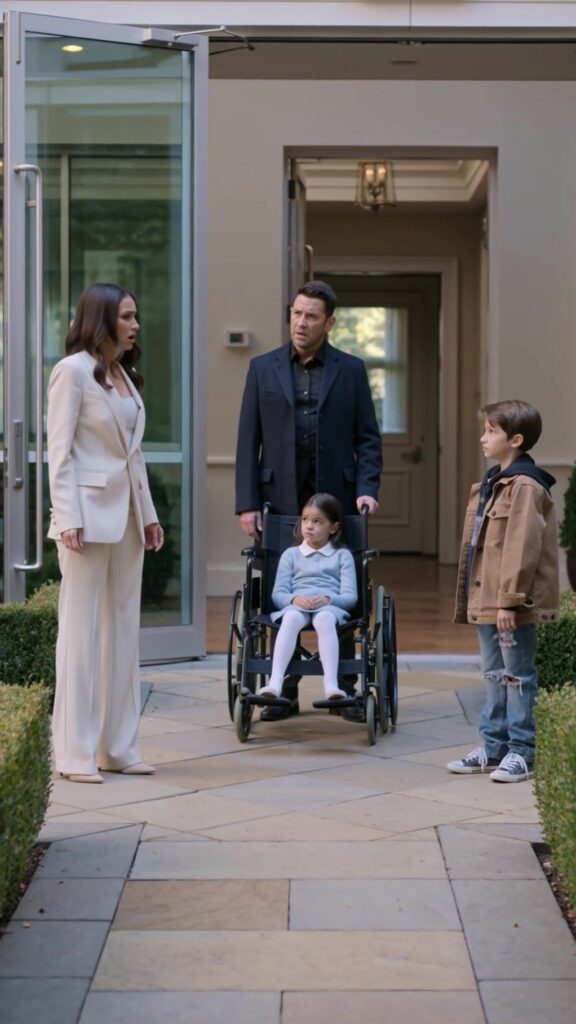
In the center of the path, a wheelchair waited in a patch of sun. A little girl sat in it with her knees covered by a crocheted blanket, her hair pinned back with a cheap plastic clip. She had been told so many times that she was “getting stronger” that she had begun to repeat it like prayer, though her legs remained still as sleep.
Beside her stood Jonas, her father, with his sleeves rolled to the forearms as if the day might require labor. He had that posture men learn when they’re trying to hold everything upright without being seen trembling: shoulders set, chin steady, one hand never far from what they cannot afford to lose.
On the left of the group, at the edge of the garden, a boy leaned against the railing. Eli was fifteen, all angles and quiet. He looked too old when he watched adults, as if he’d practiced reading their faces for years in rooms where people thought children were furniture. He did not glare. He did not fold his arms in theatrical condemnation. He simply looked from the woman to the chair and back again, letting the air carry his words without chasing them.
“She isn’t stuck like this on her own,” he said. The sentence crossed the lavender without rising. “That woman is keeping her that way.”
No stomp of anger. No raised voice. The words had the weight of a medical chart—flat, factual, merciless. The kind of statement you can’t argue with by calling it “emotion.”
Jonas turned at once. It was not the way he turned when Eli had said other inconvenient things over the years—about missing money, about broken promises, about the smell of whiskey on breath meant to kiss goodnight. This time he turned as if someone had pressed a knife between his ribs.
“Is he lying?” Jonas asked, and his voice tightened on the last word like a knot being pulled.
Margot stood near the glass doors, as though she belonged to the clinic’s modern architecture—sleek, composed, perfectly assembled. She had been his fiancée for eight months, and in that time she had learned all the correct tones: concerned, supportive, patient. She had learned to say “our girl” without sounding as if she’d had to practice. She had learned how to hold Jonas’s grief in public like a handbag.
Now, under the indifferent sun, her face emptied. Color fled so quickly it looked like something siphoned. Her body began to move backward before her mind appeared ready to explain why. One step, then another—controlled, but too fast to look innocent.
At the center of the path, Nora, the little girl, slowly turned her head toward Margot. Not frightened yet. Just confused in the way children are when they sense adults rearranging the world and calling it “for the best.” Her eyes searched Margot’s mouth, as if waiting for one of the gentle phrases Margot had always offered.
Jonas stepped forward, but not far. He stayed close enough to Nora’s chair to declare—without having to say it—that she mattered first. His hand hovered over the wheelchair handle, not gripping, just… present. If the world tilted, he wanted to be the axis she could cling to.
Eli did not move at all. He only watched.
That stillness made him more believable than any tears would have. Rage could be dismissed as teen rebellion. Calm, on the other hand, suggested preparation. Evidence. Time spent awake at night turning facts over until they aligned.
Jonas’s gaze followed Margot’s retreat, then flicked down, because people always look down when they are trying not to look at something too bright.
The light caught a glimmer in her hand.
A tiny bottle.
Small enough to hide in a palm, almost invisible against her pale fingers—except that glass, in daylight, betrays itself. It offers up reflections the way guilt offers up pauses.
Jonas saw it.
And the change in his face was so complete it seemed to hush even the distant city hum beyond the hedges. Not suspicion now. Recognition.
Margot began to turn, as if leaving quickly enough might still edit reality. She angled her shoulder toward the door, and the bottle disappeared against her wrist, tucked like a secret.
“Margot,” Jonas said, not loudly. He didn’t have to be loud. The word landed like a door slamming. “What is that?”
She stopped with her back half-turned, caught between two performances: the devoted caregiver and the woman about to flee. “It’s nothing,” she said, the way people say it when they have rehearsed the lie until it feels like a lullaby. “Vitamins. For my migraines.”
Eli’s voice came again, the same measured line. “It’s not vitamins.”
Jonas’s throat worked once. “How do you know?”
The boy finally pushed off the railing and took three steps forward, not toward Margot like a challenger, but toward Nora, like he wanted to keep his body between her and whatever explanation was about to burn the air. “Because I saw her put drops in Nora’s juice.” He looked at Jonas, not at Margot. “I thought I was imagining it the first time. So I checked.”
“Checked how?” Jonas asked, and the question sounded like a man asking for the last piece of ground before the fall.
Eli reached into his pocket and produced a folded paper towel with the carefulness of someone holding something that could shatter hope. Inside was a thin plastic syringe cap and a label he had peeled from a second bottle, smoothed flat like a pressed flower. “From the trash in the exam room,” he said. “She tears the label off when she’s done, but she missed this one.”
Margot’s shoulders rose slightly, a tiny shrug of defense masquerading as disbelief. “Eli, you’re—this is insane,” she whispered. “You’ve always hated me.”
“I don’t hate you,” Eli said, and it was the most brutal sentence of all, because it removed the easy explanation. “I watched you.”
Jonas’s eyes dropped to the label. He did not need to read every line; the clinic’s logo was there, and beneath it a printed name he had seen too often on Nora’s chart. A medication meant to quiet muscles. To reduce spasms. To make a body easier to handle.
Jonas had spent months learning the vocabulary of his daughter’s condition, swallowing syllables like pills: dystonia, neuropathy, idiopathic. He had believed the doctors because the doctors wore clean coats and spoke with sorrow. He had believed Margot because she stood beside him when the nights were longest and Nora’s crying echoed like glass breaking in a hallway.
He stared at the label until the words stopped being ink and became a sentence.
You can keep a child in a chair if you know what to pour.
His hand, the one hovering by the wheelchair, finally closed around the handle. Not to move Nora. To anchor himself.
“Why?” he asked Margot, and the question was not dramatic; it was hollow, as if someone had scooped out the center of him and left the shell upright.
Margot’s lips parted, then closed. Her gaze darted to the glass doors, to the clinic staff inside, to the safe world of fluorescent light where people were trained not to notice anything messy.
“Because…” she began, and the word died. The garden held its breath.
Nora’s small hand lifted and hovered near her own thigh, fingers twitching in an unconscious attempt to do what her legs wouldn’t. “Daddy?” she murmured, and her voice was thin but steady. “Am I… bad at getting better?”
Jonas’s face cracked at that. He knelt beside her so fast it made the gravel shift. “No,” he said, and it was the first word that sounded like prayer in his mouth. He cupped her cheek, feeling the warmth of her skin, the life that had been there all along. “No, sweetheart. You’re not doing anything wrong.”
Eli swallowed, his jaw tight, his eyes too bright. “She told me,” he said, quieter now, “that you needed her. That Nora needed her. That you’d fall apart without her.”
Margot’s composure finally slipped. “I kept it together,” she snapped, and for the first time there was something sharp in her tone, something raw and greedy. “When he was drowning in pity and paperwork, I was the one who made sure the world didn’t swallow him. Do you know what happens to a man like Jonas when the crisis ends? He looks around and remembers he can leave.”
Jonas did not look at her. He kept his eyes on Nora, because he had learned, too late, that what you look at becomes what you protect.
From the clinic’s open doorway, a nurse stepped out, drawn by the stillness the way animals sense storms. She saw Jonas kneeling, saw Margot’s pale face, saw the bottle in her hand. Her smile faltered.
Jonas rose slowly, not letting go of the wheelchair handle. “Call the police,” he said to the nurse, his voice steadier than he felt. “And call Dr. Havel. Now.”
Margot made a small sound, not quite a sob, not quite a laugh. She backed another step, then another, as if she still believed she could retreat into a version of the story where she was indispensable instead of monstrous.
Eli stayed where he was, a quiet sentinel on the left, watching the world finally catch up to what he had already seen.
The bottle in Margot’s hand flashed once more in the sun, a brief confession of glass, before her fingers tightened around it as if she could crush evidence into silence.
Jonas did not raise his voice. He did not chase her. He stood by Nora and held fast to the handle of her chair, because there were only two truths left in the garden, and one of them was his daughter’s heartbeat.
The other was the boy’s calm words drifting through lavender, unstoppable as a verdict: she had not been alone in this. Someone had been keeping her there.
And now, in the brightest part of the day, the lie finally had nowhere to hide.