Someone like him can’t know everything.
The sentence slipped from Elara Voss’s mouth as cleanly as a blade from a sheath, and the drawing room went still. It wasn’t loud, not even cruel in the way that invited immediate scandal. It was worse—quiet, polished contempt, the kind the old families of Cauldwell wore like perfume.
Across from her, in the amber glow of the chandeliers, Miles Harrow stood with his hands loosely clasped behind his back. No signet ring. No lineage embroidered into his cuffs. Just a plain dark coat that fit like he’d learned to tailor himself, and a face that belonged to someone used to watching doors rather than being welcomed through them.
The Riverglass Salon had gathered for its monthly entertainment: arguments dressed as conversation, secrets traded for laughter. On the walls, oil portraits of dead governors glowered down at the living. A quartet in the corner played something mournful and expensive.
Elara lifted her glass of honeywine and let her smile sharpen. “It’s charming,” she continued, eyes drifting over Miles as if he were a painting hung in the wrong room, “how confidently you speak on matters you haven’t lived. Policy, poetry, politics… even grief. You’re very… practiced. But someone like you—” she paused, savoring the softness of the insult “—can’t know everything.”
Several guests tittered, the sound restrained as lace. Lady Brimley covered her mouth. Lord Cayne leaned in, eager as a boy around a bonfire.
Miles didn’t answer. Not a frown, not a flinch. He merely blinked once, slowly, and his gaze remained steady on Elara as if he were listening for something beneath her words. That calm, that absence of defense, irritated her more than any retort could have. Silence was a kind of refusal—refusal to accept the role she’d assigned him: the upstart, the opportunist, the ornament.
Elara turned slightly to address the room, as if Miles had already been dismissed. “We are discussing the Minister’s new charter,” she said. “It’s all very impressive to hear a dock-born man speak like a magistrate.”
The insult was wrapped in civility, but it landed. A few faces flickered—sympathy, discomfort, delight. Cauldwell’s upper circles enjoyed cruelty as long as it was elegantly served.
Miles spoke at last, his voice low enough that the quartet’s violins seemed to bend toward it. “Do you always measure a person by where they started, Miss Voss?”
Elara tilted her head. “Why, yes. It saves time.”
Miles nodded as though she’d offered a useful fact. “Then you must be very busy,” he said. “So many beginnings. So many endings.”
There was something in that last word that touched the back of Elara’s neck like cold breath. She straightened, refusing to show it. “Poetic,” she replied. “But not an answer.”
Miles’s eyes moved—not to her face, but to the lace at her wrist, to the ribbon tied too tightly at her throat, to the thin line of bruised color just under the collarbone that the candlelight betrayed when she swallowed. He looked away again, politely. As if the sight was private, and he’d seen it by accident.
Elara’s fingers tightened around her glass. She’d dressed carefully. She’d hidden what she could. She didn’t know whether to feel fury or panic. “What are you staring at?”
“Nothing,” Miles said. “Only listening.”
Lady Brimley laughed uncertainly. “Listening to what, Mr. Harrow? The music?”
Miles glanced toward the quartet. “No. The seams.”
The word rippled through the room. Elara’s eyes narrowed. “Seams.”
“Where things are stitched,” he said. “Where they come apart.” He paused, as though choosing his next sentence with care. “Where someone tries to mend what shouldn’t be torn in the first place.”
Elara felt heat rise in her cheeks. She hated him in that moment—not because he’d insulted her, but because he spoke as if he understood. Understanding was an intimacy she had not granted.
“You’re fond of metaphors,” she said, attempting to reclaim the room with a lightness she did not feel. “Very well, Mr. Harrow. Tell us what you know. Impress us. Since you’re apparently full of insight.”
Miles’s gaze settled on the far door, where the hall beyond lay shadowed. “There’s a man outside,” he said. “He’s been there since the second course. He’s pretending to smoke a pipe he hasn’t lit, because the ember would show on the glass and someone might notice. He’s waiting for you, Miss Voss.”
The room’s laughter died abruptly.
Elara held her smile in place, the way she’d learned to hold her posture through hours of charity functions. “Nonsense,” she said. “My brother’s men are stationed at the gate.”
“Not for him,” Miles replied. “He came by the alley. He knows the cook. He brought a bottle as a favor and slipped in behind the delivery. He’s wearing a grey scarf to hide the bruise on his jaw—fresh, less than a day old.”
Elara’s stomach tightened. Her pulse became loud. There was no grey scarf at her father’s house parties unless—
“Stop,” she said, but it came out softer than she intended.
Lord Cayne shifted. “Mr. Harrow, who exactly are you describing?”
Miles finally returned his eyes to Elara’s face. “The person she is afraid of,” he said.
Something in Elara’s chest snapped—not with pain but with anger, sharp and clean. Fear was a word she despised. It implied weakness. It implied she had not fought hard enough. She forced a laugh that sounded brittle in her own ears. “Afraid? Please. If you’re trying to conjure drama, you’re doing it poorly.”
Miles stepped closer—not invading, but closing the distance like a door being shut. His voice dropped further. “Your left wrist is tender,” he said. “You favor it when you lift your glass. You’ve wrapped it in lace and perfume, but it’s swollen. He grabbed you there.”
Elara’s breath caught. In the space of a heartbeat she was no longer in the salon, but in the carriage two nights ago, the curtains drawn, the city rushing past, and a hand closing around her wrist hard enough to leave purple fingerprints. A voice at her ear: You will marry who I say. You will smile. You will behave.
Her eyes burned. She hated that her body remembered before her mind was ready to admit it. She hated the room for existing, for witnessing, for waiting.
“You can’t know that,” she whispered, and now the words were not a weapon but a plea. “You can’t.”
Miles’s expression didn’t change. But something softened in his gaze, as if he’d been in this kind of darkness before and knew it was not romantic. It was simply ugly.
“I don’t know everything,” he said. “But I know patterns. I know what a person does when they’ve been made to feel small.”
Elara swallowed. “Then what am I supposed to do?”
In the silence, the quartet’s music faltered, one violin string whining as a bow slipped.
Miles didn’t answer immediately. He looked toward the door again, listening as if he could hear footsteps through marble and velvet. “You’re supposed to stop pretending this room will save you,” he said. “It won’t. These people will gasp, and then they will forget. They’ll call it unfortunate. They’ll call it private.”
Lady Brimley’s eyes widened in alarm. Lord Cayne’s mouth opened, then closed. No one contradicted him.
Elara’s fingers trembled around her glass. The honeywine sloshed, catching light like molten gold. She felt exposed, but she also felt, for the first time in months, a strange clarity: the understanding that her refinement had been a cage, and her family name the lock.
“And you?” she asked. “What will you call it?”
Miles met her gaze fully now, and there was steel under the calm. “I’ll call it what it is,” he said. “A threat. An offense. A man who thinks he can own you.”
A knock sounded from the hall beyond the far door—soft, but deliberate. The room collectively held its breath.
Elara’s spine went rigid. Her mind raced through years of training: smile, deflect, endure, survive. She could feel the old response trying to rise like a tide, to pull her back into silence.
Someone like him can’t know everything, she had said. And yet he’d seen what she’d hidden in lace and etiquette. He’d named what she’d refused to name.
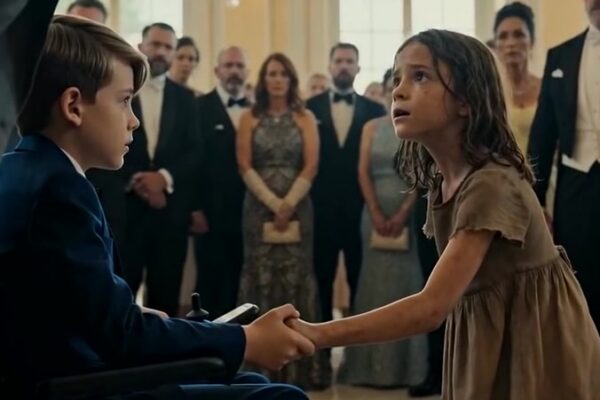
Miles held out his hand, palm up, not touching her. The gesture was simple, almost formal, but it carried something unfamiliar: choice.
“If you want,” he said quietly, “we can open that door together.”
Elara stared at his hand. The room’s eyes pressed in on her from all sides like a wall. The knock came again, a little harder.
Elara set her glass down. Her fingers were steadier than she expected. “Someone like you,” she said, voice low and shaking with something that wasn’t fear anymore, “should have learned to keep quiet.”
Miles’s mouth twitched, not quite a smile. “I did,” he murmured. “For years.”
Elara took his hand.
It was warm. It was real. It did not tighten like a trap.
Together, they walked toward the door as the salon watched, stunned into stillness. Elara felt the drag of a thousand expectations trying to anchor her, but each step cut another thread.
At the threshold, she paused. Her heartbeat thundered in her ears, loud enough to drown the violins. She glanced sideways at Miles. “What if you’re wrong?” she whispered. “What if you don’t know as much as you think?”
Miles’s gaze was fixed on the latch. “Then we learn the rest,” he said.
Elara’s fingers closed around the handle. The metal was cold, honest. She drew in a breath that tasted like smoke and honeywine and the end of pretending.
And she opened the door.