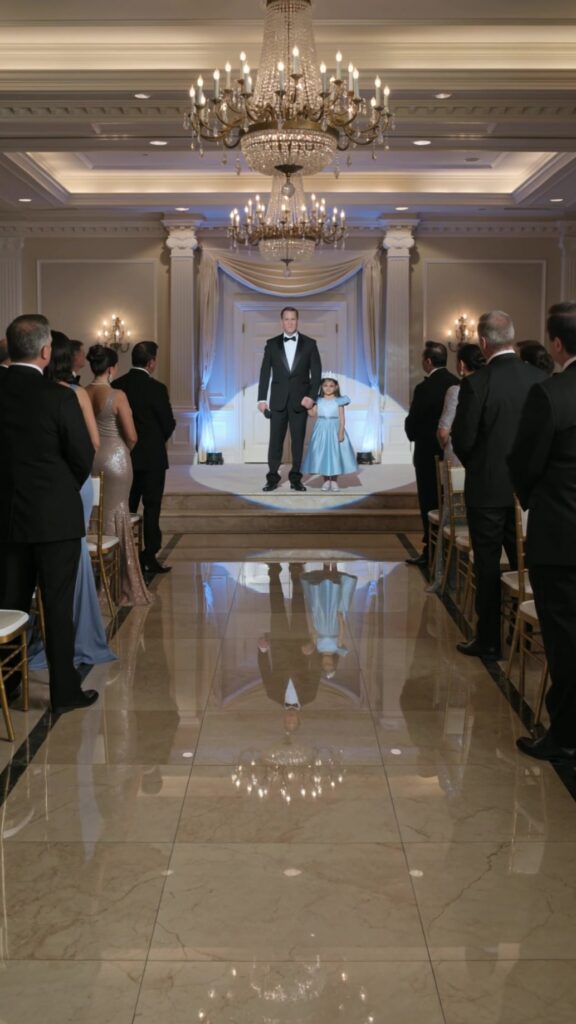
Golden light from dozens of chandeliers spilled across the polished marble floors of the Harrington mansion, sparkling like fragments of distant galaxies. The soft clink of crystal glasses mixed with the elegant hum of conversation drifting through the enormous ballroom, where power wore perfume and practiced its smile. Senators leaned toward billionaires as if secrets could be traded like stock. A surgeon famous for hands steadier than prayer spoke to a movie star whose laugh had been insured. Beyond the glass doors, a procession of black cars curved through the drive like a glossy spine.
At the center of all of it stood Daniel Harrington, forty years old and somehow older than his photographs. On stage, the microphone waited on its stand like an accusation. Daniel held it anyway, too tightly, as if it might anchor him to the room. His suit fit perfectly; his composure did not. Beside him stood Emily, eight years small in a white dress stitched with silver thread that caught the chandelier light and scattered it across her knees. She kept one hand in his, her fingers curled around his like a lifeline.
Emily did not speak. She had not spoken for three years—since the night rain and headlights turned their car into a spinning room of glass and metal. Since the moment her mother’s voice became a single broken note, cut off mid-syllable, swallowed by impact. Emily had climbed out without a bruise. Daniel had watched his wife carried away beneath a tarp that looked too clean for what it covered, and he had learned that a child can survive everything and still be destroyed.
The orchestra softened. Conversations died in folds, one after another, until the whole ballroom faced Daniel as if his wealth had purchased their attention outright. He cleared his throat. It sounded like someone trying to speak through smoke.
“I invited you here tonight,” he began, and the words came carefully, like stepping stones over water, “not only to celebrate my birthday…” He paused. The silence that followed was too sharp to be polite.
“…but because I need your help.”
A murmured ripple passed through the crowd. Daniel looked down at Emily, and for a split second the empire-maker looked like a man holding a fragile object he did not understand. “My daughter lost her voice,” he said, his tone softer than his guests had ever heard in boardrooms or interviews. “We’ve seen the best doctors and specialists. We tried everything.” He inhaled with visible effort. “If anyone can help her speak again… I will pay one million dollars.”
The number struck the room like dropped glass. People blinked. Some leaned toward each other, mouths forming private calculations. Sympathy flashed in a few faces and then retreated behind etiquette. Emily tightened her grip on Daniel’s hand, and in her eyes lived a careful, guarded watching—like a bird that had once flown into a window and remembered the pain whenever it saw sky.
Daniel lowered the microphone. A hush held, thick as velvet. Then, from the back of the room near the tall entrance doors, a small voice threaded through the air.
“I can make her speak again.”
Heads turned at once. In the doorway stood a boy of about nine, so thin his blazer—if it had ever been a blazer—hung like a question mark. Dirt darkened his knees. His shoes had mouths where the leather had split. Dark hair stuck up in stubborn tufts as if it refused to be shaped by anyone else’s rules. Two security guards moved toward him, their hands already reaching for his arms.
“Kid,” one guard hissed, “you’re not supposed to be in here.”
The boy didn’t flinch. His gaze stayed fixed on Emily as if the chandeliers were nothing, the senators were nothing, the money was nothing. “I can help her,” he repeated.
A few guests let out soft, disbelieving laughs. Someone muttered about opportunists. Daniel’s jaw tightened, his grief suddenly armoring itself as anger. “Who let him in?” he demanded, his voice cold enough to frost the gold in the light. “Get him out.”
The guards stepped closer. The boy lifted his chin. “I heard you,” he said, calm as a clock. “I can make her talk.”
Daniel’s temper, stretched thin by years of failure, snapped. “Go do your work,” he spat, the words echoing off marble. “This is not a child’s game.”
Something in the ballroom shifted—approval among some, discomfort among others. The boy’s expression did not change. He simply stepped forward. The guards reached for him, and he turned his wrists slightly, not striking, not pleading—just moving with an odd certainty that made their hands hover, unsure.
Emily, still silent, took a half-step toward the front of the stage. No one noticed at first. Her eyes were locked on the boy’s face with the focus of recognition. Daniel felt the small pull on his hand and looked down, startled.
The boy came to a stop a few feet away. Up close, his face carried faint scars—thin lines like old scratches. His eyes were dark and tired, the eyes of someone who’d had to watch the world from doorways. He spoke quietly, so quietly it seemed meant only for Emily, yet the room somehow heard it all the same.
“Your voice didn’t disappear,” he said. “You buried it.”
Daniel bristled. “You don’t know anything about my daughter.”
The boy finally glanced at Daniel. “I know what happens when grown-ups tell you to be brave and then get angry when you can’t.” His gaze returned to Emily. “I know what happens when people ask the same question over and over, and every answer hurts.”
Emily’s lower lip trembled. She was perfectly still otherwise, like a statue trying not to crack. The boy raised his hand slowly, palm open—not touching her, not intruding. He looked toward the stage microphone and then back to her, as if asking permission.
“No tricks,” he said. “No doctors. Just one thing.”
Daniel’s throat tightened. The room waited, breath held in expensive lungs. “What thing?” Daniel managed.
The boy’s voice softened. “Tell her the truth you never said out loud.”
Daniel blinked. His brows drew together. “What truth?”
The boy didn’t answer Daniel. He watched Emily. “They keep trying to fix you,” he told her gently, “but nobody tells you what you needed to hear that night.”
Daniel’s face went pale in the chandelier light, as if someone had drained him of his practiced authority. He knew, with sudden clarity, that Emily had not only lost her mother. She had lost the safety of believing that adults could keep promises—like the promise that every ride ends at home. He knew he had spent three years buying experts because it was easier than admitting he had avoided the one sentence that felt like swallowing glass.
He looked at Emily’s small hand in his. The skin was warm. Alive. His daughter. The only person left who had been in that car besides him, the only witness to their family’s ending.
Daniel turned back to the microphone, but his knees felt weak. He didn’t speak to the room. He spoke to the child beside him. “Emily,” he said, and his voice shook. “I need you to hear me.”
Her eyes lifted to his, wide and wet. The ballroom blurred around her—faces, gowns, the glittering universe on the floor—until there was only her father and the air between them.
Daniel swallowed hard. “That night,” he whispered, “I was driving too fast.”
A collective intake of breath swept the room, a wave of scandal and shock. Daniel didn’t stop. The words were painful, but they were also real, and real was the thing he had avoided in favor of polished grief.
“It was raining,” he continued, voice breaking. “Your mom asked me to slow down, and I didn’t. I thought I was in control. I wasn’t. It’s my fault she’s gone.”
Emily’s fingers tightened convulsively around his hand. Her face crumpled like paper held too close to flame.
Daniel leaned down, lowering himself until his eyes were level with hers. “I’m sorry,” he said, and the apology was not a performance. It was raw, ugly, trembling. “I am so sorry. You didn’t do anything wrong. You didn’t cause it. You didn’t deserve it. And you don’t have to protect me by being quiet.”
The boy stood very still, as if he knew this part could only be done by father and daughter. The room held its breath so tightly the chandeliers seemed to flicker.
Emily’s mouth opened. No sound came at first—just a shape of a word, a broken attempt. Her chest hitched. Tears spilled. She pressed her free hand against her own throat as if surprised to find it still there, still capable.
Daniel whispered, “It’s okay. Even if it hurts.”
Emily’s lips moved again. A thin sound emerged—small, hoarse, like a door opening after years of rust. The word came out on a sob.
“Dad…”
Daniel’s breath left him as if he’d been struck. He pulled her into his arms, holding her so tight the silver embroidery pressed into his suit. Emily clung to him, trembling, and then another word pushed free, shaky but unmistakable.
“I… I tried.”
Daniel closed his eyes, tears hot and unstoppable. “I know,” he murmured. “I know you did.”
A few guests wept despite themselves. Others stared, ashamed, as if they had witnessed something private and holy after arriving only for spectacle.
Daniel looked up through tears to find the boy. “Who are you?” he asked, voice ragged.
The boy’s gaze flicked toward the doors, toward the night beyond the glass. “Just someone who knows what silence costs,” he said. Then, quieter, “Keep your money.”
Daniel stepped forward instinctively. “Wait—please.”
The boy’s eyes softened for the first time. “Don’t pay people to listen to her,” he said. “Just listen.”
Security hesitated, uncertain now, watching Daniel for instructions. Daniel raised a hand—not to summon them, but to stop them. The boy turned and walked back the way he had come, his worn shoes whispering against marble as if the mansion itself didn’t quite want to remember him.
Emily lifted her head from Daniel’s shoulder. Her voice, though fragile, was present—like a candle newly lit in a room long dark. “Where is he going?” she asked, the question simple and devastating in its proof.
Daniel stared at the door, at the line of luxury cars, at the world he could purchase and the one thing he almost lost forever. He tightened his arms around his daughter and answered honestly, for once not trying to control the story.
“I don’t know,” he said softly. “But you’re here. And I’m here. And I’m not letting you be alone in the dark again.”
The chandeliers kept spilling their galaxy-light across the marble floors, but now it looked different—less like decoration, more like a promise: even broken things could shine if someone finally told the truth that set them free.