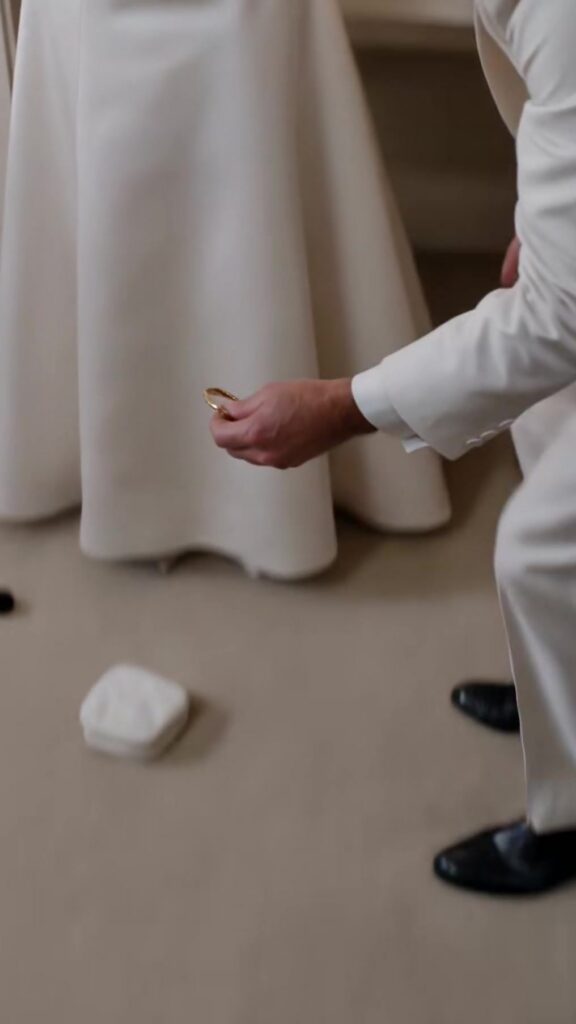
The room exploded in one second.
Not with fire or shrapnel, but with a shove so violent it made the mirrored bulbs along the vanity rattle and sent a tray of powder compacts skating like coins across polished wood. The bridal suite—white walls, champagne flutes, silk garment bags hanging like pale ghosts—went from laughter to oxygenless silence so quickly that the music from someone’s phone sounded obscene.
Mara had been leaning in to dust highlighter along the bride’s cheekbone when the bride’s hands struck her chest. Mara’s shoulder hit the edge of the table; pain lit her collarbone. Brushes arced into the air as if thrown by an invisible hand. Lipsticks rolled beneath satin heels. A hot wave of perfume and panic rose together.
“You stole my bracelet!” Celeste Varrin’s voice was a blade. It cut through the bright vanity lights, through the bridesmaids’ gasps, through the father-of-the-bride’s muffled laughter from the next room. “She stole it. I saw her touch my jewelry.”
Phones lifted like reflexes. A dozen lenses caught Mara on her knees, one palm pressed to the table to keep herself from falling. Her other hand clutched her kit, instinctive as breathing. She tasted copper. She tried to speak, but the words snagged in her throat.
“I didn’t,” Mara managed, breathless. “I didn’t take anything.”
Celeste’s cheeks were flushed, her eyes bright with the kind of fury that came from never being contradicted. She wore a robe of ivory silk embroidered with pearls; a seamstress had been sent from Paris to fit it. Her bridesmaids hovered behind her in matching blush robes, hair clipped, lips parted as if watching a play.
“Open your bag,” Celeste demanded. “Right now.”
Mara shook her head, not because she had something to hide, but because the bag held her life: her cheap palette wiped clean at night, her worn sponges, the small bottle of skin-safe adhesive she’d bought with money meant for rent. She worked weddings because brides cried and laughed and, for a few hours, believed in beginnings. It was the closest she ever got to one.
Celeste did not wait for consent. She lunged forward, grabbed the strap of Mara’s kit, and jerked it from her grasp. The zipper screamed. Celeste’s manicured fingers plunged inside and turned the contents over like a gambler clearing a table.
Foundation bottles thudded onto the carpet. Hairpins scattered. A packet of wet wipes tore open and bled soap scent into the air. Then something small and metallic slipped free, striking the floor with a delicate chime.
A baby bracelet.
It lay between Celeste’s slippers and Mara’s knee, no bigger than a finger, a thin band of gold with a tiny clasp. Under the harsh lights it seemed absurdly bright, as if it had never known dark drawers or time.
“There,” Celeste said, triumph already rising into her mouth. “What did I tell you? She’s—”
But the word never landed.
Julian, the groom, had entered the room on some instinct, drawn by the sudden hush. He was still in his shirt sleeves, tie loosened, his hair styled by the same hands that now trembled. He stepped forward, bent down, and picked the bracelet up with two fingers as if it might burn him.
His face changed mid-breath. The color drained so fast it was as though someone had turned a dial. His eyes fixed on the engraving, and a muscle in his jaw began to work soundlessly.
“Julian?” Celeste’s voice softened, confused by the lack of applause. “It’s mine. Give it—”
“This,” Julian said, and his voice did not belong in a bridal suite. It belonged in a courtroom, or a hospital corridor at midnight. He held the bracelet up to the light. “This isn’t yours.”
An older man stepped from the doorway. Dr. Halden, the family physician, had been invited because the Varrins invited people the way other families arranged flowers—out of tradition, obligation, and an unspoken need to have witnesses. He peered at the bracelet, then at Julian’s hand, then at Mara’s face.
The doctor’s skin went gray, the way it did when bad news arrived before the words. He swallowed once, hard. “That band,” he whispered, “was tied to the newborn they said died.”
No one moved. Even the phones dipped, as if their owners suddenly remembered shame.
Celeste laughed, brittle and too loud. “That’s—what are you talking about? My mother—” She turned, looking for the anchor that had never failed her: Elise Varrin, seated near the window in a chair that had been brought in like a throne. Elise’s hair was perfect. Her pearls sat at her throat like a verdict.
Elise did not laugh back. Her gaze was on Mara, and it was not contempt. It was calculation caught off guard.
Mara pushed herself upright, her shoulder protesting. Tears were already on her cheeks; she hated that. She wiped at them with the back of her hand and left a faint streak of foundation across her skin like war paint. “It’s not… it’s not what she thinks,” Mara said, voice trembling. “I didn’t steal a bracelet from her jewelry box. I brought that with me.”
Celeste’s eyes widened. “Why would you—why would you have a baby bracelet?”
Mara’s hands shook as she reached toward the kit Celeste had torn apart. She picked up an empty sponge case, then set it down, as if needing something to hold. “My mother kept it in a tin with our birth papers,” she said. “She told me not to lose it. She said it was proof, in case someone ever told me I imagined things.”
The room felt suddenly smaller, the air heavy, as if the walls had crept inward.
“Proof of what?” one of the bridesmaids whispered.
Mara looked at the bracelet in Julian’s hand, then at Elise by the window. The bright lights made Elise’s face gleam, but they couldn’t smooth the tiny tremor at the corner of her mouth. “My mother said one daughter was buried on paper,” Mara said softly, “and raised alive.”
Julian’s fingers tightened around the gold band. “The initials,” he said, and his voice broke on the last word. “They’re—”
“C.V.,” Dr. Halden murmured, as if speaking them might summon ghosts.
Celeste’s smile faltered, then collapsed entirely. She turned toward her mother with the slow horror of someone approaching a mirror and realizing the reflection is wrong. “Mom,” she said, not angry now, just unmoored. “Why would a dead baby’s bracelet have my initials?”
Elise stood. For the first time since Mara had met her—first time since Elise had glided into the suite and inspected Mara’s work like a jeweler examining a stone—her composure slipped. Her hand went to her throat, fingers pressing against pearls as if they were strangling her.
“Because,” Elise said, and the word came out thin. She looked at Julian, then at Celeste, then at Mara, as if deciding which catastrophe she could survive. “Because the letters were chosen before you were born.”
Celeste’s breath hitched. “What does that mean?”
“It means,” Dr. Halden said, stepping forward with a gentleness that did not soften the truth, “that there was another child.”
Mara stared at Celeste, seeing past the silk robe and the diamonds and the fury, seeing a girl whose life had been arranged like furniture. Mara had spent her own life in rentals and secondhand clothes and jobs that never lasted. She had envied women like Celeste, thinking they were protected from certain kinds of pain.
Now Celeste looked like a person standing on the edge of a trapdoor.
Julian held the bracelet out, not to accuse, but to demand reality. “Elise,” he said, “tell us.”
Elise’s eyes flicked to the phones, to the bridesmaids, to the mirror that reflected every angle. Then she looked at Mara as if Mara were the only one she couldn’t control. “Your mother,” Elise said, voice sharpening, “was paid to disappear.”
The words landed with a thud heavier than any fallen makeup case. Mara felt her knees weaken again, but she forced herself to stand. “She was told,” Mara whispered, “that her baby had died.”
Dr. Halden closed his eyes, as if the confession physically pained him. “I signed documents,” he said, and his voice trembled with old regret. “I was young. I believed the family’s story. I thought it was… mercy.”
Celeste made a sound like someone choking on air. “You—” She pointed at Mara, but the accusation had transformed into something else, something animal and terrified. “Who are you?”
Mara swallowed. Her throat felt raw, scraped clean by years of silence she hadn’t understood. “I don’t know,” she said, and the honesty was worse than any lie. “I thought I was just… me. But my mother kept that bracelet. She kept a blanket too, with initials stitched in the corner. The same ones.”
She looked at Celeste and felt the room tilt. “If we share those letters,” Mara said, “then either someone made a cruel mistake… or someone made a choice.”
Elise’s mouth opened, but no sound came. The vanity lights hummed. Somewhere outside, a string quartet warmed up, unaware that the wedding was unraveling thread by thread.
Celeste’s hands curled into fists at her sides. “Say it,” she demanded of her mother, voice hoarse. “Say what you did.”
In the mirror, Mara saw herself: mascara smudged from tears, hair falling from its clip, a poor woman in a rich room. Yet she was no longer small. She was an unanswered question refusing to go away.
Elise’s gaze drifted to the window, to the garden where guests waited, to the aisle prepared for vows that suddenly felt like theater. When she finally spoke, it was in a voice stripped of polish. “I had twins,” she said. “And I kept one.”
The silence that followed was the true explosion—louder than shouting, more devastating than broken glass. It shattered what everyone had assumed was solid: names, inheritances, family trees, the story Celeste had lived inside like a safe house.
Mara felt Julian’s eyes on her, full of questions he did not yet have permission to ask. She felt Celeste’s stare, not hatred now but something rawer—recognition trying to form in the rubble.
On the carpet, among scattered lipsticks and spilled powder, the wedding morning lay in pieces. And in Julian’s hand, the baby bracelet gleamed like a tiny sun, too bright to ignore, making liars of everyone who had called the past buried.
Mara took a shaky breath and met Celeste’s eyes. “I came here to paint your face,” she said. “I didn’t know I was walking into my own history.”
Celeste’s lips parted, as if to scream again, but no sound came. She looked, instead, at her mother—at the woman who had written her life in ink and tried to erase another in the same stroke.
And the room, already exploded, waited for what would burn next: the wedding, the family, or the truth finally spoken all the way through.