Before his mother died, she made him say it three times, as if the words were knots she could tie to keep him from being swept away.
“Find the woman in the photo,” she whispered, her breath clicking thinly in her throat. “Make her look at you. Then ask why she left you in the rain.”
He was sixteen and too old to be told to memorize sentences like prayers, but the room smelled like antiseptic and lilacs—someone had brought flowers to a dying woman, as if fragrance could barter with death. His mother’s hands, once strong from lifting crates at the grocery warehouse, lay light as paper on the blanket. Her eyes were bright with fever and purpose.
He said the sentence once.
She made him repeat it.
He said it a third time, and only then did she close her eyes like the ritual had been completed.
After the funeral, he discovered how many people could tell you they were sorry without ever asking what you’d lost. He wandered through condolences, through casseroles left on the stoop, through the sudden quiet of an apartment that had always held her humming. In the back of her closet, he found the envelope.
No return address. No love note. Just a photograph—creased, damp-stained at the corners, as if it had once been carried through a storm and never truly dried. A woman stood under a streetlamp, rain streaming off her hair, clutching a bundled baby against her chest. The baby’s face was turned away. The woman’s face was turned toward the camera, eyes narrowed against the downpour—beautiful and exhausted, like someone who had outrun something and still feared it might catch up.
On the back, in his mother’s handwriting: “For when you’re ready.”
He wasn’t ready. Not for months. Not for the way the question grew teeth in his mind. Who was she? Why had his mother kept this? Why had she needed him to ask about rain, specifically—like the weather itself was evidence?
It was the black sedan that finally made the words rise.
He worked evenings at La Marquette, a restaurant whose menu was written in fonts that looked expensive. The foyer glowed with warm, honeyed light; chandeliers hung like captured constellations. On rainy nights, the awning outside filled with elegant guests waiting for their cars, laughing softly as if even their amusement had been trained.
He was carrying a tray toward the kitchen when he saw the sedan glide to the curb, its paint drinking in the streetlight. The windows were tinted, the doors opening with quiet authority. The valet stepped forward, umbrella ready.
And then he saw her.
Not her face at first—just a silhouette, the line of a neck above a dark dress, the curve of a wrist as she gathered her coat. Something in his chest tilted. His hand tightened on the tray. It was the same shape, the same presence as the woman in the picture, but sharpened by wealth and years.
His mother’s sentence returned, exact as a blade.
Find the woman in the photo.
Make her look at you.
Then ask why she left you in the rain.
His body moved before his mind had finished arguing. He went out through the service door, into the cold rain that slapped his cheeks. By the dumpster sat a bucket used for mopping the back corridor—gray water, a film of lemon cleaner and dirt. He grabbed it with both hands. The metal handle bit into his palms.
He told himself he was only going to walk closer. Only going to see her face. Only going to confirm.
But rage is a thing that can live quietly for years, digesting grief, growing strong in the dark. And the moment she stepped fully into view—furious already at the inconvenience of weather, beautiful in a way that seemed like a deliberate insult—his arms swung.
The bucket’s contents hit the sedan’s side with a sound like a slap. Water splattered across the door, the wheel, the woman’s shoes. Muddy streaks crawled down the paint like bruises.
A collective gasp rose from the awning. Phones appeared, black rectangles pointed like weapons. The valet froze, umbrella half-extended, unsure whether to shield the woman or himself from the unfolding humiliation.
The rear door snapped open wider. She stepped out of the rain’s curtain, her face lit by the restaurant’s gold glow, and it was like the photograph had inhaled and become flesh.
Her eyes were hard. Her mouth was red and perfect. Fury made her look even more alive.
“Have you lost your mind?” she demanded, voice sharp enough to cut through the rainfall.
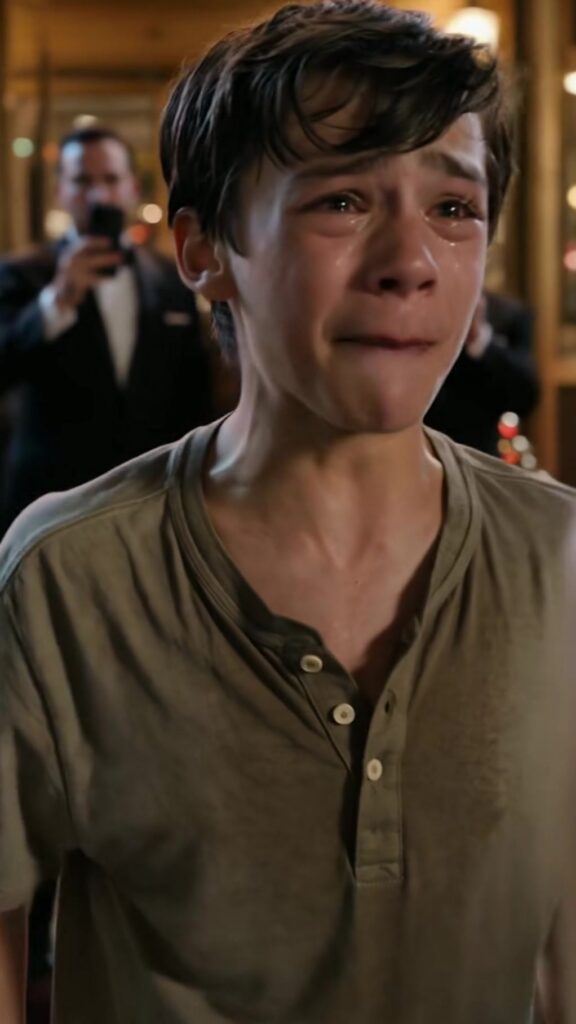
He didn’t shout back. He couldn’t. His throat had filled with something hot and heavy, the kind of sorrow that doesn’t travel well in words. Instead, he started to cry—quietly, uncontrollably. Tears mixed with rain on his face. It wasn’t dramatic. It was the cracking of something that had been held too tight.
He stared at her, forcing himself to do the second part of the sentence. Make her look at you. Not at the car. Not at the crowd. Not at the stain spreading across her dress hem. At him.
“You left my mother in the rain,” he said.
A ripple went through the onlookers. Someone whispered, too loudly, “Is this a prank?” Another voice: “Is that her son?”
The woman’s expression stayed rigid, but her eyes narrowed, scrutinizing him as if he were a problem she could solve by staring harder. “I don’t know who you are,” she said. “Get away from my car.”
He swallowed, forcing the last part of the sentence out through his shaking. “Why?”
He reached into his jacket pocket. His fingers were trembling so violently the photo nearly slipped free. He unfolded it with wet hands, careful not to tear the softened paper. The crowd leaned in without meaning to, drawn by the gravity of a secret about to be spoken aloud.
He held the photograph up between them like evidence in a trial.
The woman’s gaze dropped to it. For a moment, the rain seemed to soften, or maybe his hearing did—everything else falling away except the small rectangle of history in his hands.
Her face changed.
Not completely. Not like in movies where someone collapses into tears. It was subtler and therefore more terrifying: a flicker of recognition, a tightening at the corners of her eyes, a hesitation like a foot finding a stair that isn’t there.
The mask of indignation slipped enough for something raw to show through.
He watched her look at the young version of herself, drenched and desperate under a streetlamp, holding a baby that could only have been him.
He lifted his eyes to hers. “She said you were my real mother.”
The woman’s breath caught. It was audible, a small choking sound swallowed immediately by pride. Her fingers flexed at her sides, as if she wanted to snatch the photo and hide it, or tear it in half, or press it to her chest.
For a second she looked less like a rich stranger being inconvenienced and more like someone haunted.
Then, in a voice lowered so the crowd had to strain to hear, she said, “I knew this day would come.”
The sentence landed like a new bruise.
He had prepared for denial. For mockery. For security guards. For her to laugh and call him a thief of attention. He had not prepared for certainty—as if she’d been waiting, counting down, rehearsing her own lines.
“What does that mean?” he demanded, stepping closer into her umbrella’s shadow. The rain soaked the back of his shirt. He didn’t care. “You knew—so you just—what? You just lived your life?”
Her eyes flicked to the phones. To the valet. To the restaurant’s glass doors behind which diners watched like they were witnessing theater. Something tightened in her jaw.
“Not here,” she said.
“Here,” he insisted. “Right here. Make me understand.” His voice broke on the last word. “My mother died. And her last wish was a sentence about you.”
The woman’s anger returned in a flash—not at him, he realized, but at the world that had cornered her. At the rain. At the crowd. At a past that refused to stay buried. She looked at the photo again, and her eyes shone with something that wasn’t rainwater.
“Your mother,” she said slowly, “was braver than I deserved.”
He felt the sentence pull him forward. “Then why did you leave her out there?”
At last, she met his gaze fully—fulfilling, cruelly, the instruction his mother had given him. The air between them tightened like a wire.
“Because,” she said, each word carefully chosen as if it might explode, “if I had taken you with me, both of you would have died.”
He stared, not understanding, not wanting to. “That’s a lie.”
“It’s not.” Her voice cracked on the last syllable, and the crack was the only proof of something human inside her. She glanced over her shoulder at the sedan, then back at him. “I didn’t leave you in the rain because I didn’t want you. I left you in the rain because the people in the car behind me would have taken you. And they would have used you to get to me. Or used me to get to you.”
The crowd shifted, uneasy now, sensing the story had teeth, sensing it wasn’t a simple scandal but something darker.
He clutched the photo tighter. “Who are you?” he asked. “Really.”
Her lips pressed together, and for a moment he thought she would refuse, retreat into tinted glass and wealth and attorneys. But then her gaze dropped to the baby in the photograph, to the curve of the bundle, and her voice softened into something that sounded almost like regret.
“I was the wrong kind of woman to have a child,” she said. “And you were the right kind of child to be used as leverage.” She inhaled shakily. “Your mother gave you a life that wasn’t mine to give.”
He wanted to scream that a life without answers was not a gift. He wanted to tell her about the nights his mother woke gasping from dreams she refused to explain, the way she triple-locked the door even in safe neighborhoods, the way she flinched at black sedans.
He forced the sentence back into his throat and found new words instead. “So you watched me?” he asked, voice low. “All this time?”
Her silence was answer enough. It wasn’t empty silence. It was weighted, crowded with years of looking from far away.
He felt sick. “You could have come,” he whispered. “Once. Just once.”
“If I had come close,” she said, and now she sounded tired—older than her dress and jewelry suggested, “they would have found you. Your mother understood that. She made choices I didn’t have the courage to make.” She looked at him with something that might have been pain. “She kept you alive.”
The rain streamed off the awning in steady sheets. Somewhere inside, a dinner bell chimed softly, oblivious.
He held up the photograph again, as if it might speak. “She wanted me to ask you why,” he said. “She made me say it over and over.”
The woman’s eyes closed briefly. When they opened, they were glossy. “Because she knew you’d need me to say it out loud,” she replied. “So you’d stop believing it was because you weren’t worth coming back for.”
The truth, when it arrived, didn’t feel like comfort. It felt like a different kind of wound.
She took a step toward him. The crowd leaned in. The phones lifted higher.
“Do you want the rest of the story?” she asked. “Or do you want revenge?”
He thought of his mother’s hands, fragile on the blanket. Thought of her insisting on the sentence, not as a curse but as a map. Thought of how she’d said it like she was handing him a door and trusting him not to drown in what waited behind it.
His voice came out hoarse. “I want to know what she died protecting me from.”
The woman nodded once, sharply, as if making a decision she’d delayed for sixteen years. Then she did something that finally startled the crowd into silence: she reached into her clutch and pulled out her own phone.
She held it up so he could see the screen.
On it was a name, typed and ready, like she’d rehearsed this moment too—like she’d been waiting for him to show up soaked and shaking with a photograph in his hands.
“Get in the car,” she said. “And don’t let anyone follow.”
He looked from the phone to her face, to the rain-smeared sedan, to the warm restaurant doors behind him that suddenly felt like the entrance to a life he could never return to.
In the reflection of the glass, he saw himself: a boy drenched in stormwater and grief, holding proof that his life began as someone else’s emergency.
He folded the photograph carefully and slid it back into his pocket, not like a weapon now, but like a key.
Then he stepped toward the open door, toward the woman who had been a mystery shaped like absence, and toward the story his mother had died insisting he demand.
The rain kept falling, relentless and cold, but for the first time since the funeral, he felt something else beneath it—an approaching thunder, not in the sky, but in the truth waiting to be spoken.