The child ran like someone had told her not to stop until she found the ring. Not like a game, not like a dare—like a command that had been pressed into her ribs and was pushing from the inside. Her small shoes slapped the sidewalk and skidded when she cut corners too tight. Her hair escaped its braid in frantic strands. Two hands clenched an old metal locket against her chest, the chain biting a red line into her neck.
Midday traffic hissed. People moved aside without looking at her face, the way a city makes room for accidents while refusing to witness them. A man in a suit stepped over her path and muttered. A woman with a stroller tugged her child back. No one asked why a girl was crying hard enough to choke.
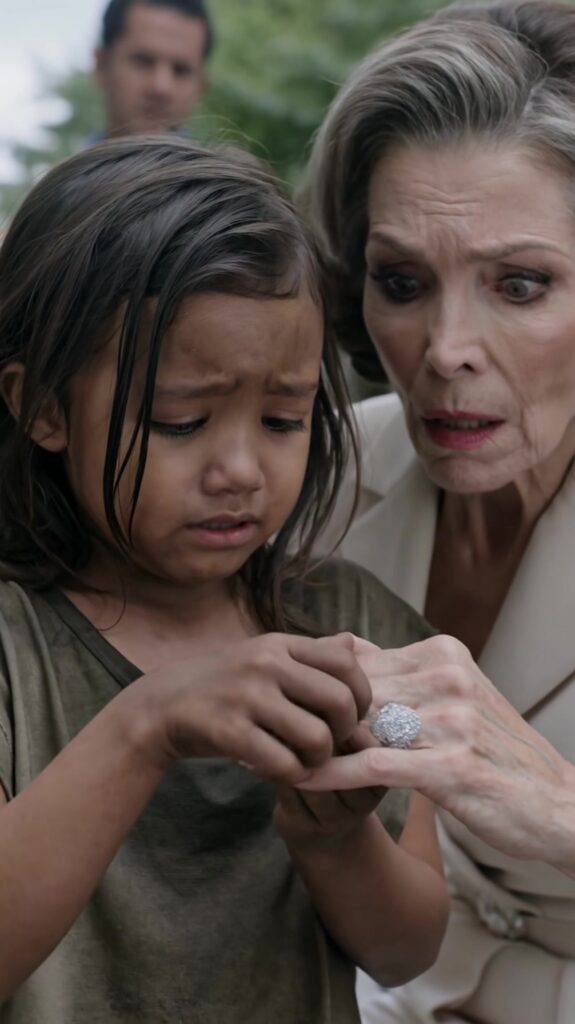
No one—except the elderly woman on the bench, who had chosen that spot as if it belonged to her. She sat in tailored dark clothes, ankles crossed, posture immaculate. Gloves covered her hands despite the warmth, and when she shifted, the stone on her right hand flashed like a small, cold flare of daylight.
The girl stopped in front of her. Not within reach. Just close enough that leaving would be a decision.
She tried to speak, but the words broke in her throat. When she finally lifted her face, her eyes were swollen and bright with fear, the kind that is older than a child should have.
“My mom…” she whispered, and it came out so faint it sounded like she’d forgotten how to use her voice.
The old woman’s gaze flicked, irritated at first—then snagged on the locket, on the girl’s grip, on the way her knuckles had gone white. The irritation drained. It didn’t turn into kindness. It turned into attention.
The girl’s shaking finger rose. She pointed—not at the woman, not at her face, but at the ring. “That,” she said, the syllable scraped raw. “She said—find that.”
The old woman leaned forward as if pulled by a hook. Under the powder and expensive perfume, her skin seemed to thin, revealing something tight and alarmed beneath. “Where did you get that locket?” she asked, and for a heartbeat her voice wasn’t cultivated at all. It was sharp.
The girl swallowed hard. “She gave it. This morning. She said I had to run. She said don’t stop until I see it.” She pointed again at the ring. “That ring.”
On a nearby path, a middle-aged man had slowed. He wore a work jacket that didn’t fit quite right, like it had been borrowed or kept too long. He watched because of the child’s sobbing, then because of the woman’s expression—because rich faces were trained to reveal nothing, and this face had failed.
The girl unclasped the locket. The hinge squealed softly, an old protest. Inside, behind the thin plastic cover, was a faded photograph. The image was half-ruined with age: an apartment stairwell door, a woman caught between shadow and light, and on her hand—a bright, unmistakable ring.
The elderly woman’s breath hitched. “No,” she said, as if the picture were accusing her.
The man stepped closer without meaning to. His eyes landed on the photograph and he froze, the way an animal freezes when it hears a sound it recognizes from a trap.
In the photo, behind the woman with the ring, a younger woman stood with a blanket-wrapped bundle in her arms—an infant’s face barely visible, a smudge of pale skin and closed eyes. The younger woman’s mouth was open as if mid-plea or mid-warning. Her eyes, even blurred, looked straight at whoever had taken the picture.
The little girl looked up at the old woman as if she were staring into a storm cloud. “She said hide,” she whispered. “She said you’d know.”
The old woman stood so abruptly her handbag slid off the bench. It hit the ground with a soft thud. Her gloved hand went to her throat. She didn’t look offended. She didn’t look sad. She looked terrified—like a door she had nailed shut decades ago had just been pushed from the other side.
“She kept the escape picture,” the old woman breathed, the words slipping out like a confession she never intended to make.
“What are you talking about?” the man demanded, and when the old woman’s eyes snapped to him, there was recognition—mutual and immediate, like two people suddenly seeing the same nightmare in daylight.
The old woman’s voice dropped. “You shouldn’t be here,” she said to him. “Not after—”
“After you paid to erase it?” the man shot back, anger shaking his jaw. “After you changed your name and bought your silence with new gloves?”
The girl flinched at the harshness but didn’t move away. Her hands remained locked on the locket, as if letting go would make her disappear.
The old woman looked at the child again, and for a moment something softer passed across her face—then was stamped flat by fear. She glanced over her shoulder, scanning the park, the path, the clustered people, the camera mounted above a lamppost. “Where is your mother?” she asked.
The girl’s chin trembled. “She told me not to look back. But I heard… a car door. And someone said my mom’s name.” She swallowed. “She pushed me into the alley by the bakery. She said run to the park. Find the ring. Show the picture. Then… then you’ll have to help me.”
The old woman’s gloved fingers tightened into a fist. The ring threw off a bright, cruel spark. “Help,” she repeated, as if the word were foreign. “Help is what I didn’t do.”
The man bent, picked up the old woman’s handbag, then thought better of handing it to her. He set it on the bench instead, as if it might be evidence. “You remember her,” he said. It wasn’t a question. “The woman in the photo.”
The old woman’s lips parted. She looked like she might deny it—then her shoulders sagged with the weight of too many rehearsed lies. “I remember,” she admitted. “I remember the stairwell. I remember the baby.” She stared at the child. “I remember being told that if I didn’t sign, they would ruin my family. I believed them.”
“And you let them take her,” the man said, each word a step toward old rage. “You let them take both of them.”
The girl’s voice cut between them, thin but fierce. “My mom said it’s not over. She said you have the key.” She lifted the locket like a talisman. “She said the ring is the key.”
The old woman’s gaze dropped to her hand. The ring was ornate, an heirloom at a glance—gold filigree, a stone that seemed too bright to be real. Her gloved thumb brushed the side of it, and her breathing changed, as if her body had remembered a motion it had tried to forget.
“It isn’t jewelry,” she said hoarsely. “It’s a seal.”
The man’s eyes narrowed. “A seal for what?”
She looked past him, past the benches and the trees, toward the street where a black car had just slowed too long at the curb. The world suddenly seemed louder: a dog barking, a skateboard clattering, a siren somewhere distant but approaching.
“For the safe room,” she answered. “For the place they told me didn’t exist.” Her hand trembled as she turned the ring, and the stone shifted with a tiny click, like a lock yielding. “Your mother didn’t send you here for comfort, child. She sent you because she knew I’d be afraid enough to finally do the right thing.”
The girl’s tears slipped quietly now, no longer frantic but steady, like rain beginning after a long drought. “Is she coming?” she asked.
The old woman met her gaze, and in it the child saw something that looked like guilt and something that looked like resolve. “If she’s alive,” the old woman said, “they will try to stop her.” She pulled off one glove with shaking fingers, baring a hand marked with age and old scars. The ring glinted. “And if she isn’t—then we will finish what she started.”
The man took a step closer, instinctively placing himself between the girl and the street. “How do we open it?” he asked.
The old woman closed her fingers around the ring as if it could steady her. “Not here,” she said. “They watch parks because children run to them. They know people look away.” She reached out—slowly, carefully, as if asking permission from the air itself—and touched the edge of the locket. “But this picture,” she murmured, “this is proof I couldn’t bury. Your mother was smarter than all of us.”
The black car at the curb rolled forward again, but another vehicle slid into its place, windows tinted too dark, pause too deliberate. The old woman’s face hardened.
“Hold my hand,” she told the child, and the command was gentle but absolute. “And don’t stop,” she added, voice catching on the words as if they came from a distant memory. “Not until we find the door that ring was made to open.”