The mansion erupted in panic the moment the old grandfather clock struck noon and the hush of wealth—thick carpets, silent chandeliers, air that smelled faintly of lilies—shattered like glass.
Isla Varron, the daughter who had been raised on velvet certainty, hurled herself across the living room. Her heels skidded on the polished floor and she screamed, so sharp it seemed to scrape the walls, “Take that key away from her!”
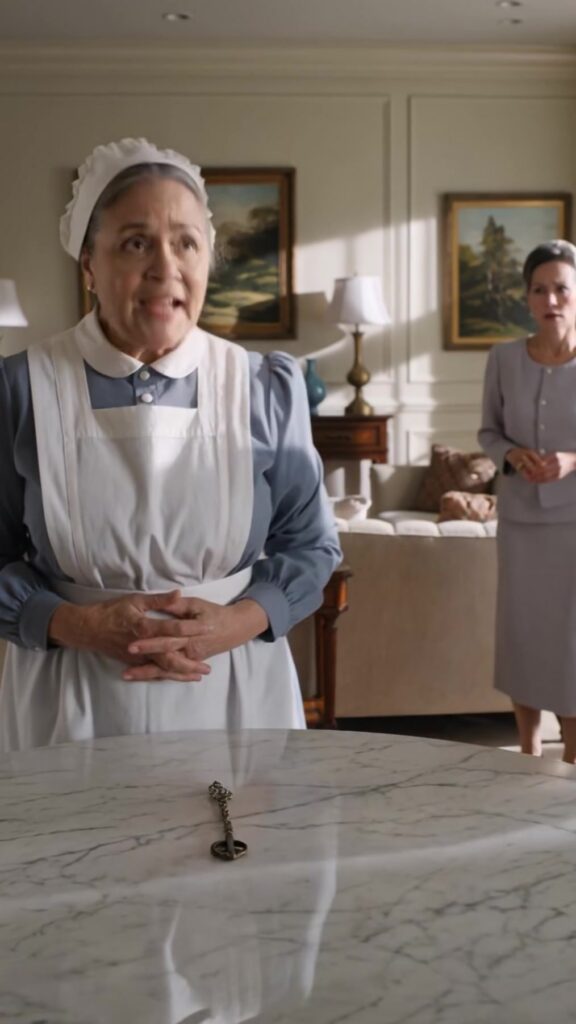
Everyone’s eyes snapped to Mavis, the elderly maid. She stood near the marble fireplace as if it were a witness stand, her back straight despite the tremor in her hands. A small antique key hung from a chain looped around her fingers, its metal dull in the daylight that poured through the tall windows.
Dorian Varron, the son with the family’s restless jawline and their late father’s impatience, lunged toward her. He grabbed at the chain, missed, and nearly stumbled. Mavis didn’t retreat. She watched him the way one watches a storm from behind thick glass—unblinking, measuring.
On the sofa, Celeste Varron, their mother, rose halfway to her feet. The motion looked wrong on her, as if standing required an effort the body no longer believed in. Her face had gone pale enough to make her pearls look like bruises. The room was flooded with sunlight, but the air felt chilled, as though the house had exhaled something ancient and cold into its own bones.
No one breathed.
Mavis stepped forward and placed the key onto the center of the marble coffee table with a care that bordered on reverence. The key made a soft click. It caught the light and flashed, the brief glint of a blade.
Dorian stared at it as if he’d never seen metal before. “That’s the vault key,” he said, his voice smaller than it had been a moment ago.
Celeste’s head jerked in denial. “No. No,” she insisted, the words cracking as panic finally found her throat. “Your father destroyed everything in that safe.”
Mavis looked at her calmly, without pity and without triumph. Then, slowly, she shook her head. “No,” she said. “He hid one name.”
The silence that followed was not empty; it was crowded with years of dinners, speeches, and the careful choreography of a family that had trained itself never to flinch. Isla’s hand hovered over the table as if she might crush the key with her palm. Dorian’s eyes flicked from his mother to Mavis, searching for the edge of the joke. There was none.
The family lawyer, Edwin Slate, cleared his throat. He was a stiff man in a dark suit whose expression had been carved from rules. Edwin had brought a small metal box and set it down as though it contained something that could bite. Now he opened it with the deliberation of a man hoping time might fix itself if he moved slowly enough.
Inside were documents wrapped in a faded ribbon. Edwin untied it. His fingers were precise, but his knuckles had turned white.
He drew out the first paper, scanned the top lines, and the color drained from his face so quickly it looked as if the ink on the page had stolen it. Edwin’s mouth opened, closed, then opened again. Nothing came out.
Isla took a step back, her shoulder brushing the edge of a gilded mirror. In it, her reflection looked like a stranger—eyes too wide, lips parted as if waiting for a verdict.
Dorian snatched the document from Edwin’s hand. His gaze dropped to the opening lines. He read once. Then again. His grip tightened until the paper creased beneath his fingers.
“Primary heir…” he began aloud, voice shaking on the second word. Then he stopped, as if his tongue had failed him.
The room froze.
Mavis lifted her eyes to him. They were not a servant’s eyes. They were a witness’s eyes. “Finish the sentence,” she said. “Tell them whose son he really was.”
Dorian’s lips parted. His mother made a sound—small, strangled—like a breath caught under water. Isla whispered, “No… not him…”
Outside, a bird struck the window and darted away, leaving a faint smear like a fingerprint of panic.
Dorian swallowed. The paper trembled. “Primary heir to the Varron estate,” he read, “is—” His gaze jumped to the name, snagged on it, and his voice thinned. “—Jonah Vale.”
Isla’s laugh came out wrong, a brittle snap. “That’s… that’s the gardener’s boy.”
Edwin Slate found his voice at last, but it sounded as if he would have preferred not to. “Jonah Vale is listed here as the acknowledged son of Alistair Varron,” he said. “Born eight-and-twenty years ago. The supporting affidavits… are included.”
Celeste swayed. For a second Isla reached for her, then stopped, as if contact might spread the revelation through skin. Celeste’s fingers dug into the sofa’s armrest. “No,” she said again, but now it was a plea, not a command.
Mavis leaned forward slightly, her gaze fixed on Celeste as if pinning her in place. “You told him not to sign,” Mavis said quietly. “You told him the house would collapse if the wrong brick moved. But he signed anyway.”
“He was sick,” Celeste hissed, desperation sharpening her voice. “Alistair wasn’t himself. He—”
“He was himself at the end,” Mavis replied. “That was the problem.”
Dorian’s eyes flashed, furious and lost. “You knew,” he accused, staring at Mavis as if she were the architect of his humiliation. “You knew all this time.”
“I knew because I was there,” Mavis said. Her hands folded in front of her, composed despite the tremor still living in her fingers. “I carried your father’s medicine. I heard him practice the words he never said at dinner. And I held this key because he was afraid you would burn the truth the way you burn letters you don’t like.”
Isla’s voice dropped to a whisper, but it cut through the room like thread through fabric. “Jonah doesn’t even belong here.”
Mavis’s expression tightened, not with anger but with something older. “He belongs because he exists,” she said. “And because your father never stopped looking for him. He put his name in the vault because he couldn’t bear for it to be erased again.”
Edwin Slate cleared his throat as if trying to scrape the air clean. “There is… more,” he said. “A clause.”
Dorian did not look up. “Read it,” he demanded.
Edwin lifted another page. “If any named family member interferes with Jonah Vale’s claim,” he read carefully, “their portion is reduced to one dollar.”
The words fell into the room and stayed there, heavy and final. For a moment, even Isla’s outrage stalled, held back by the sheer audacity of their father’s last move.
Celeste’s shoulders sagged. She looked suddenly older than her tailored dress, older than her careful hair, older than the portrait of her wedding day that hung over the fireplace. “He did it,” she whispered, stunned. “He actually did it.”
Mavis’s eyes did not soften. “He tried to make it right,” she said. “Not clean. Not painless. Just right.”
Dorian stared at the key on the marble table. The daylight painted it in gold, but the metal seemed darker now, as though it had absorbed the secrets it had guarded. “Where is he?” Dorian asked, and for the first time his voice sounded like a boy’s, raw and uncertain. “Where is Jonah?”
Mavis’s breath caught, not in fear but in the effort of carrying another truth into the light. “He’s on the grounds,” she said. “He came this morning. He didn’t know whether to walk through the front door. He’s been waiting by the greenhouse, where your father used to go when he couldn’t stand the sound of his own lies.”
Isla’s fingers curled into a fist. “You brought him here?”
“I brought the truth here,” Mavis replied. “The rest of it came on its own.”
In the sudden, fragile quiet, the house seemed to listen. The chandeliers didn’t glitter; they watched. The portraits didn’t smile; they judged. Somewhere deep within the mansion, a door clicked as if a lock had shifted.
Dorian looked at his mother. Celeste’s eyes were wet now, and the tears looked less like grief than surrender. Isla’s gaze darted toward the window, to the gardens beyond, as if she could spot the intruder from here and will him away.
But the key lay on the table between them, catching the light, refusing to be ignored. And in that bright, icy room, the Varrons understood at last that panic was only the beginning—because the moment a hidden name is spoken, the old life does not simply crack.
It breaks open.