The Noon Market was a living thing—breathing steam from soup kettles, sweating citrus perfume, speaking in a dozen arguments at once. A man sang out the price of cherries like a prayer. Another swore his fish had been swimming that morning. Between the stalls, people moved with the impatient choreography of hunger: elbows, baskets, coins, curses.
Lina hovered at the seam where the stone street met a puddle of yesterday’s rain. Her coat was too thin for the wind that always found the cracks between buildings, and her shoes were too big, tied at the ankles with twine. In both hands she held one white flower, its petals still clean despite the market’s grime. An old ribbon cinched the stem—faded to the color of dusk, frayed along one edge, but tied with care.
She had been told to stand there. Not by anyone in this market, and not by anyone who called her “child” with kindness. She had been told by her mother, years ago, in a room that smelled of boiled cloth and fever. “If you ever have nothing else,” her mother had whispered, “keep the ribbon. It’s a name that doesn’t wash away. The man who tied it… he’ll know you. He’ll know before you speak.”
Lina didn’t understand why a ribbon could be a name. She only knew that on days when her stomach gnawed at her backbone, she would retie it, as if tightening the knot could hold the world together.
That day, she wasn’t begging so much as waiting—watching faces, searching for the look that meant recognition. The market swallowed hundreds of people. None looked at her longer than a blink.
Then the woman arrived like a knife drawn from silk.
She wore a coat that shone as if it had never met dust. Her hair was pinned with a jeweled clip, her gloves pale and unwrinkled. Two bags hung from her arms like trophies. She did not thread through the market; the market parted for her, instinctively, as if her money carried its own weather.
Lina stepped back, clutching her flower as the woman’s shadow fell over it. She didn’t ask for anything. She only stood there, small as a sparrow, the ribbon trembling at her fingers.
The woman’s heel came down with a practiced cruelty, as casual as stepping on a leaf.
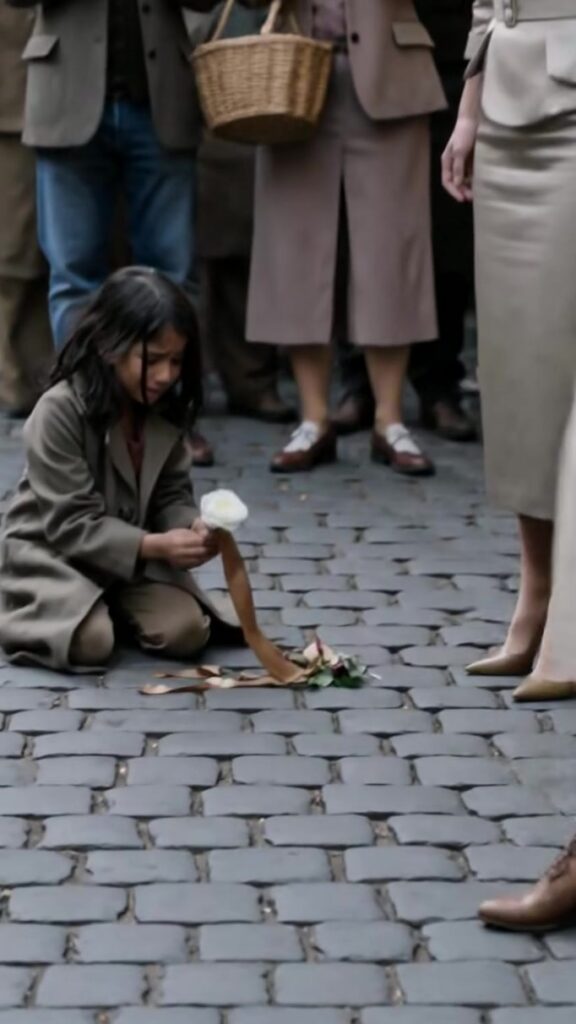
The white petals exploded under the sole—softness ruined in one blunt motion. The stem bent and snapped. The ribbon jerked free and fell into the wet, clinging to stone.
“Go somewhere else,” the woman said, her voice sharp enough to cut through the shouting. “You stain places like this.”
The market, which had been loud a heartbeat before, stuttered. A vendor mid-bargain forgot his numbers. A cart wheel stopped scraping. Even the pigeons seemed to pause, startled by the sudden hush.
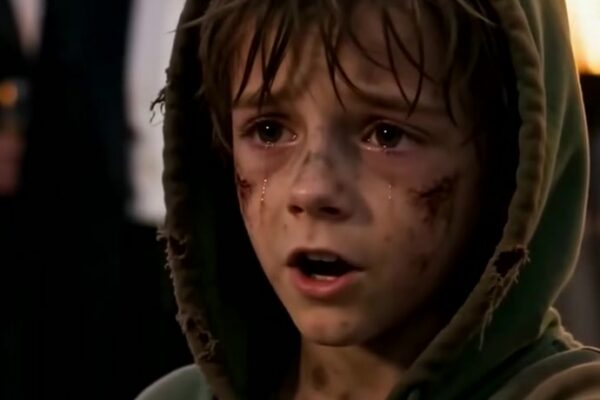
Lina’s breath caught like it had struck a wall. She dropped to her knees without thinking, palms scraping stone, fingers trembling as they reached for the wreckage. She tried to gather petals that would not gather, tried to press the crushed bloom back into its old shape, as if she could apologize to it.
Her sobs came out in broken pieces. “My mother said—” she managed, voice cracking against the noise that wanted to return. “She said the man who gave her the ribbon… would know me the moment he saw it.”
The elegant woman laughed, the sound too bright for the dirty air. “A story? To make people feel guilty? How inventive.”
Someone near the melon crates lifted a phone, the screen catching the scene like a net. A woman with shopping bags stopped mid-step, her mouth open as if she had forgotten how to close it. Two teenagers whispered, eyes darting between the heel and the child.
Behind a stall stacked with apples, an old fruit seller went rigid.
His name in the market was Oran, because he had sold oranges there so long that people joked he had been born under the crates. His hands were rough with years of lifting and sorting, nails permanently stained the color of peel. He had a way of speaking softly even when the market shouted, as if his voice belonged to a quieter life.
Now those hands began to shake. An apple slipped from his fingers and thudded onto the wood, rolling into the aisle. Oran didn’t reach for it.
He stared at the ribbon on the stone—at the specific loop, the particular way it frayed, the faint pattern still visible beneath the fading dye. The market’s noise returned in distant echoes, but around him, the air tightened like a held breath.
He stepped out from behind his stall. The crowd, sensing something without knowing what, shifted aside. Oran moved slowly, as if the ground might betray him.
“Where did you get that?” he asked, but his voice had already broken into a whisper. His eyes were on Lina now, not on the crushed flower. On the shape of her face. On the slope of her cheekbones, the shadow under one eye, the small scar at the edge of her brow as if from an old fall.
Lina blinked through tears, still kneeling. “It was my mother’s,” she said. “She said… he tied it.”
Oran’s lips parted. He looked as if he was trying to remember how to breathe. “I tied that ribbon,” he said, and the words did not sound like a claim so much as a confession.
The market truly stopped then. Even the vendors who had tried to restart their shouting fell silent. People leaned in without moving closer, their bodies pulled by the gravity of a moment that did not belong to any of them.
The elegant woman’s smile slipped. She lowered her foot slowly, as if she had only just realized she was standing on someone’s life.
Oran took another step. Tears gathered at the rim of his eyes and clung there stubbornly, refusing to fall until he spoke again. “I tied it around my daughter’s wrist,” he said. “When she was a baby. She had hands like yours—always holding on.”
A murmur ran through the crowd, the sound of many people recognizing a story they had heard in fragments. Oran’s missing daughter. The child who had vanished years ago between the stalls. The posters that had yellowed on lampposts. The empty look that sometimes came over Oran’s face when a mother scolded her child too sharply.
Lina stared up at him, her tears drying in shock. “Your daughter…?” The words tasted unfamiliar. She had never owned a past that belonged to her.
Oran crouched, slowly, as if afraid to startle her into disappearing. His gaze flicked to the ribbon again, then back to her. “The night she vanished,” he said, and his voice trembled with old pain, “I tied it so if she got lost, someone would see it and bring her back. A foolish hope. I searched every alley, every dock, every doorway. I kept selling fruit here because I couldn’t bear to leave the last place I saw her.”
His hand hovered above Lina’s—did not touch, only asked permission in the space between them. “What is your name?”
Lina swallowed, the market spinning around her. “Lina,” she whispered. “My mother called me Lina.” She looked down at the crushed petals, then at the ribbon, now smeared with mud. “She said my real name was… waiting.”
Oran’s breath hitched like a sob. “Elara,” he said softly, as if speaking the name could summon the missing years. “I named her Elara. After the star that sailors use when they’re afraid of the dark.”
The elegant woman stepped back, her face pale beneath her powder. For the first time, she seemed to notice all the eyes on her—not admiring, not indifferent, but accusing. Her lips moved as if to form an excuse, but no sound came.
Oran finally touched Lina’s hand, barely, two fingers to her knuckles, like someone checking if a ghost is solid. Lina flinched at the contact, then held still. The warmth of his skin was real. The touch did not take anything; it offered.
“Your mother,” Oran asked, “where is she?”
Lina’s gaze dropped. “Gone,” she said, and her voice went small again. “Last winter. She said to come here when the stalls were full. She said the market remembers.”
Oran bowed his head, grief and gratitude mixing into a pain so sharp it made him sway. When he looked up, his eyes were wet and certain. “Then the market did remember,” he said. He stood, still holding Lina’s hand, and for a moment the two of them were the center of the world.
A woman from the crowd stepped forward and pressed a clean cloth into Lina’s lap to wipe the mud from the ribbon. A man lowered his phone, suddenly ashamed of recording. A vendor cleared his throat and said, hoarse, “Take my apples for her. No charge.” Another offered bread. Another offered a blanket. The market, which had always fed itself first, began to feed a child who had been starving in plain sight.
The elegant woman turned as if to flee. A voice stopped her—quiet, but carrying like a bell.
“You stepped on a flower,” Oran said, not looking at her. “But it wasn’t the flower that mattered. It was the ribbon. It was the bond you tried to grind into the stones.”
She froze, swallowed, then hurried away, her heels clicking too fast, too loud, as if trying to outpace what she had done. No one moved to make room for her this time.
Oran lifted the ribbon carefully, washing it with the corner of his sleeve until the faint pattern showed again. He retied it around Lina’s wrist, fingers clumsy with shaking. The knot was the same. The memory of it sat in his hands like a prayer answered late.
“Come,” he said, voice raw. “Not as a beggar. Not as a story.” He looked around the stalls, the onlookers, the old stones that had witnessed his grief for years. “Come as my daughter. And let this place see you walk out.”
Lina—Elara—rose slowly. Her knees ached, her stomach was still empty, her life still a puzzle of missing pieces. But the ribbon was warm against her skin, and for the first time she felt the world pull her forward instead of pushing her away.
As they walked through the aisle, the market remained silent—not out of fear, but out of reverence. The sellers held their breath. The shoppers stepped aside. The pigeons fluttered up and away, and sunlight slipped between awnings to catch the ribbon’s faded color as if it were new.
The crushed flower lay behind them on the stone, ruined and ordinary again. Yet the ribbon—rescued, retied, recognized—had stopped the whole market, not with magic, but with memory. And in that pause, a lost child found her name.