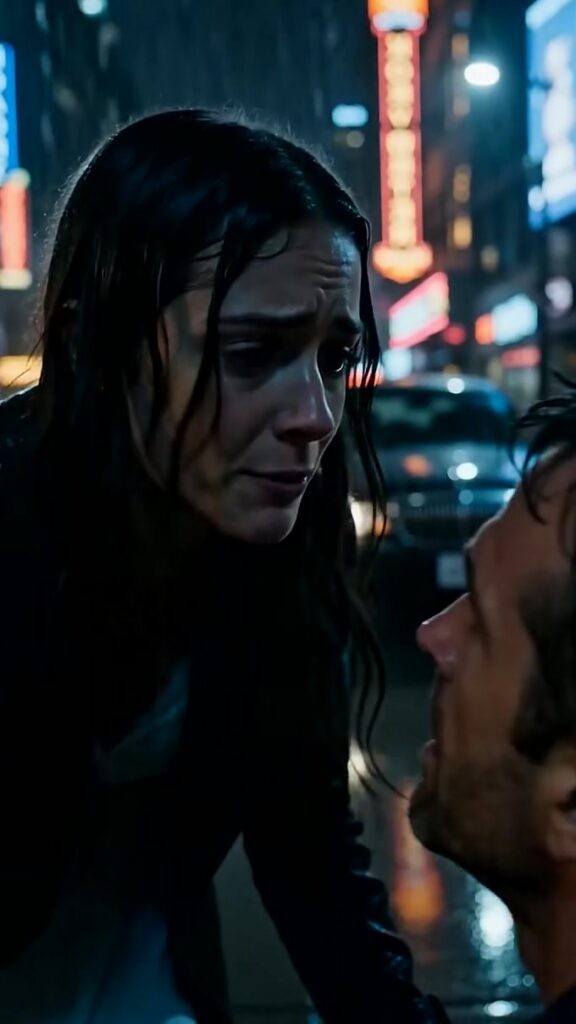
She screamed it as if the words were a life raft and the street was an ocean.
“Please—marry me!”
Traffic hissed through the rain, tires cutting dark water into fans. Neon bled down the asphalt like bruised light. People turned their heads, then quickly looked away, as if desperation were contagious. The shout didn’t carry the usual mess of heartbreak or drunken daring. It had a hard edge—an urgency shaped like fear.
She stood in the center lane, soaked so thoroughly her expensive coat clung to her like a second skin. Mascara had surrendered; her hair was plastered to her cheeks. But there was nothing fragile about her posture. Even trembling, she held herself with the habit of power—shoulders squared, chin lifted, as though the storm itself owed her an apology.
The camera of the city—a thousand indifferent eyes—shifted toward her. And then, as if following a thread only she could see, she turned toward the bridge.
Under its low belly, sheltered from the worst of the downpour, a man sat wrapped in a worn blanket the color of old paper. His shoes had given up their soles. His beard had grown in uneven patches. He looked like the kind of person the city erased from its stories. The kind of person people stepped around without noticing they were stepping around a life.
When her heels splashed across the shallow flood toward him, he didn’t flinch. He merely lifted his gaze as though waking from a dream he hadn’t agreed to have.
“Adam,” she said, and the fact she knew his name struck like lightning.
His voice came out low, scraped thin. “What?”
She stopped a few feet away, close enough that the light from a streetlamp caught the sharp angles of her face. Her eyes kept darting—left, right, behind him—like she expected someone to step from the shadows and put a hand on her shoulder.
“I’ll give you everything,” she said, breath unsteady. “A house. Money. More than you could spend. I need you to marry me today.”
Adam studied her the way people studied an unfamiliar animal in the wild: cautiously, searching for the moment it might strike. “Why me?”
She swallowed. The bravado faltered for a fraction of a second, and behind it something raw showed through. “Because I need it to be real,” she said. “And because you have nothing to gain from lying about it.”
A horn blared somewhere, then faded. The rain thickened. The underpass smelled of wet concrete and old smoke. Adam didn’t move, but something in him shifted—an attention sharpening, a quiet brain rejoining the world.
“Real,” he repeated. “You’re asking for a real marriage.”
“A legal one,” she corrected too quickly. Then she exhaled, and the correction sounded like a confession. “If I’m not married by midnight, I lose everything.”
“Everything,” he echoed, almost amused, but the amusement had no warmth.
“My company,” she said. “My house. The trust. All of it. My father’s will… it was written like a trap. He left control in a blind trust until I’m married. It’s midnight in four hours.”
Adam’s gaze slid past her shoulder to the street. A black SUV rolled slowly by, too slow for the rain, windows tinted darker than night. It passed, then circled the block.
Victoria noticed him noticing. She stiffened. “You saw that.”
“Someone watching you?”
She tried to smile. It fell apart. “Not someone. My uncle. The trustee. He wants me to miss the deadline.” Her voice dropped. “He’s not going to wait politely.”
The word “uncle” landed with a particular weight, one Adam seemed to recognize. His eyes narrowed, as if he were reading a line between her sentences.
“So you ran into the rain,” he said, “to ask a man under a bridge to save your empire.”
Victoria’s jaw worked. “I ran because I can’t trust my friends. I can’t trust my lawyers. And my fiancé—” She choked on the word. “He’s already on my uncle’s side. They all are. I needed someone outside it.”
Adam pulled the blanket tighter, though he wasn’t cold. He was thinking. The way he looked at her now was not the hungry look of a man offered money. It was the assessing look of a man offered access.
“And after?” he asked.
She blinked. “After what?”
“After midnight,” he said. “After you keep your crown.”
Victoria’s lips parted, then closed again. For the first time, she seemed to realize she hadn’t planned beyond the cliff edge. “We sign papers,” she said. “We—” Her voice thinned to a whisper. “You can ask me anything. Name it. I’ll do it.”
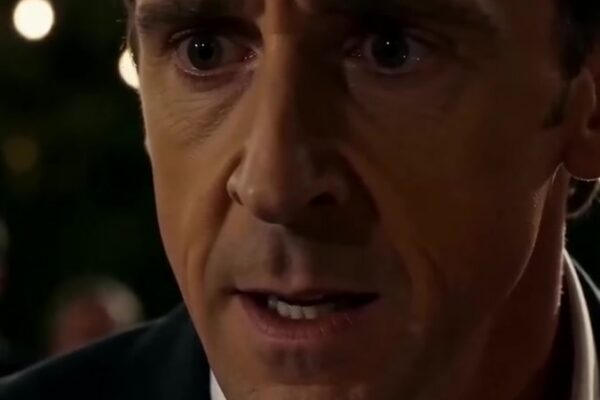
Adam rose, unfolding himself from the concrete like a shadow detaching from the wall. He was taller than she expected. Under the grime and the beard, there was structure—cheekbones, a scar along his brow, the remnants of someone who had once been careful about his appearance. He stepped closer until she could smell rain and smoke on him, until she had to tilt her head to keep his eyes.
“Then I have one condition,” he said.
Victoria’s breath caught, and she did not like the sound of her own fear. “What is it?”
Adam didn’t answer immediately. He looked at her like he was searching her face for a hidden switch. “Say your full name,” he murmured.
“Victoria—”
“All of it.”
She hesitated, then forced the words out as if they burned. “Victoria Harroway.”
Adam’s mouth tightened. “Harroway,” he repeated, and the syllables carried a history.
He reached into the blanket and pulled out a thin plastic folder, miraculously dry. Inside was a yellowing photograph and a folded sheet of paper sealed in a cracked envelope. Victoria’s eyes flicked down, and her face drained so fast it was like someone had pulled the plug on her.
“You’ve been carrying that?” she whispered.
“For three years,” Adam said. “While you went to galas and signed deals and smiled for magazine covers.”
She didn’t deny it. Her gaze snagged on the photograph: a woman with kind eyes holding a small boy on her hip. The boy’s face had been scribbled over in ink as if someone had tried to erase him.
“That’s—” Victoria started, but her voice broke.
“My mother,” Adam said. “She worked for Harroway Holdings. She died in your father’s building when the sprinkler system ‘failed.’” His fingers tightened on the folder. “The day after she told someone she had proof the accounts were being cooked.”
Victoria’s throat bobbed. “I was nineteen,” she said. “I didn’t—”
“You didn’t look,” Adam cut in. “You didn’t have to. People like me don’t come with invitations.”
In the street, the black SUV slowed again. This time it stopped, hazard lights blinking like a heartbeat. A door opened, and a man stepped out under an umbrella, his posture too calm for the weather. He scanned the underpass, and when his gaze found Victoria, he lifted a phone to his ear.
Victoria’s panic returned in a rush. “Adam, please. Whatever you want, I’ll—”
“Here’s the condition,” Adam said, voice quiet as a blade being drawn. “You don’t buy me with a house. You don’t buy me with pity. You marry me, and after midnight you sign over full access to the Harroway archive. Every sealed file. Every settlement. Every nondisclosure.”
“You want my company,” she breathed.
“I want the truth,” Adam replied. “And I want your uncle to watch you hand me the keys.” He leaned in, close enough that she could see the rain trembling on his lashes. “Because I know what your family did. I just need the paper to prove it.”
Victoria stared at him as if seeing him for the first time—not as a stranger under a bridge, but as something the Harroways had failed to bury. The man in the street began walking toward them, umbrella angled forward like a shield.
She looked from Adam to the approaching figure, then back. A choice flickered behind her eyes: the old habit of survival, the new terror of consequence. She took a breath that sounded like surrender and like courage at once.
“If I do that,” she said, “they’ll destroy me.”
Adam’s expression didn’t soften. “They already tried,” he said. “Now decide whether you’ll go down protecting them, or standing with the people they stepped on.”
Victoria closed her eyes for a heartbeat. When she opened them, there was water on her lashes that might have been rain or something else. “Fine,” she whispered. “Access. Everything.”
Adam nodded once, then turned toward the street. He lifted his hand, palm open, in a gesture that was almost polite.
“Good,” he said. “Then let’s get married.”
As the umbrella-man reached the edge of the underpass, Adam stepped into the light with Victoria beside him, and the city—finally paying attention—watched a soaked heiress and a forgotten man walk toward midnight as if they were walking into court.
Victoria’s voice shook, but it rang clear when she said it again, not to beg this time, but to declare war.
“Please,” she told the night. “Marry me.”