The living room had been designed to look like forgiveness.
Everything in it promised softness: cream-colored walls, wide windows rinsed in daylight, a pale rug that swallowed footsteps. The kind of place where voices naturally lowered as if reverence were built into the crown molding. Even the framed photographs—weddings, graduations, beach trips—seemed to have been arranged to prove a point: this is a good family. This is a safe home.
But safety was a costume. And tonight it had slipped.
Evelyn Hart stood near the coffee table with both hands clenched around a dish towel she hadn’t realized she’d picked up. Seventy-eight years old, small as a bird now, her spine no longer proud, her breath too quick for the calm room. She had lived in this house longer than any of the polished furniture. She had watched her husband repaint these walls himself, his hands smudged with white, his laughter echoing through empty rooms as they made a life from lumber and vows. She had buried him from this address. She had mourned him under this roof.
And yet tonight she was being spoken to like a stranger who’d overstayed her welcome.
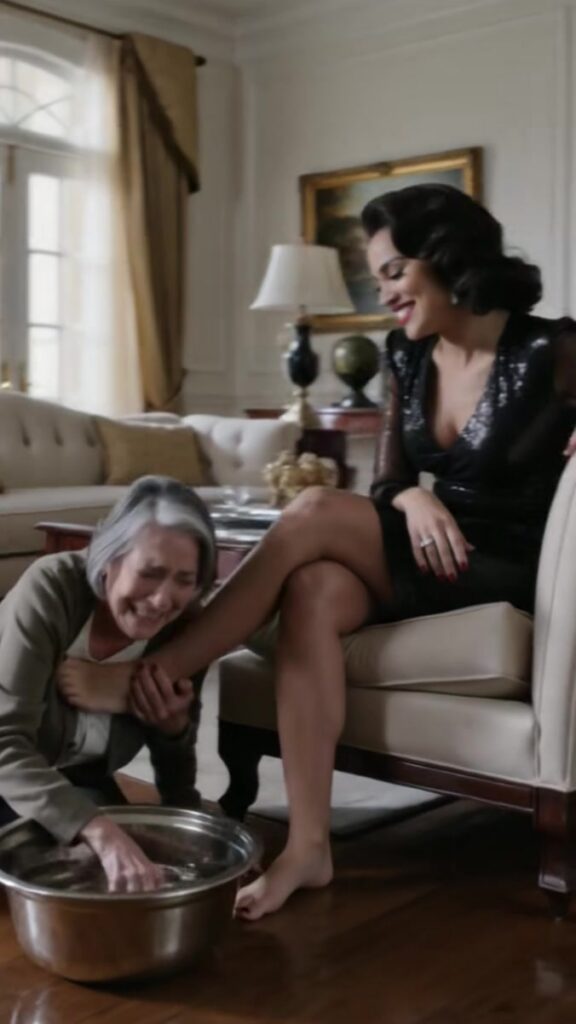
“Don’t just stand there,” Sloane Marrow said, stretching the syllables like silk being pulled tight. Sloane was posed on the sofa as if it were built for her alone—one leg tucked under, the other extended, bare foot gleaming with salon gloss. Her ring caught the light when she flicked her hand dismissively. “You heard me. If you want to remain here, you’ll show me you understand how things work now.”
Daniel stood by the window with his shoulders angled away from his mother, as if the view outside could save him from looking directly at what he’d allowed. He was a tall man in his forties, the kind whose suits fit too well to belong to an old neighborhood. His jaw trembled once, then stilled. His eyes stayed on the garden as if something out there required urgent attention.
Evelyn’s voice came out thin. “Daniel… please.”
He turned just enough to meet her gaze, and for a heartbeat she saw her boy in him—the child who used to bring her dandelions and swear they were treasure. Then his face hardened, not with cruelty, but with something worse: the coward’s discipline. He did not speak.
Sloane’s smile widened like a blade finding skin. She lifted a small metal basin from beside the sofa—an old, utilitarian thing Evelyn recognized from the basement, where it had waited among Christmas decorations and forgotten tools. Sloane swung her arm and sent it skidding across the hardwood.
It scraped and shrieked against the floor, a sound too violent for such a carefully staged room. The basin spun once, caught the light, and stopped directly in front of Evelyn’s slippers like a command.
“On your knees,” Sloane said. “Now.”
Evelyn’s throat tightened. She tasted copper. It wasn’t just humiliation—it was disorientation, as if the house itself had tilted. She looked down at the basin and saw water already inside, cold enough to fog the metal. She couldn’t remember it being filled. She couldn’t remember agreeing to any of this.
“Sloane,” Daniel murmured, finally, and the word held no force. It was a feather tossed at a fire.
“Don’t,” Sloane snapped without looking at him. “If you want your mother to stay, she plays by my rules. I’m not marrying into a household with… baggage.”
Baggage. Evelyn—who had kept Daniel fed when money was thin, who had cleaned offices at night when his father’s illness stole their savings, who had held his hand the day the doctor said the word terminal. Baggage.
Her knees ached just imagining the floor. Her dignity ached more. Yet her fear was heavier than both, because she had heard the way Daniel had said “my house” lately. She had watched him start using phrases Sloane fed him like candy: boundaries, fresh start, necessary changes.
Evelyn lowered herself slowly. The rug did not reach where the basin sat, as if the room had intentionally left that patch of wood bare. Her knees met the hardwood with a dull knock, pain sharp and immediate. Her hands trembled as she reached into the water. It stung with cold.
“Louder,” Sloane said, leaning back. “Thank me properly for not throwing you out today.”
Evelyn’s eyes blurred. She could not see the family photos clearly anymore. She heard her own breathing break into ugly pieces. “This was my husband’s home,” she whispered, not as an argument, but as a lifeline tossed into a storm. “We built—”
Sloane laughed softly, effortlessly, as if Evelyn were telling an amusing story at a dinner party. “Not anymore.”
Daniel’s hands curled into fists. He stared at the floor between them, unable to look at his mother, unable to look at the woman he’d chosen, unable to look at himself.
Evelyn lifted Sloane’s foot with both hands. The skin was warm compared to the water, the contrast making Evelyn flinch. She began to wash—careful, gentle, the way she used to wash Daniel’s scraped knees when he was small. The action made her stomach turn. Her tears dropped into the basin, disappearing without a sound.
Then the front door opened.
The click of the lock sounded louder than the basin had. The hinge creaked once, like a warning. A draft of colder air slipped into the room, carrying the smell of rain and city stone.
All three of them froze. Even the house seemed to stop moving its light across the floor.
A man stood in the doorway, framed by the hall like a portrait that had decided to step out of its frame. He was older—late sixties, perhaps—broad-shouldered, wearing a dark coat buttoned high. His hair was silver, combed back neatly. In one arm he held a thick folder sealed with red tape, the kind of thing you didn’t bring to someone’s home unless you meant to change their life.
His eyes traveled through the room in a slow, measured sweep. The basin. The foot extended like a throne’s privilege. The old woman kneeling, hands submerged, shoulders shaking. The son standing mute by the window.
Something tightened in the man’s face—not anger exactly, but an almost surgical focus. Like a judge receiving evidence.
Sloane’s voice went brittle. “Who are you? We didn’t—”
The man stepped inside and closed the door behind him with deliberate care. The sound of it latching felt like a seal.
He set his gaze on Sloane, and when he spoke, his voice was calm enough to be terrifying. “Perfect,” he said. “Now the woman who did this can hear the will before the police do.”
For a heartbeat, the room didn’t understand what it had heard. Then understanding arrived like a blow.
Sloane’s smile collapsed. Daniel’s face drained so fast it looked painted over with white. Evelyn, still on her knees, looked up as if she’d been pulled by an invisible thread, water dripping from her fingers. Her tears kept coming, but her eyes widened, searching.
“Will?” Daniel croaked, stepping forward half a pace. “What will? My father’s will was handled years ago.”
The man’s attention slid to him briefly, and Daniel flinched as if the gaze itself had weight. “You were told what you were permitted to hear,” the man said. “I am Martin Kells. Executor of Thomas Hart’s final directives. Not the summary. The directives.”
Evelyn made a sound that was not quite a sob, not quite a laugh. “Thomas… he—”
Martin Kells nodded to her with something that looked almost like respect. “He anticipated a great many things, Mrs. Hart. Including this.”
Sloane pushed herself upright on the sofa, suddenly careful, suddenly calculating. “This is ridiculous,” she said, but her voice had lost its velvet. “She’s old. She’s confused. We were just—”
“Demonstrating power,” Martin finished for her. He lifted the folder slightly, the red tape catching the light like a wound. “Or should I begin with the clause written for the exact moment someone forced her to kneel in this house?”
Evelyn’s breath hitched. Daniel’s mouth opened and closed, words failing to form. Sloane’s hand moved instinctively to her engagement ring, twisting it as if it could anchor her.
Martin crossed the living room with measured steps and stopped near the coffee table, keeping a respectful distance from Evelyn on the floor. He did not offer to help her up yet. Not because he didn’t care—because he wanted the scene witnessed exactly as it was.
“Thomas Hart,” Martin said, opening the folder with a precise motion, “was a man who understood that love does not always survive greed. He also understood that cruelty is rarely accidental.”
He drew out a document, thick with signatures and seals. The paper looked too official to argue with.
“This property,” Martin continued, “was placed into a trust upon Thomas’s death. Mrs. Hart retained full right of residence for her lifetime, without interference. Any attempt to coerce, intimidate, or remove her triggers an immediate forfeiture of the beneficiary’s interest.”
Daniel staggered back as if struck. “Beneficiary…” he whispered, and now he understood the trap he’d stepped into. “You mean me.”
Martin’s eyes didn’t soften. “Yes.”
Sloane rose fully, panic finally burning through her composure. “That can’t be—Daniel owns this house.”
“Daniel was permitted to live here,” Martin corrected. “He was permitted to believe he owned it. He was permitted, by his own choices, to reveal his character.”
He turned a page. “There is more. A separate provision—written in Thomas’s own hand, witnessed, notarized—states that if Mrs. Hart is ever forced to perform an act of degradation within this home, particularly one involving submission, the executor is to contact law enforcement and pursue charges for elder abuse and coercion against any parties responsible. Including accomplices.”
Daniel made a strangled sound. “I didn’t— I didn’t touch her.”
Martin’s voice remained level. “You watched.”
Evelyn’s hands slipped from Sloane’s foot. The foot dropped, suddenly ordinary, suddenly powerless. Water splashed onto the floor and spread in a thin, shining sheet.
For the first time in the room’s long, curated life, the silence was not polished. It was raw. It held the weight of what had been done and what could no longer be undone.
Martin looked down at Evelyn, and only then did his expression change, not to pity, but to something steadier—an offered hand without sentiment. He extended his arm. “Mrs. Hart,” he said, “you can stand now. If you wish.”
Evelyn stared at his hand. Her knees throbbed. Her pride felt bruised, but not dead. She placed her wet fingers into his palm and rose, trembling, water dripping onto the rug that had been meant to hide all mess.
Sloane’s voice cracked. “Daniel, say something. Tell him this isn’t—”
Daniel looked at his mother then—really looked. Not at her age, not at her inconvenience, but at the person whose life he’d tried to trade for ease. His eyes were wet, and for the first time all night he seemed afraid, not of losing the house, but of himself. “Mom,” he whispered, as if the word might stitch back time.
Evelyn didn’t answer him. She turned her gaze to the family photos lining the wall. She saw herself in the background of so many of them, half-smiling, holding plates, holding babies, holding the shape of a family together. She wondered how many times she had mistaken silence for peace.
Martin closed the folder softly. “I have already made the call,” he said, and the calmness of that admission made Sloane sway. “An officer is on the way. There will be statements. There will be consequences. And there will be a new locksmith here before night ends.”
Sloane’s face twisted, searching for a weapon in words, a way to reclaim control. None came. She looked around the expensive room as if expecting the decor to defend her.
Daniel took a step toward Evelyn, stopped, and let his hand fall. “What do you want me to do?” he asked her, voice hoarse.
Evelyn finally spoke, and her words were quiet but carried the authority of someone who had nothing left to lose. “I want you,” she said, “to listen to the sound of your own silence. And understand what it cost.”
The room held its breath again—not from fear of Sloane, but from the weight of truth settling into every corner. Outside, rain tapped at the windows like an impatient witness.
And in the shining spill of water on the floor, the house reflected a different scene now: not comfort, not control, but reckoning—arrived at the door in a dark coat, carrying paper that had waited years for this exact moment to be read aloud.
When the knock finally came—firm, official, inevitable—no one moved to pretend they were still a good family in a safe home.
The performance was over.