The office smelled like money—new bills, old varnish, cologne expensive enough to have its own hush. It clung to the dark wood walls and seeped into the soft lamp light, as if the air itself had been polished and priced. Outside, the city threw cold blue reflections against the glass, like a second world trying to press its face to the room.
Against the far wall stood a safe that didn’t look like furniture so much as a silent animal: matte black, tall as a man, its surface swallowing the lamp’s glow. The keypad on its face pulsed faintly, a patient heartbeat.
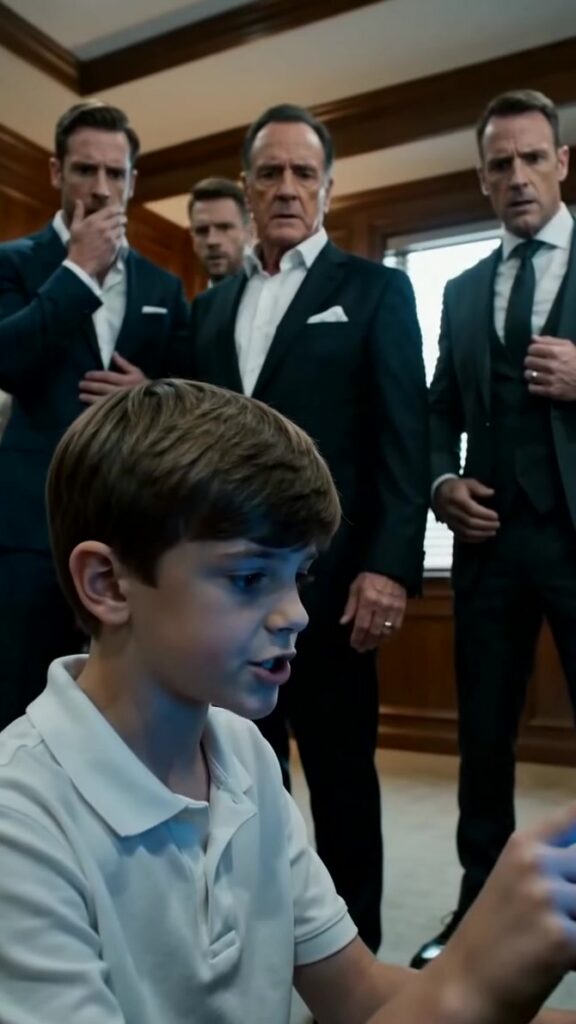
Four men occupied the space behind a kneeling boy, and the arrangement made the room feel staged. Like a photo you’d find later in an exhibit about greed. The men were dressed in the kind of suits that didn’t crease, shoes that didn’t scuff. They had the calm of people used to calling taxis that arrived instantly and problems that went away when paid.
The boy wore a white polo and dark pants. His feet were bare on the polished hardwood, toes splayed for balance. His hands hovered over the keypad with the careful poise of a pianist about to begin a piece he’d practiced too long in secret. He should have looked terrified. The men expected trembling, pleading, the desperate clumsiness of a child in the wrong room.
Instead he looked… absent. Not vacant—present in a different place. His eyes held the safe the way you might hold an old memory.
The oldest of the four men stood closest. His hair was silver and immaculate, his black suit cut so sharply it might have drawn blood if you brushed against it. His watch caught the lamp light and gave it back in controlled flashes. He watched the boy with the cold confidence of someone who believed the world was a ledger and he owned the pencil.
“One hundred million dollars,” he said. His voice didn’t rise. It didn’t need to. “That’s what I’ll give you if you open it.”
One man beside him covered his mouth, as if to trap a breath before it betrayed him. Another kept adjusting his tie, fingertips nervously smoothing imaginary wrinkles. The third couldn’t stop staring at the safe, pupils wide as if the black door were a cliff edge and he was afraid of falling.
The boy didn’t turn around. He pressed a number.
The keypad sounded a bright, clinical beep. In the heavy room it landed like a pin dropped in a cathedral.
He pressed another. Beep. Another. Beep.
The men did not breathe normally. Their ribs rose too high, too shallow, in urgent little sips of air, each man listening to the next beep as if it might become a siren.
The boy’s composure seemed to wound them. They’d wanted fear—they needed it. Fear would have kept him small. Fear would have reminded them that they were the ones with names on buildings, with lawyers on retainer, with money that could make judges blink and forget.
He pressed again. Beep.
Finally, without looking back, he asked quietly, “Why would you pay me one hundred million…”
Another beep.
“…for something you don’t actually want opened?”
The question didn’t sound like an accusation. It sounded like a simple observation, like noting the rain. But it struck the room like ice water poured down the collar.
The silver-haired man’s face changed first—only a fraction, a twitch in the jaw, a narrowing of the eyes that tried to be annoyance and came out as alarm. “What do you mean?” he asked. He kept his tone controlled, but control has a sound when it’s forced, like a door held shut against a crowd.
The other three men looked at the boy differently now. Not like a hired curiosity. Not like a child. Like a fuse burning toward something they couldn’t see.
The boy’s fingers paused above the keypad. For the first time he lifted his eyes, not to the men directly, but to their reflections ghosting across the safe’s black surface. In the matte finish their faces looked warped, stretched into pale masks.
His expression stayed unreadable. Too calm. Too certain.
He pressed one more number. Beep.
Then, low and steady, he said, “Because if this opens…”
Silence dropped hard. Even the city outside seemed to hold its breath, the blue reflections frozen in the glass.
The boy’s thumb hovered over the final button. The men behind him had the posture of gamblers watching a card turn. The oldest man didn’t stop him. He couldn’t. Pride anchored him in place, and something else—hope, sharp and hungry—kept his mouth closed.
The boy pressed the final button.
A sharp confirmation tone sounded, too cheerful for the moment. Then a mechanical click, deep and final, like a bone setting.
The safe unlocked.
Every man in the room went pale at once, as if the door had swung open and let the ocean in. The one with his hand over his mouth made a thin, strangled sound. The man adjusting his tie stopped, fingers going rigid at his throat. The one who’d been staring at the safe took a step back, bumping a chair, as if distance could save him.
The silver-haired man didn’t move, but something in his eyes shattered—an old certainty cracking under pressure. He stared at the safe like it was staring back.
The boy rose slowly to his feet, barefoot on money-scented wood. He didn’t pull the door open yet. He turned his head toward the oldest man, just enough to show his profile—small, composed, oddly adult.
His voice came out almost like a whisper. “…everyone in this room is finished.”
The sentence might have ended there. But the boy’s gaze slid past the man’s shoulder, over the suits, the watches, the polished shoes, and it seemed to settle on something beyond them—something remembered.
“Not because of what you kept,” he continued, “but because of what you thought you could bury.”
The silver-haired man’s lips parted. For a moment his arrogance tried to return, to put itself back on like a jacket. “You don’t know what’s in there,” he said, and the words were meant to be a command.
The boy finally looked directly at him. His eyes were dark and steady. “I do,” he said. “I’ve heard it my whole life.”
He reached for the safe door. The men behind him stiffened as if pulled by strings. The room’s scent—money, wood, cologne—suddenly felt like rot wearing perfume.
“You offered me one hundred million,” the boy said, fingers wrapping around the heavy handle. “You didn’t offer it because you wanted the door open. You offered it because you wanted to prove you could still buy outcomes.”
The safe door began to swing outward, slow and reluctant, its hinges whispering. A sliver of darkness appeared—thicker than shadow, dense as velvet. Cold air breathed out of it, raising gooseflesh on the boy’s arms.
“Stop,” one of the men choked, finally finding his voice. “Whatever you want—”
“It isn’t money,” the boy said, not unkindly. “Money is the smell in this room. It isn’t the thing.”
The opening widened. Inside, there were no glittering bars, no stacks of currency. Instead, a file box sat alone on the bottom shelf, plain cardboard stamped with an old label. Beside it lay a small black drive, the kind you could lose in a pocket—and a sealed envelope with a crimson wax stamp that looked too fresh.
For one heartbeat, nothing happened. The men leaned forward against their own will. The city’s blue reflections trembled on the glass like water in a cup.
Then the envelope’s wax seal fractured with a tiny, crisp snap, as if an invisible finger had pressed into it. A thin sheet of paper slid out by itself and lifted slightly, caught by the cold air now spilling into the room.
The men stared at it like it was a verdict.
The boy didn’t flinch. He reached in, took the paper between two fingers, and held it up where the lamp light could touch it. It wasn’t a contract. It wasn’t a will. It was a list—names, dates, numbers, and at the bottom, a single line written in careful hand: Deliver to the boy when he returns.
The silver-haired man’s face emptied. “No,” he whispered, and it was the first honest word he’d spoken all night.
The boy looked at him with something that might have been pity if it hadn’t been so clean. “You kept it here because you thought black steel could hold it,” he said. “But you were guarding a message. Not from me.”
He set the paper down on the edge of the open safe, then reached for the small black drive. He turned it over once, as if weighing the heft of a whole ruined future.
“Who are you?” the man adjusting his tie asked, voice trembling now that there was no point hiding it.
The boy’s eyes flicked toward the safe’s reflection again. Four distorted men. One barefoot child. One open door.
“I’m the thing you didn’t plan for,” he said. “Not a hacker. Not a thief. The witness you couldn’t purchase because you never thought a witness could grow up.”
The oldest man’s throat worked. “We can—” he began.
“You can’t,” the boy interrupted softly, and the softness made it worse. “That offer—one hundred million—wasn’t a reward. It was a confession. You didn’t want it opened because you knew what opening meant.”
He stepped away from the safe, drive in hand, leaving the door gaping like a mouth. The cold air continued to pour out, carrying no scent at all, as if truth was sterile.
Outside, the city’s blue reflections shifted—one building’s lights blinking, another’s going dark—indifferent to the drama in a room high above it. But inside, the men looked suddenly small, stripped of their tailored armor, four figures caught behind a barefoot boy who had learned the price of silence and decided it was too expensive.
The office still smelled like money. It always would.
But now it also smelled, faintly, like the moment a safe stops being a fortress and becomes a doorway.
The boy walked toward the door without running, without triumph. Only purpose. As his fingers closed around the handle, he paused and spoke one last time, as if offering them a final, unnecessary mercy.
“If you wanted to stay safe,” he said, “you shouldn’t have built a safe.”
Then he left them with the open black mouth in the wall, the list in the lamp light, and the sound of their own breathing—ragged at last, and far too late.