The double doors crashed inward like they’d been kicked by a wrecking ball, and the entire bar shuddered—bottles rattling on shelves, a neon sign buzzing angry, the old floorboards giving a startled groan. Conversation died mid-sentence. Even the jukebox seemed to swallow its own music. In the sudden hush, smoke hung in layers under the ceiling fans like a storm that forgot to rain.
In the doorway stood a child so small he looked misplaced in the harsh rectangle of afternoon glare. He stumbled over the threshold as if his legs had forgotten what solid ground felt like. Dirt smeared his cheeks; the knees of his shorts were torn through; one sleeve hung in strips. His chest hitched in quick, painful pulls, each breath dragged out of him like it had hooks in it. He didn’t scan the room, didn’t search for a friendly face. He ran as though he’d already chosen where safety lived and had no time to doubt.
He darted between heavy tables bolted to the floor, past men in worn leather cuts and steel-toed boots. A few hands moved instinctively toward belts and holsters, then stopped when they saw the terror in him. The boy cut straight through the haze and stopped at a table near the center—the one where the biggest rider in the room sat like a monument. The man had shoulders that filled doorframes and a jaw carved from old grudges. A scar cut down his left cheek, pale against weathered skin, and the patch on his vest showed a wolf’s head stitched in dark thread.
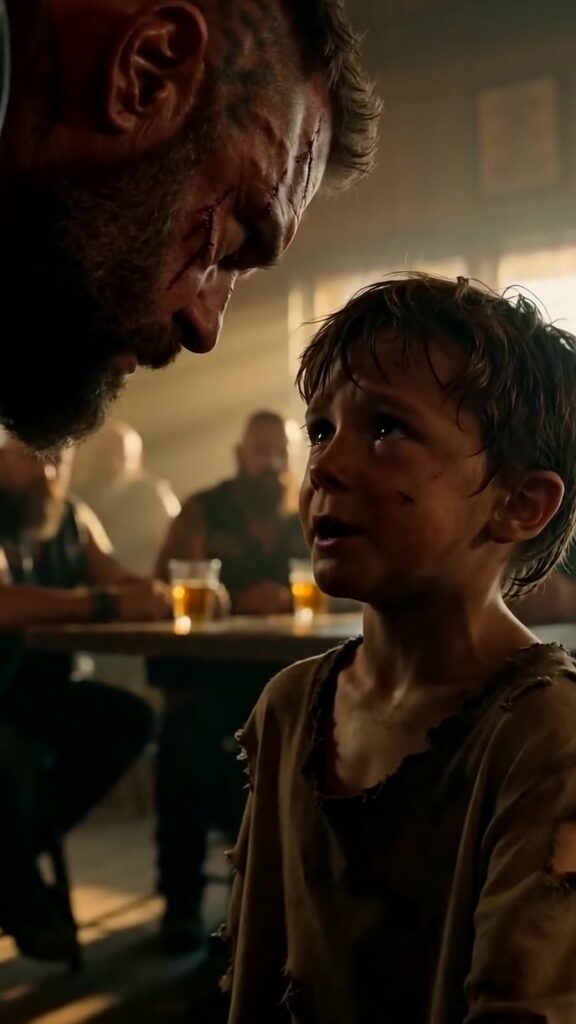
The boy reached out with a shaking hand and grabbed the biker’s knee, fingers clinging like he might be swept away by a current if he let go. “Please,” he rasped, voice thin and cracked, “I need help.” The words didn’t carry far, but the bar was so silent they landed like a coin on a coffin lid.
The biker stared down at him, eyes hard, not unkind but not gentle either—eyes that had watched men lie and bleed and still try to bargain. He leaned in just enough to hear the child over the low hum of the fans. “What’s your name, kid?”
The boy swallowed. His throat worked like it hurt. “Eli.” His gaze flicked once toward the door as if he expected it to sprout teeth. “My dad… he told me if I was ever in trouble, I should come to this place. He said to find the man with the scar and the wolf.”
A ripple ran through the men nearby—recognition, disbelief, then the instinct to distance themselves from whatever story was forming. The biker’s hand rose slowly, two thick fingers touching the scar on his cheek as if verifying it was real. His expression tightened by a fraction. “Who’s your father?”
Eli’s lips trembled. He looked like he was about to fold in on himself. But he forced the name out anyway, a whisper in a room full of armed men. “John Wick.”
Somewhere behind them, glass slipped from a hand and shattered. The sharp sound did what fear always did—it made the quiet feel heavier. A man at the bar muttered an oath under his breath. Another stared at his drink as if it had turned into something alive. Nobody laughed. In a place like this, names were currency, and that one was a debt collectors didn’t survive long enough to pay.
The big biker’s face changed first, like a door inside him swung open to a hallway he’d tried to brick up years ago. “That’s a story,” he said carefully. “That can’t be true.” He meant it as a warning, not an accusation—because lying with that name was suicide, and children didn’t usually choose suicide.
Eli flinched, but instead of arguing he fumbled at his collar with dirty fingers. A thin black cord slid into view. Hanging from it was a ring—plain, dark metal, worn smooth by years of being held, hidden, gripped too hard in sleepless nights. The biker’s eyes locked onto it. For a second, the bar seemed to tilt.
He had seen that ring once, long ago, when a different man had walked into a different room with grief like a second shadow. A man who didn’t talk about the woman he’d loved, but carried her absence in the way he breathed. The biker remembered the chain at the throat, the ring pressed to skin, the promise behind it like a loaded gun.
Eli’s voice broke apart. “They hurt my mom,” he said, each word dragged across broken glass. “They came to the house. Daddy told me to run when he said run. He told me not to stop, even if I heard… even if I heard things.” His eyes flooded and he wiped them with the back of his wrist, smearing grime into tears. “He said if anything happened, I had to find you. He said you’d know what to do.”
The biker’s hands flattened on the table, knuckles whitening. The men around him watched the doorway now. Outside, the afternoon light turned harsh, and in it moved shapes—too still to be passersby, too deliberate to be lost. Shadows that didn’t belong to any good story.
Eli took a step back, the cord with the ring taut between his fingers. “They followed me,” he whispered. “I tried to lose them in the alleys. I hid under a truck. I—” He shook his head hard, as if he could shake loose the memory. “Daddy said don’t wait for him. He said if he didn’t come back right away, that meant he couldn’t. He said I had to keep going.”
The biker rose. His chair scraped the floor with a slow, dangerous sound. He was suddenly very still, a storm held behind bone. He glanced around the bar, not to ask for help but to measure what kind of loyalty remained in the room. A few men met his eyes and, one by one, nodded—grim, resigned, the nod of people who understood that some choices, once made, couldn’t be taken back.
He crouched until he was level with Eli. Up close, his scar looked like it had been earned, not given. “Listen to me,” he said, voice low enough to feel like a secret. “You stay behind me. You don’t run again unless I tell you. You hear?” Eli nodded, trembling.
The biker stood and turned toward the open doors. The silhouettes outside shifted, closing in on the threshold. He rolled his shoulders like a man shrugging off sleep, and the bar seemed to tighten around him, waiting. “Kid,” he asked without looking back, “where is John right now?”
Eli’s answer came small, drowned in the whir of fans and the sudden, collective breathing of men who knew what was coming. “He told me goodbye,” the boy said. “He told me not to expect him.”
The biker’s jaw flexed once. Then he reached under the table and drew out a weapon wrapped in oilcloth—not a showpiece, but a tool. Around the room, other men stood, chairs dragging, leather creaking, metal whispering from holsters. The wolf on the biker’s cut seemed to stare toward the light with bared teeth. “All right,” he murmured, more to himself than anyone else. “Then we do what we always do when the dead start knocking.”
He took one step toward the door, placing his body between Eli and the sunlit threat beyond it. And the bar—old wood, old sins, old loyalties—held its breath as the first shadow crossed the threshold.