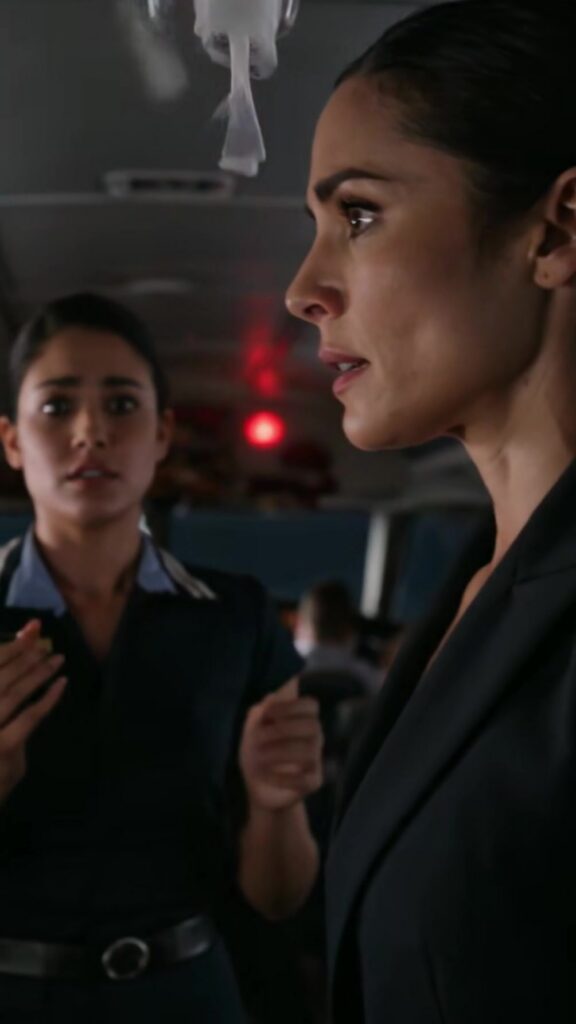
The cabin was a long, dim tunnel of breathing bodies, seatbelts, and soft blue light that made everyone look like ghosts of themselves. A steady engine hum stitched the silence together. Heads lolled. A baby’s sock hung from a tired hand. Someone’s screen glowed with a paused movie, its actors frozen mid-laugh. Above, the air vents whispered, and the smell was that familiar mix of recycled air, coffee long gone cold, and the faint metallic note of altitude.
Maya sat in 18C with her hands folded, not asleep, not quite awake—watching the rhythm of the aisle as the flight attendants moved like quiet mechanics. Her aviator watch, old and scuffed, rested heavy against her wrist. It had once meant something. Now it was just weight.
The man beside her snored gently, his mouth open. Across the aisle, a teenager recorded a silent selfie with the window’s reflection. The plane cruised, a metal certainty cutting through black sky, carrying hundreds of small private lives toward morning.
Then the world detonated.
A crack like lightning slammed through the fuselage. The aircraft lurched as if struck by an invisible fist. Overhead bins rattled in a chain reaction—plastic latches whining, suitcases thudding against their confines. Lights flickered hard, went out, came back in stuttering pulses. The soft hum became an angry roar that rose and fell in panicked surges.
Alarms blared. Not the polite chime of a seatbelt sign, but a raw, urgent scream that hit the body before the mind understood it.
Passengers snapped awake into terror. Phones rose like a field of glowing periscopes. Hands clenched armrests. Someone shouted a prayer. Someone else shouted for their mother. A cup skittered down the aisle, spilling cold coffee in a wavering ribbon.
Another violent shake rolled through the cabin. The plane dipped—so fast stomachs floated, so hard a chorus of gasps erupted as one. A woman screamed. The scream didn’t stop.
From the forward galley, a flight attendant’s voice tore through the chaos, cracking with strain and something close to disbelief. “Is there a pilot on board?!”
The question didn’t land like a request. It landed like a verdict.
For a moment, all eyes turned forward, toward the closed cockpit door as if it might open on its own and spill reassurance into the aisle. Instead the door sat there, implacable. Then it shuddered. Not from impact—someone inside had struck it, or fallen against it.
The door was half open.
Passengers leaned, craning over seatbacks. The thin slice of cockpit visible beyond the gap held a tableau that didn’t belong in any of their planned lives. The captain was slumped in his chair, head turned oddly toward the window, body unmoving. An oxygen mask dangled near his shoulder like an abandoned thought.
The first officer was alive—too alive. His hands clamped the yoke with white-knuckled desperation. His headset was crooked, his eyes wide and glassy, pinned to instruments that flashed red warnings. He looked like a man trying to hold back the ocean with a door.
Another shudder hit. The cockpit shook. The plane dipped again, and the overhead lights cut out completely for half a second. In the darkness, the alarms seemed louder. When the lights returned, the cabin looked different: no longer a place of travel, but a theater where a disaster was mid-act.
Fear spread fast, contagious as smoke. People stood only to be forced back down by the rolling motion. Someone tried to push forward, only to be shoved back by the press of bodies. The flight attendant at the galley braced herself against the wall, eyes darting between the cockpit and the passengers, an impossible choice in her face.
Then a voice—low, calm, unshaken—cut through everything as if it belonged to a different world.
“I need cockpit access. Now.”
The chaos didn’t stop, but it shifted. The sound of it changed, as if everyone’s panic had been interrupted mid-sentence.
Maya stood in the aisle.
Not swaying. Not clutching a seatback. She stood like the plane was a platform beneath her feet, not a wild animal trying to throw her. Her expression was still, focused—neither brave nor reckless, simply decided.
The flight attendant turned, and the color drained from her face.
Recognition hit with the force of another impact—something between relief and dread. The attendant’s eyes searched Maya’s features, as if trying to remember whether this was a dream.
A flash of memory flickered across her mind: a training seminar in a bright room that smelled of stale pastries. A woman at the back asking blunt questions. Laughter from others. A dismissive smile from an instructor. “Just a passenger,” someone had said, as if that word explained everything.
Back in the shaking cabin, the attendant’s lips parted. “You…?”
Maya didn’t answer. Her gaze stayed locked forward, past the sea of faces, past the trembling door, to the instruments screaming beyond it. “Open the door.”
For a second, the alarms sounded far away. The passengers stared, caught between suspicion and hope. A man with a rosary paused mid-prayer. The teenager’s camera steadied, its lens hungry for meaning.
The attendant hesitated—protocol and instinct wrestling in her eyes—then her hand found the latch.
Click.
Sharp. Final. Like a switch thrown.
Maya moved forward.
She walked as if she’d done it a thousand times, as if the aisle were not swaying but simply narrowing toward a point that needed her. People pressed back into their seats to make room, watching her pass with the wary reverence reserved for surgeons and soldiers. A man tried to speak—tried to ask who she was—but the words died in his throat.
Maya’s left hand rose briefly, not to steady herself but to adjust her watch. The old aviator watch caught the flickering light, its scratched face familiar to anyone who knew aviation history, the kind worn by people who trusted machines with their lives.
She stepped into the cockpit.
The air inside was harsher, colder, filled with the smell of hot electronics and stress sweat. Warnings flashed across panels—overspeed, autopilot disconnect, altitude deviation. The first officer looked at her like she was a hallucination he couldn’t afford.
“Ma’am—” he began, voice breaking, then swallowed. “We—Captain’s—he—”
Maya didn’t look at the captain. She didn’t need to. There was a stillness to that slumped body that meant time had already moved on without him. She reached for the headset, slipped it over her ears with practiced motion, and adjusted the mic.
Another shake hit, and the yoke jerked violently. The first officer fought it, but his movements were raw, frantic, too large. The plane responded like a frightened horse to a panicked rider.
Maya’s hand reached out.
Extreme close-up, if anyone could have filmed it properly: her fingers wrapping around the controls with a firm certainty that seemed to quiet the cockpit by sheer will. Her grip was not possessive. It was corrective.
“I’ve got it,” she said.
The first officer blinked. His breath hitched, then rushed out. He looked as if someone had finally handed him a rope in deep water. “Who are you?”
Maya’s eyes moved over the instruments in a fast, fluent scan, taking inventory of disaster. “Someone who doesn’t have time to explain.” She eased pressure on the yoke, trimmed carefully, coaxing rather than fighting. Her voice stayed level, anchoring itself to procedure. “Tell me what happened. When did the alarms start? Any indication of a strike?”
He spoke in fragments—bang, shake, instrument failures, captain collapsed mid-callout—while Maya listened with the focus of a person reading a map in a storm. Outside, the night was endless. Inside, her hands began to rewrite the plane’s story one input at a time.
In the cabin behind them, passengers held their breath as the pitch of the aircraft changed—subtle, almost imperceptible, but different. The screaming alarms didn’t stop, yet the motion smoothed from violent lurches into a rough tremble.
Maya keyed the radio. “Mayday, mayday, mayday,” she said, calm as a metronome. “This is Flight 702. We have an incapacitated captain, severe turbulence or possible structural event, unstable flight. Request immediate vectors and priority landing.”
A hiss of static answered, then a voice—distant, surprised—asking for confirmation, for names, for credentials. Maya didn’t flinch.
“I’m on the controls,” she said. “Give me heading and altitude. Now.”
Something about her tone made the controller obey before doubt could bloom. Numbers came through, crisp and fast. Maya repeated them back, each syllable a nail hammered into the chaos.
The first officer watched her hands. Watched her eyes. Watched the way she didn’t plead with the aircraft but negotiated with it. His shoulders, knotted with terror, loosened by degrees. He found himself breathing again.
“You’re—” he started, recognition dawning late, like the slow reveal of a photograph. “You’re Maya Sato.”
Maya’s jaw tightened—not at the name, but at what it dragged behind it. Old headlines. A tribunal room. A verdict that had exiled her from the sky. She ignored it the way she ignored the alarms: as noise that could not be allowed to steer.
“Flaps,” she ordered, not looking at him. “Confirm airspeed. Confirm we’ve got hydraulics. Then help me bring us home.”
Behind the cockpit door, the cabin waited in trembling silence, every soul balanced on the thin edge of her voice. The plane still shook, the lights still flickered, but something new threaded through the air—an emotion sharper than fear.
Hope, arriving with the steadiness of footsteps in a shaking aisle.
Maya stared into the instrument glow, hands firm on the controls, and guided the wounded aircraft through the dark as if she could force the night itself to make room.
“I’ve got it,” she said again, softer this time, to the plane, to the people behind her, to the part of herself that had once believed she’d never touch a yoke again. “Hold together. Just a little longer.”