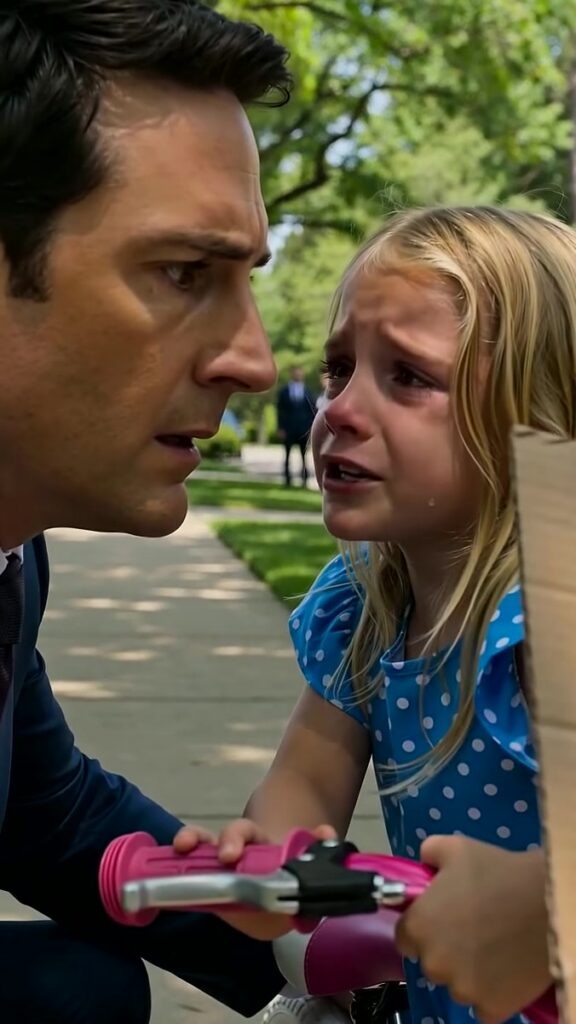
The little girl had been crying long before Adrian Cole stopped his car.
He noticed it through the windshield like a crack spreading across glass—soundless at first, then undeniable. Not the bright pink bicycle angled beside her. Not the handmade FOR SALE sign swinging from the handlebars. Not even the improbable sight of a child alone on a street where hedges were trimmed by contracts and sidewalks looked freshly painted every morning.
It was the kind of crying that didn’t reach for strangers. The kind you did when you’d already asked everyone you trusted and learned there was no one left.
Adrian’s tires sighed against the curb. Behind him, the city breathed its afternoon heat and the faint hiss of sprinklers. Ahead, the girl stood in a blue dress dotted with white circles, her hair pulled into two lopsided puffs, her shoulders rigid as if she were holding herself together with muscle alone. His phone buzzed on the passenger seat with another missed call from the office. He ignored it.
He stepped out in a navy suit too expensive for the asphalt and crossed the sidewalk slowly, palms open, lowering himself to one knee so his height wouldn’t swallow her. The smell of cut grass and hot concrete mixed in his throat.
“Hey,” he said, gentle enough to be heard without being announced. “You okay?”
She wiped her cheeks with the back of one hand and kept the other clamped on the bicycle grip as if the bike were a railing above deep water. Her chin trembled, but she didn’t look away. That courage, thin as paper and just as easily torn, struck him almost harder than her tears.
“Sir,” she managed. “Would you buy my bike?”
Adrian’s gaze drifted to the cardboard sign. The letters were uneven and pressed too hard, as if whoever wrote them had been angry or frightened or both. “Why are you selling it?” he asked, though the question already felt like a lie—because children didn’t sell bicycles in this neighborhood unless something had gone disastrously wrong.
Her voice broke on the next words. “My mom hasn’t eaten in days. I’m selling my bike.”
The sentence landed inside him with the weight of a door slammed shut. He forgot the heat. Forgot the perfectly spaced trees. Forgot that his own life was built on signatures and smooth explanations—things that made suffering neat enough to be kept out of sight.
“Where is your mother?” he asked.
The girl opened her mouth. Nothing came. Her breath snagged, and her eyes slid past his shoulder—not toward a house or a driveway, but down the street, where a black SUV sat too still in the sun. Three men stood near it, dressed like security, pretending not to watch. One of them wasn’t pretending at all.
Adrian felt his spine stiffen. Old instincts, inherited and honed, rose up in him: notice everything, trust nothing, never be surprised. He followed the girl’s gaze with the smallest turn of his head.
He knew those men. Not their names, but the uniform of them—the tailored dark suits, the hands held close to the waist, the unnatural calm. The kind of calm that belonged to people paid to move problems somewhere else.
Adrian looked back at the child. Her voice shrank to a whisper, as if the air itself were listening. “She told me to sell it before they took her.”
The world altered, not with a sound but with a tilt. Rich street. Bright bike. Summer sky. All of it became a stage set slid aside to reveal a corridor of something colder.
“Who took her?” Adrian asked.
The girl swallowed. Tears tracked down both cheeks, catching in the sunlight. Her fingers tightened on the rubber grip until her knuckles went pale. “My mom said…” Her eyes darted again to the men. “…if I ever saw you, I should ask for Daniel.”
Daniel.
The name emptied Adrian’s lungs. His mind, always so practiced at order, went suddenly chaotic—images colliding: a laugh in a kitchen; a hand slapping a table; a younger brother’s grin; smoke; screaming; the smell of burning plastic; the finality of a closed casket and a family that did not speak the word afterward.
Daniel Cole had been declared dead twelve years ago. Adrian had watched the news. Signed documents. Stood beside his father while condolences slid off tailored shoulders. He had been trained to grieve in private and never in questions.
Now the name appeared on a child’s tongue like a match struck in darkness.
Adrian’s gaze dropped to the bicycle. Beneath the FOR SALE sign, tied around the frame, was a thin ribbon bracelet, sun-faded to the color of old bone. On it, stitched in uneven thread, were two initials: D.M.
His heart lurched as if it recognized before he did. Daniel used to make those bracelets with stubborn patience, threading letters with the seriousness of a boy who believed love could outlast a family’s fury. D.M. had meant something once—someone, more precisely. A girl their father wouldn’t allow into the same room as their name.
Adrian reached toward the ribbon with fingers that didn’t feel like his.
The little girl grabbed his sleeve, panic sharp. “Please,” she breathed. “Don’t let them see you with me.”
Her touch was small, but it anchored him. He looked up into her face, really looked, and something inside him strained at the edges of belief. The eyes—wide, dark, framed by lashes too long. The curve of the mouth when she tried to hold it steady. A familiar stubbornness in the set of her jaw.
He didn’t know how he knew. He simply did.
This child hadn’t come for money.
She had come for family.
Footsteps approached on the sidewalk, measured and sure. A voice cut the afternoon cleanly: “Step away from her, sir.”
Adrian didn’t turn immediately. He kept one knee on the pavement, his body angled to shield the girl like he could become a wall with bone and will. He felt the presence behind him—one man close, two still by the SUV. He pictured the street’s security cameras mounted on discreet poles, the neighbors who would peek through curtains if there was shouting, the way this neighborhood handled danger by calling someone else to remove it.
He rose slowly, keeping the girl behind his leg. The suited man had a clipped haircut and the blank expression of someone trained to be forgettable. His eyes flicked to the girl, then back to Adrian as if Adrian were the only variable worth assessing.
“She’s a child,” Adrian said. His voice came out steadier than he felt. “Where are her parents?”
“Not your concern,” the man replied. “This is a private matter.”
Private. Adrian heard the word like a family motto. Private meant sealed. Private meant buried. Private meant you could do anything as long as it didn’t spill into daylight.
Adrian glanced down at the ribbon again. D.M. Then he looked at the girl, who clung to the bicycle and to him in turns, as if unsure which could keep her upright. “What’s your name?” he asked, soft enough that the man might miss it.
She hesitated. Then, as if reciting something she had practiced under a blanket in the dark, she said, “Mara.”
Mara.
Not a name Adrian knew, but it fit too perfectly beside the initials. Daniel. Mara. Or Daniel and someone whose name started with M—someone his father had erased. The missing letter in a family story written with intentional gaps.
The suited man took a step closer, his hand drifting toward the inside of his jacket. “Sir,” he warned, “move.”
Adrian’s phone vibrated again. This time, he pulled it out. He didn’t look at the screen. He held it loosely at his side, thumb hovering over the emergency button he’d never once used in his curated life. But the police would come, take statements, write reports—then the SUV would leave, and the girl would vanish, and every question would be labeled a misunderstanding.
Adrian did not need police. He needed truth.
He forced a thin smile at the man in the suit. The kind of smile his father used when he was about to destroy someone politely. “I’m Adrian Cole,” he said. “And if you tell my father you put hands on a child in public, I promise you he won’t pay you enough to survive what follows.”
The man’s expression flickered—the briefest crack. Recognition, then calculation. Adrian watched it with grim satisfaction. Power was a language he’d been raised fluent in, and he hated that it still worked.
“This isn’t about your father,” the man said, but his stance shifted, uncertain now. He glanced toward the SUV, seeking instruction from the silhouettes waiting there.
Adrian seized the moment. He bent slightly, speaking to Mara as if he were explaining something simple. “When I tell you to run,” he murmured, “you run to my car. Passenger side. Lock the door.”
Mara’s fingers trembled on the handle. She looked terrified, but she nodded once, hard, like a promise.
Adrian straightened. He met the suited man’s eyes. “Tell whoever sent you,” Adrian said, “that Daniel’s name doesn’t belong to them anymore.”
He didn’t wait for permission. He turned and sprinted, not away from the girl but with her, the bicycle rattling as Mara ran beside him, dress flaring, feet slapping the pavement. Behind them, the calm broke—shouts, the scrape of shoes, the sudden slam of an SUV door.
Adrian reached his car first, yanked the passenger door open, and shoved the bike in halfway as Mara scrambled into the seat. He slammed the door and heard the lock click just as a hand struck the window from outside.
He swung into the driver’s seat, heart hammering, and looked in the rearview mirror.
The black SUV was rolling forward, hungry and certain.
Mara stared at him, tears still spilling, but her voice was clear when she spoke. “My mom said you’d know where Daniel is,” she whispered. “She said you’d know why they lied.”
Adrian’s hands tightened on the steering wheel until the leather creaked. The street ahead glittered with sunlight and manicured safety. The street behind them held a shadow with his family’s shape.
He put the car in gear.
“Then we’re going to find out,” Adrian said, and drove straight toward the life he’d been trained never to question—toward the fire, the missing boy, and the truth his father had tried to bury under perfect lawns and private silence.