The diner had been loud a second ago. Not the kind of loud that hurt, but the kind that stitched a morning together: forks clicking on plates, somebody’s radio bleeding tinny country from the kitchen, boots dragging on tile, a couple of truckers trading complaints about weather as if they could wrestle the sky into behaving. Sunlight came in hard through the glass door and made a bright rectangle on the floor like a stage no one asked for.
Then the bell above the door snapped once, sharp as a fingernail. The noise didn’t vanish so much as it retreated, as if the whole room had leaned back to see who’d stepped into that rectangle of light.
The man who entered looked ordinary in the most carefully practiced way—baseball cap, windbreaker, jeans too clean for the county roads. His face had that restless tightness of someone forever counting exits. A little girl walked beside him, her wrist pinched in his fist. He didn’t guide her; he anchored her.
At the counter, Boone had been turning a mug in his hands without drinking, watching the world through the mirror-polished curve of the coffee machine. Everyone called him Boone because that was what his cut said, and because names were sometimes easier as nicknames. He’d been a lot of things in his life—mechanic, soldier, the kind of man who understood the language of bruises without needing to see them bloom. His beard had gone gray at the edges. His knuckles carried pale ridges where skin had split and healed, split and healed again.
In the coffee machine’s reflection, Boone saw the girl’s eyes. They didn’t land on the pie case. They didn’t widen at the jar of lollipops near the register the way kids’ eyes usually did. They moved across faces in quick, hungry sweeps—searching, weighing, pleading without saying a word.
The man kept her close as he moved along the line of booths toward the counter, like a thief crossing a bright yard. He avoided eye contact with the waitress. He didn’t glance at the menu board. He didn’t smile to soften his presence. He was trying to buy time, Boone thought, and trying not to spend it.
In the booth behind Boone, Jax shifted, leather creaking. “You seeing this?” he muttered. His voice stayed low, but it carried in that hush the room had chosen.
“Yeah,” Boone said, still looking at the coffee machine, as if his attention belonged to something harmless. His mind didn’t. His mind ran ahead, assembling possibilities like tools laid out on a cloth. Custody dispute. Drunk dad. Kid in trouble. Worse.
The man reached the counter. His grip stayed tight until he needed his other hand. Wallet. Cash. Something quick and simple. That was the plan: a coffee to make him look normal, a sandwich to justify being there, and then out through the other door if anyone got bold.
He loosened his fingers for a breath. One second, maybe less.
The girl moved like a match struck. She slid free, not with frantic flailing but with practiced economy, and walked straight to Boone as if she’d decided something the moment she saw him.
The whole diner leaned with her. A spoon stopped halfway to someone’s mouth. The cook’s spatula paused over the griddle. Even the radio seemed to go quieter.
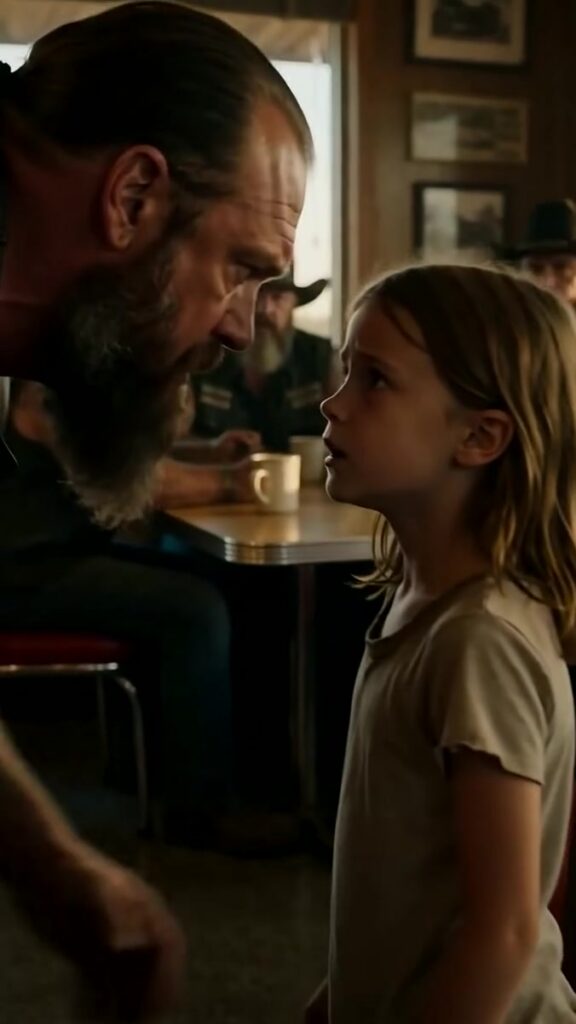
Boone turned, finally facing her. Up close, she looked six, maybe seven. Brown hair in a loose ponytail. A yellow sweater with a stain shaped like a starburst. A small scrape on her chin that had been cleaned but not comforted. She grabbed Boone’s forearm with both hands, fingers trembling, as if she could attach herself to him like a lifeline and keep from being dragged back into water.
Boone bent until his eyes were level with hers. He softened his face because he knew how fear could read even kindness as a trap. “You okay, sweetheart?” he asked, voice careful, steady.
Behind her, the man spun around too fast. His smile showed up late, pasted on. “Hey—come here. Now.” His tone was the kind adults used when they wanted obedience to sound normal.
The girl didn’t move. She lifted her mouth to Boone’s ear and whispered with the urgency of someone who had only one chance to be believed.
“That’s not my dad.”
The words didn’t echo. They didn’t need to. They landed like a weight on the counter, heavy enough to bend the air.
Boone went still. Not confused—dangerously calm. His body remembered how to become a wall. He rose slowly, not in a rush, not as a threat. He simply unfolded to full height and stepped half a pace so the girl disappeared behind the broad black of his leather vest.
Chairs scraped back like a flock taking wing. Jax stood. Milo stood. Tiny stood, and Tiny was never tiny except in name. Across the room, two other bikers rose from a corner booth, their faces neutral, their eyes sharp. Nobody reached for a weapon; nobody had to. The shape of them was a message all by itself.
The man froze at the counter. His gaze flicked to the door, then to the windows, then to the narrow gap between the grill and the wall. Calculations ran behind his eyes. Boone watched those calculations the way he watched the weather—reading the direction trouble would blow from.
“Then who are you?” Boone asked.
The man’s mouth opened. Closed. He tried another smile, wider this time, more desperate. “Look, she’s confused. Kids say things. We’re just—”
“Just what?” Boone kept his hands visible. He kept his posture loose. He kept his voice low enough that the girl behind him could hear calm in it. “Just holding her like she’s property? Just rushing her through the room like you don’t want anyone to notice?”
The waitress, Claire, had stopped by the pie case with a pot of coffee in her hands. Her knuckles were white around the handle. Boone caught her eye and gave the smallest shake of his head. Not yet. Don’t spook him. Don’t let him bolt.
The man’s gaze snapped to Boone’s cut, the patch on his back. Something ugly curled at the corner of his mouth, not quite a sneer, not quite fear. “I don’t want trouble,” he said, but the words sounded like an accusation.
“Neither do we,” Boone replied. He shifted subtly so the man couldn’t see the girl’s face. “What’s her name?”
The man hesitated. A second too long. “Lily,” he said finally, too quick, as if he’d chosen the first flower he could reach.
Behind Boone, the girl’s fingers tightened in his vest. Boone didn’t look back, but he felt the small shake of her head against him like a silent siren.
“That’s not it,” Boone said.
The man’s throat worked. His eyes darted again. Boone saw the moment the decision formed—when the plan collapsed and the animal part took over. The man’s shoulders dipped, his hand sliding toward his jacket pocket.
Boone didn’t move first. Jax did. One step, boots loud on tile in the new silence. Tiny blocked the door without looking like he’d blocked the door, just a big man shifting to stand where big men stand. Milo angled toward the window. The diner wasn’t a diner anymore.
The man cursed under his breath, not at them but at the sudden narrowness of his world. “She’s mine,” he said, and whatever he meant by mine made Boone’s stomach harden.
“No,” Boone said, voice cold now, because the line had been crossed. “She’s a child. And she asked for help.”
Claire’s hand slid under the counter. Boone heard the faint click of the phone receiver being lifted. The cook, Hector, had stepped into the doorway of the kitchen, wiping his hands on his apron, eyes locked on the man like he was watching a pot about to boil over.
The man backed toward the door, bumping into a chair. It toppled with a crash that sounded enormous in the hush. He flinched at his own noise. “You’re making a mistake,” he said, voice cracking. “You don’t know who I am.”
Boone took one slow step forward. “Doesn’t matter,” he said. “We know who she is. And we know what you’re doing.”
The man’s hand came out of his pocket holding a small folding knife, blade snapping open with a sharp metallic bite. A few people gasped, a sound like air being sucked through teeth. Boone didn’t flinch. He’d seen blades. He’d been cut. The knife was for courage, not skill.
“Back up,” the man warned, and his eyes were wild now, not calculating anymore. “Let me leave.”
Boone lifted his hands slightly, palms out. “Put it down,” he said. “Walk away without her. That’s the only leaving you’re doing.”
The girl behind him whispered something, so small Boone almost missed it. “Please,” she said, not to Boone, but to the room, to the universe, to anything that could choose mercy over violence.
Boone heard sirens in his imagination before they arrived. He heard the story the police would ask for, the details they’d need, the way the girl would be asked to repeat her fear until it became a bruise on her tongue. He also heard, underneath all of it, the thin thread of hope she’d thrown like a rope when she’d walked up to him.
“Listen to me,” Boone said to the man, voice steady as a heartbeat. “You step outside with that knife, the law will be waiting. You step toward her, you won’t make it two feet.”
The man’s gaze flicked over the bikers again. He saw, finally, what Boone had seen from the start: not a handful of men in leather, but a barrier with muscle and patience and nothing to lose by doing the right thing.
His grip wavered. The blade trembled. For one fragile moment Boone thought he might drop it.
Then the bell above the door jingled again—soft, accidental—because Tiny had shifted just enough to brush it.
The man startled at the sound, and panic did what panic always did: it chose the worst option.
He lunged.
The diner, loud a second ago, exploded into motion—boots pounding, a table scraping, Claire shouting into the phone, Boone stepping to meet the charge like a door closing. The girl stayed behind him, small and shaking, but she did not run. She had already run as far as she could. Now she clung to the only wall that had risen for her.
Outside, somewhere beyond the bright glass, the county road shimmered in the sun as if nothing in the world had changed. Inside, everything had.
And Boone, with the weight of that whisper still in his ear, made a promise without words: no one would take her from this room again.