The whole street heard the motorcycles before anyone saw them. Not a single engine, not a casual rider cutting through the neighborhood on a shortcut, but a tide—low and steady—rolling over the trimmed hedges and the parked minivans, pressing against the windows of neat houses like a storm that had decided to arrive on two wheels.
It was golden hour, when light made everything gentler than it really was. Yet the sound wasn’t gentle. It seemed to shake loose old memories from the asphalt. At first, people just paused—hands on garden hoses, grocery bags frozen mid-swing—waiting for the reason. Then the pack turned onto Alder Lane as if it belonged to them. Chrome caught the sun and threw it back in hard, bright flashes. Dust lifted in a warm ribbon. Curtains shifted in half-open windows. A dog barked once and then stopped, as if it too understood that barking would not change anything.
The motorcycles rolled down the quiet street and slowed in the same place, in front of the white house with the leaning mailbox and the porch light that never quite worked. The house looked like it always did: modest, careful, almost shy. The kind of place where time moved politely. The kind of place where the loudest thing was the evening news.
And then—silence. Not messy, not abrupt. Engines cut in disciplined sequence, and quiet fell like a sheet over the street. The sudden absence of sound made the world feel exposed.
One by one, the riders dismounted. Their boots met the pavement with the measured weight of men who knew how to stand in grief. Black leather, dark denim, faces weathered by miles and hard choices. On their backs, stitched in grim, clean thread, was the same emblem: IRON TIDES MC.
They didn’t wander. They didn’t loiter or jeer or laugh. They arranged themselves along the edge of the lawn in a line that was too straight to be accidental. Shoulder to shoulder, hands at their sides, eyes forward—still as soldiers in a ceremony nobody had invited the street to witness.
At the center, a man stepped forward alone. He was older than most of the riders, his beard cut short, his hair threaded with gray. His face looked carved from long nights. He carried a folded olive-drab Army duffel bag in both hands, cradling it with a care that made the object seem fragile as glass. He walked up the front path as if every step had to be earned.
Far down the street, a police car sat parked with its lights turning softly in the distance. No siren. No urgency. Just presence, like someone had understood this was not a scene to interrupt, only a moment to record.
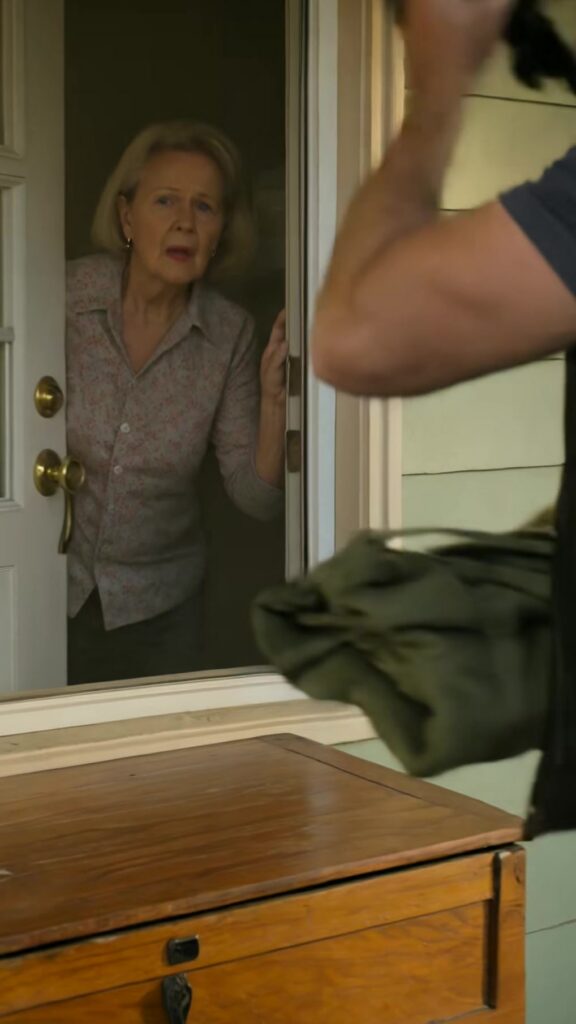
Inside the house, Eleanor Bishop watched from behind the screen door. She was seventy-four and had learned to keep her worries arranged neatly, like dishware in a cabinet. Still, the sight of so many men—so much leather, so many grim faces—made her heart stumble. She hadn’t had strangers come to her door in years. Certainly not strangers who arrived like a procession.
She opened the screen door slowly, the hinge complaining in a familiar squeak. Her hand tightened around the handle, knuckles blanching. She saw the duffel bag and didn’t understand it yet, not until the man reached the porch.
He didn’t step onto the porch with the easy entitlement of someone arriving to demand something. He paused at the bottom step as if asking permission from the house itself. Then he climbed, careful, and set the bag down on the old wooden chest Eleanor kept under the window—an heirloom that still smelled faintly of cedar even after decades.
The warm light caught what had been tucked beneath the bag’s flap: a square of cloth with the U.S. Army patch, another with the Iron Tides emblem, and the corner of a photograph folded crisp, like it had been carried in a wallet too long.
Eleanor’s breath snagged. She didn’t know why her eyes had gone straight to those patches, why her mind had filled with sand-colored images and the stale taste of worry, but her body reacted before her thoughts did.
The man removed his helmet. He had deep lines around his mouth, the kind earned by holding back words. His eyes were red-rimmed, fixed not on the bag but on Eleanor’s face. When he spoke, his voice was quiet enough that the street had to lean in to hear it.
“Mrs. Bishop,” he said, like her name was something sacred and heavy. “I’m Grant Hale.”
Eleanor’s throat tightened. She tried to remember if she’d ever met a Grant. She had not. Yet the way he said her name made it feel like he’d carried it a long time.
“I don’t know why you’re here,” she managed. “Who… who are you to my—” She couldn’t say the word. She didn’t let herself say it, because the word might make the fear real.
Grant’s jaw worked as if chewing through something bitter. “He asked us never to tell anyone.”
Eleanor felt her knees soften. The porch rail was suddenly the only thing keeping her upright. “Who?” she whispered, though she knew the answer coming would split her life down the middle.
Grant looked back over his shoulder. The line of riders didn’t move, didn’t speak. Their silence felt like a vow. Grant turned to her again, and grief sat plainly in his face. It wasn’t theatrical grief. It was the kind that had been packed down, carried, and finally brought to a doorstep because it had nowhere else to go.
“Ma’am,” he said, voice roughening, “your son died saving my life.”
The street seemed to stop breathing. Somewhere a sprinkler clicked off, the sound sharp as a snapped thread. A neighbor’s hand covered her mouth. A teenager who’d been filming lowered his phone without meaning to.
Eleanor stared at the duffel bag the way a drowning person stares at a shore they don’t believe they can reach. She had known her son was gone. The Army had told her. There had been words like accident and incident and classified and we are sorry for your loss. There had been a folded flag in her hands, a chaplain’s voice, a grave marker that looked too small to contain the boy she remembered.
But this—this bag, those patches—felt like another truth stepping out of the shadows.
“He… he wasn’t—” Eleanor’s voice broke. “They said it was quick. They said—”
Grant nodded once, hard. “They didn’t lie about that part. But they didn’t tell you who he was either. Not all of him.”
Her fingers trembled as she reached toward the photograph. The paper seemed to resist, as if it knew what it contained. She pinched the corner and pulled it free, unfolding it with care that felt like prayer.
The image was sun-faded and creased, taken under harsh light somewhere that wasn’t home. Her son—Caleb—stood in Army uniform, dust on his boots and a grin that startled her with its familiarity. Beside him stood Grant, younger in the picture but unmistakable, his arm slung around Caleb’s shoulders like family. Behind them, a wall scribbled with names, a corner of razor wire, sky bleached pale.
Eleanor’s knees nearly gave out. She grabbed the porch rail, breath coming in short, wounded pulls. “Caleb,” she whispered, and the name sounded like it came from somewhere deeper than her throat.
Grant watched her with a kind of reverence that made him look older than his years. “He didn’t want you to worry,” he said. “He didn’t want you to hear the things people would say if they knew he rode with us. He told me, ‘My mom deserves a quiet life. Let her think I’m just a soldier.’”
Eleanor’s eyes lifted from the photograph to the line of men. They stood still, but now she saw something different in them: not threat, but weight. She saw the way some of them kept their eyes lowered, as if the porch were an altar. She saw one rider clasping a set of dog tags around his fist like a rosary.
“You mean…” she began, and the sentence could not find its end.
Grant put a hand over the duffel bag, palm flat. “He was one of us before he deployed. Not in the way people imagine. He wasn’t chasing trouble. He was chasing brothers. A place where promises mean something.” Grant’s voice cracked on the last word. “He made us promise we’d never bring our world to your door.”
Eleanor hugged the photograph to her chest as if she could press it through her ribs and into her heart. “Then why now?” she asked, and the question sounded like accusation only because it had to fight past pain.
Grant’s gaze dropped to the bag. “Because the part they told you was classified is going to stay buried. Because the report will never say what he did, and that eats at me. It eats at all of us.” He swallowed. “He saved me, Mrs. Bishop. He dragged me out when everything was burning and screaming, and he made me leave. He made it an order.”
Eleanor closed her eyes, and for a moment the porch swayed under her. She saw Caleb at sixteen, too tall for the kitchen doorway, asking for seconds with that same grin. She saw him at twenty, hugging her so tightly she’d laughed and told him not to crush her. She saw him in a dress uniform, standing stiff as if that stiffness could keep her from seeing his fear.
“What’s in the bag?” she asked, though she already sensed the answer.
“His things,” Grant said gently. “The pieces they didn’t return. The pieces he wanted you to have. His letters. His patch. Some sand from where he… from where he last stood. And a recording.”
“A recording?” Eleanor’s voice was small.
Grant nodded. “He made it before the last mission. He said if anything happened, you should hear his voice without anyone else translating it.” He hesitated, then added, “I didn’t listen. I couldn’t. It felt like stealing.”
Eleanor looked at the duffel bag again. The olive-drab fabric was scuffed at the seams, marked by travel and time. It looked ordinary, like any piece of gear. But she understood now that it was a door—one that opened into a version of her son she’d never known.
On the street, the police lights continued their slow, muted turn, casting distant red-blue ripples across the pavement. The officer stayed inside his car, hands visible on the steering wheel, watching with the stillness of a man who’d been told to let grief do its work.
Eleanor drew a shaky breath and reached for the duffel bag handle. Her fingers closed around it, and the weight surprised her—not because it was heavy with objects, but because it was heavy with the life it contained.
Grant stepped back half a pace, giving her space the way someone gives space around a wound. “We’re not here to ask for anything,” he said. “We just… we needed you to know. And we needed him to come home properly. To you.”
Eleanor opened her eyes and met his. “Did he suffer?” she asked, because every mother carries that question like a stone.
Grant’s throat bobbed. “No,” he said, and the word was firm, shaped carefully. “He was scared, but he wasn’t alone. He made sure of that.” He glanced toward the line of riders. “He made sure none of us were alone.”
Eleanor stared at the men who had arrived like thunder and stood like a funeral guard. Something in her loosened—not the grief, not the loss, but the fear. She saw in their posture a kind of devotion she had not expected to find on a quiet suburban street.
“Come in,” she said suddenly, surprising even herself. Her voice trembled but held. “It’s… it’s too hot to stand out there.”
Grant looked hesitant, as if crossing the threshold would break a promise. “Ma’am, I don’t—”
“He made you brothers,” Eleanor said, tightening her grip on the bag. “And I’m his mother. That makes you—” The words failed, and she swallowed hard. “That makes you people who shouldn’t be left on the lawn.”
Grant’s eyes shone. He nodded once, sharply, like accepting an order. Behind him, the line of riders remained still, but a ripple passed through them—an almost imperceptible easing in their shoulders, as if the world had allowed them to exhale.
Eleanor stepped back and held the door open. The house behind her smelled faintly of lemon cleaner and old books, of a life that had been trying to stay ordinary. She looked down at the duffel bag one more time, the patches catching the last amber light, and understood that ordinary was no longer possible.
On the porch, the thunder had arrived. Now it was becoming something else: a reckoning, a homecoming, the beginning of the truth.