The garden luncheon was staged like a painting that wanted to be immortal. A long white table ran down the center of the lawn, linen pulled taut as drumskin, crystal catching the sun and throwing it back in bright, clean fragments. The roses were so lavish they looked indecent, tight fists of color forced open for people who never planted anything with their own hands. Even the breeze seemed rehearsed, lifting napkins and laughter just enough to make the scene feel effortless.
Everyone there had dressed for two audiences: the one at the table, and the invisible one in the cameras held at polite angles. They spoke in compliments that never landed too close to the truth. They sipped pale wine and kept their elbows tucked in, as if sharp bones might betray a hunger they’d promised themselves they’d outgrown.
At the center table sat Everett Halden, the patron saint of success, dressed in a suit that could have been poured onto him. He wore his smile the way the linen wore its whiteness—bright, pressed, and meant to convince. His wife, Celeste, had diamond light at her throat and a laugh that chimed when it was useful. Investors leaned toward Everett as if he radiated warmth. Reporters tilted their heads, listening for a line that could become a headline.
Everett raised his glass. “To the future,” he said, and the table lifted their own, a forest of stemware catching sun.
The future arrived on bare feet.
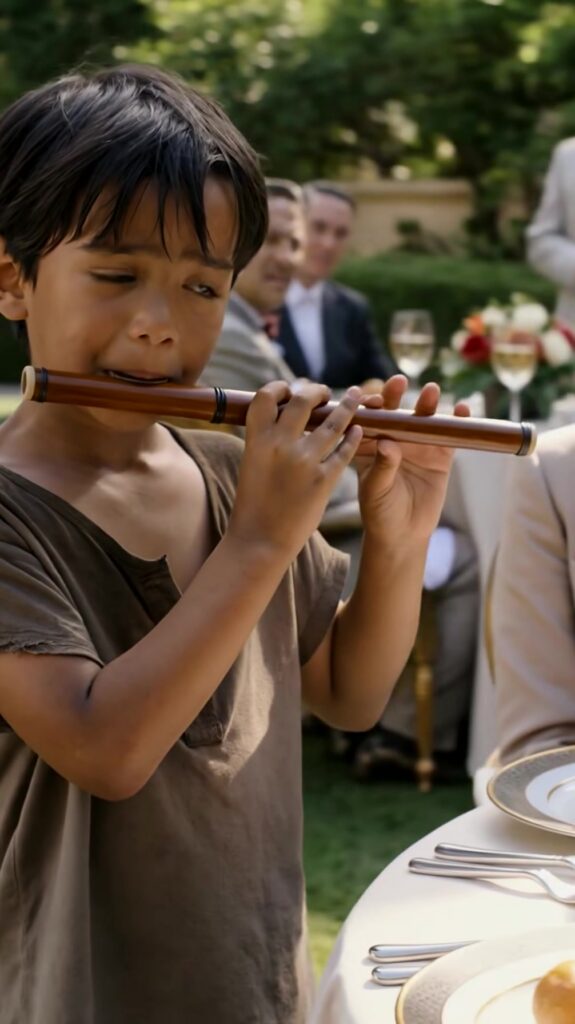
He came through the hedge opening that led to the service path, a gap meant for staff and caterers, not for anyone who looked like this. He was thin in a way that spoke of long arithmetic—too little food divided across too many days. His shirt was torn at the shoulder and clung to him with dust. His hair had been cut by necessity, uneven and blunt. In one hand he carried a small wooden flute, dark with wear, as if it had been held so often it remembered the shape of his fingers.
Conversation didn’t stop all at once; it frayed. A laugh died mid-breath. A fork hovered, uncertain. Heads turned in synchronized offense.
Everett’s eyes narrowed first with confusion, then with anger that arrived faster than pity ever could. He sat up straighter, the motion controlled, practiced. He did not look at the boy the way you look at suffering. He looked at him the way you look at a crack in glass—something dangerous because it might spread.
“Security,” Everett called, though his voice stayed smooth. “Get him out of here.”
A few guests averted their eyes as if that could absolve them. A photographer lowered his camera, suddenly aware of the wrong kind of picture. Celeste’s lips tightened into a line that could have cut.
The boy didn’t flinch. He walked to the near end of the table, stopped in the open space between chairs. He held the flute with both hands as if it were the only solid thing left in his life. His chin trembled, then steadied.
“Please,” he said. His voice was small, but it found the silence and filled it. “I need money. My mom is sick.”
Everett leaned back in his chair with a small, theatrical sigh, the kind men used when they wanted the room to join them in amusement. He let a smile curl at the edge of his mouth. “Then earn it,” he said, and his gaze flicked toward the flute. “Play.”
Someone at the far end snorted. Someone else murmured, “How charming,” without charm. Celeste’s mouth lifted in a brief smirk, as if the boy were a piece of street theater brought in to spice the afternoon.
The boy lowered his eyes. For a heartbeat he looked like he might turn and run. Then he brought the flute to his mouth.
The first note was soft. Not pretty in the polished way of concert halls, but honest, vibrating with a kind of careful grief. The melody was short—only a few measures—yet it carried the shape of a lullaby, something meant to soothe a crying child in a room where the walls were thin and the rent was late.
It drifted over the table, threading between glass stems and silver cutlery. It made the roses seem suddenly overripe. It made the laughter, the staged ease, feel like costume jewelry.
Everett’s smile faltered.
Only for a moment—so quick most people wouldn’t have noticed if they hadn’t been watching him for signs of greatness. His eyes fixed on the boy’s hands, on the way his fingers moved with familiarity and restraint. A pulse beat in Everett’s jaw.
The boy stopped before the melody could resolve. He lowered the flute. The silence after it was louder than the song itself.
He reached into his pocket and drew out an old photograph, edges softened from being handled too much, too often. He held it up with both hands.
Everett’s chair scraped the grass as he stood abruptly. He snatched the photograph with a speed that startled the table. At first his expression was pure irritation—how dare this child bring something ugly into this sacred whiteness?—and then, as his eyes found the image, his face drained of color.
In the photograph, a younger Everett stood in a doorway that looked tired. His arm was slung around a woman with a thin smile and tired eyes. In his other arm was a baby wrapped in a blanket that didn’t match.
Everett’s fingers tightened on the paper until the corners bent.
“Where did you get this?” he demanded. The smoothness was gone. His voice cracked, just slightly, in a way that made several guests look up sharply.
The boy watched him without blinking. The trembling had left his body, as if the melody had drained all the fear and left only purpose. “My mother kept it,” he said. “She said it was proof you were real. Proof she didn’t imagine you.”
Celeste stood so suddenly her chair tipped back. One of the diamonds at her throat caught the sun and flashed like a warning. “Everett,” she said, and it wasn’t a question—it was a weapon she didn’t want to lift and was being forced to anyway.
A reporter’s pen froze above a notepad. Someone’s wineglass clinked against a plate with a small, accidental sound, like a bell announcing catastrophe.
Everett’s mouth opened. Closed. He looked from the photograph to the boy, then to Celeste, as if the right order of looking might rearrange the past.
The boy drew a breath that made his ribs show beneath his shirt. When he spoke again, his voice was stronger, sharpened by years of rehearsing the words in his head. “She said you left her pregnant,” he said, “the same week you got engaged.”
The words struck the table like a dropped stone. A few guests inhaled sharply. Someone whispered, “My God.” Celeste’s hand flew to her throat, not to protect the diamonds but to keep herself from making a sound she couldn’t take back.
Everett’s eyes flicked around the faces staring at him—investors calculating risk, socialites hungry for scandal, reporters already composing sentences. His perfect world, so carefully curated, had been punctured by a boy with dust on his cheeks and a flute that remembered a lullaby.
“This is—” Everett began, but the lie wouldn’t form. The photograph in his hand was too real, the melody too precise. He had not thought the part of his life he’d sealed off could learn to knock.
Two security men appeared at the edge of the lawn, moving uncertainly, waiting for a cue. Everett didn’t look at them. His gaze stayed on the boy, who stood with his shoulders squared as if he’d borrowed strength from somewhere older than himself.
“What do you want?” Everett asked, and the question sounded like surrender disguised as irritation.
The boy held up the flute. “I wanted you to hear what you left behind,” he said. “And I want you to pay for her treatment. Not for me. For her.” His eyes glinted, not with greed but with a fierce, exhausted clarity. “Then you can go back to your clean table.”
Everett’s hand shook as he looked down at the photograph again, at the younger version of himself who still had the decency to stand in a doorway without thinking of cameras. The lawn felt suddenly too bright. The roses smelled too sweet. The linen looked like a lie.
Celeste took a step back, as if distance could protect her from the truth. “Is it true?” she whispered, and in her voice was not only betrayal but fear—fear of what their life had been built on.
Everett’s jaw worked. He could deny it and watch it become a war. He could admit it and watch everything fracture. Around him, forks rested untouched. The future he’d toasted a minute ago waited, listening.
“We can discuss this privately,” Everett said at last, but his voice had lost its command. It sounded like a man trying to bargain with a storm.
The boy shook his head once. “No,” he replied, steady and calm. “You already had private. Private is where you buried her.” He lifted his chin, eyes sweeping over the guests who had laughed. “I came here because this is where you pretend to be good.”
The luncheon had been meant for photographs. Now it was one. Faces frozen in disbelief. A man caught between past and present. A boy standing barefoot on rich grass, holding a flute like evidence.
Everett glanced toward the reporters, toward the cameras slowly rising again, and understood with a sudden, sick clarity that the boy hadn’t only asked for money. He had demanded a reckoning. And in the brutal stillness of that garden, Everett Halden—who had bought silence his whole life—realized silence was no longer for sale.
The first security man took a step forward. Everett raised a hand without looking, stopping him. The gesture was small, but it split the afternoon into before and after. The guests watched, hungry and horrified, as the man at the center table looked at the boy and, for the first time in years, saw something he could not edit out.
“Tell me her name,” Everett said quietly.
The boy’s grip tightened on the flute. “You know it,” he answered. “You just trained yourself to forget.”
And with that, the carefully staged luncheon—white linen, crystal, laughter—collapsed into something raw and unmanageable: the past, arriving uninvited, and refusing to leave.