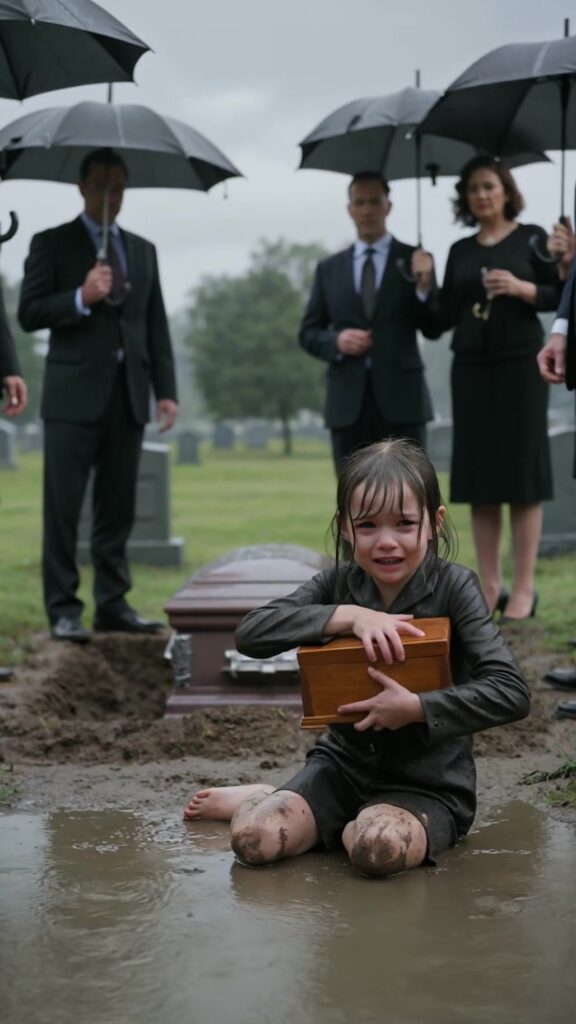
Rain stitched the afternoon into a single gray sheet, flattening the cemetery into a watercolor of umbrellas and bowed heads. The path between the headstones shone like wet slate. Somewhere beyond the iron gates a bell had tried to ring, but even that sound had died quickly, smothered by the weather and the rules of grief.
They stood in careful formation around the open grave: colleagues in black coats, neighbors who had brought casseroles, distant relatives with damp eyelashes and polite expressions. A few sobs escaped like birds and were immediately caged again. At the center of it all was Lenora Vale, the widow, her veil pinned with a pearl comb that did not tremble. One gloved hand hovered near the mahogany casket as if the whole world had been arranged for her to touch and release.
The priest spoke of sudden illnesses and noble men, of a life spent providing. The words were practiced and safe. The men who worked with Adrian Vale nodded as if the nod could substitute for understanding. Lenora’s posture remained immaculate, her chin lifted a fraction too high for someone who had lost her husband only four days earlier.
Then a ripple moved through the outer ring of mourners—a shift in umbrellas, a murmur that did not match any prayer. Someone turned. Someone else did the same. Like a flock reacting to the same unseen hawk, heads began to pivot toward the cemetery entrance.
A child was walking up the path.
She was small enough to disappear behind the gravestones, but the space she carried around her seemed larger than any adult’s. She had no umbrella. Her hair clung in dark ropes to her cheeks. Her dress—if it had ever been a dress—hung in shredded layers, soaked through and heavy, and her feet were bare on the cold stone. Mud clung to her calves as if the earth had tried to keep her.
In both hands she held an old music box, pressed flat to her chest. It was the kind that belonged in an attic: tarnished silver edges, a scratched lid, a tiny key crooked on its hinge. She clutched it like a breathing thing.
Lenora’s gaze snapped from the grave to the girl, and something passed across her face too quickly to name—an alarm that she smothered before anyone could accuse her of it. She leaned slightly toward Milton Greaves, Adrian’s business partner, who stood nearest the path.
“Don’t let her come closer,” Lenora said, her voice low but razor-sharp. “Stop that child.”
Milton hesitated the way men hesitate when a command arrives dressed as grief. Then he stepped out, raising a hand toward the approaching girl as though he were guiding traffic. “Hey, sweetheart,” he called, forcing kindness into his tone. “This is a private—”
The girl didn’t slow. Her eyes were fixed on the casket as if it were a doorway and she’d been locked out too long. She moved around Milton’s outstretched arm with a quick, sidestepping motion that did not belong to a child who was lost. She was not confused. She was coming to something.
Milton reached for her shoulder. She flinched, not away, but forward, the way someone flinches when there’s no time to be afraid. Her foot slipped on the wet grass at the edge of the gathering. The mud gave under her weight. She stumbled and dropped to her knees with a soft, ugly sound that made people gasp as if the ground had struck her on purpose.
For a moment there was only rain and breathing. Someone’s umbrella tilted to cover her, then pulled back again, unsure of whether shelter was allowed.
The girl bowed her head. Her shoulders shook. Her crying came in harsh, broken pulls, the kind that steal air and make the body small. She held the music box out in front of her, as if she were offering it to the grave itself.
“Sweetheart,” the priest began, but the word did not reach her.
With fingers that trembled violently, she found the crooked key and turned it. A metallic click snapped through the hush, bright as a match. Instead of a melody, there was a thin burst of static—then a man’s voice, softened by distance and age and some imperfect device, but unmistakably human.
“If you’re hearing this,” the voice said, “then I can’t fix it myself.”
Several heads jerked up. Milton’s hand fell away as if he’d been burned. Lenora went very still, the way a person goes still when the floor under them shifts.
The voice continued, steadier now, like a man speaking late at night when no one is supposed to listen. “My daughter… if you found the box, you did exactly what I hoped you would.”
A shiver ran through the circle of mourners. Not from the rain. From the way the word daughter had landed. Adrian Vale had no children. That was a fact Lenora had repeated with tight sadness in interviews about the foundation they planned to start. That was a fact everyone believed because it had been announced like a verdict.
The girl lifted her head. Water ran off her eyelashes. Her eyes were a dark, unwavering brown. She looked not at the priest, not at Lenora, but at the casket.
“He knew me,” she said hoarsely. Her voice was small, but it cracked the afternoon open. “He told me where to go.”
Lenora’s lips parted. The color drained from her face until her makeup sat on her skin like paint on marble. “No,” she whispered, and the word sounded less like denial than like calculation failing. “No, no…”
The recording hissed. Adrian’s voice returned, quieter, as if he had leaned closer to the microphone. “I’ve made mistakes. Some were my own, some were arranged for me. There is one thing you need to understand before anyone tries to tell you a story.”
The girl’s hands tightened around the music box. She stared at Lenora now, and in that stare was something too old for her age—an awareness of grown-up cruelty learned the hard way.
“They’ll say I left you,” the voice went on. “They’ll say you don’t exist. They’ll say you are a problem to be removed. But you are real, and you are mine. And if I am gone, it’s because someone needed me silent.”
Milton swallowed hard, his Adam’s apple bobbing. A man in the second row shifted his umbrella to hide his face. The priest’s hands, clasped around his book, trembled slightly.
Lenora took a step forward, then stopped as if an invisible line barred her. “Turn it off,” she breathed, but she did not move to do it. Her gloved hand hovered near her throat now, two fingers pressed lightly against her pulse.
“Listen,” Adrian’s recorded voice urged. “There is proof in the study, behind the portrait of my father. The code is the day you were born. If anything happens to me, you take it to someone who can’t be bought.”
The girl’s breath hitched. Tears cut clean tracks through the grime on her cheeks. She looked around at the wet faces and the polished shoes, at the adults who had come to mourn a man they did not truly know.
“He didn’t die the way they said,” she whispered, and the words felt like a stone dropped into deep water. She lifted the music box higher, so everyone could hear. “He told me to play this here. In front of everyone.”
The recording crackled again, and Adrian’s voice lowered, weighted with exhaustion. “And one more thing, my darling—if Lenora is standing beside my coffin, don’t let her touch you. Don’t let her take this from you. She will say she’s protecting the family name. She will say you’re lying. But she’s the one who—”
Static surged, drowning the sentence for a heartbeat. The girl flinched as if the noise hurt her. Then the sound cleared just enough for one final phrase to push through, broken but sharp.
“—lied about you,” the voice said.
The cemetery seemed to stop breathing. Even the rain felt quieter, as if it were listening too.
The girl rose unsteadily from her knees. Mud clung to her skin. She faced Lenora, holding the music box like a lantern. Her small shoulders were squared, not with confidence, but with necessity.
“He said you lied,” she told the widow, each word placed carefully, like a match being laid to a fuse. “He said you were the reason I couldn’t come home.”
Lenora’s composure finally cracked. It wasn’t a sob. It was a flash—her eyes widening, her jaw tightening, the faint twitch of her hand as if she might strike or snatch. For the first time, the mourners saw something beneath the elegance: a predator’s impatience, cornered in the open.
Milton took a half step toward Lenora, then stopped, torn between loyalty and fear. The priest lowered his book. Somewhere behind them, a phone camera quietly lifted above an umbrella, recording the moment the funeral stopped being a performance.
The girl looked past them all to the casket. Her voice softened, but it carried. “I’m not here to ruin him,” she said. “I’m here because he asked me to make sure you couldn’t erase me again.”
She turned the music box in her hands as if she were choosing her next breath. The rain ran down its scratched lid, washing it clean in thin, silver streams.
“There’s more,” she said. “In the study. Behind the portrait.”
And as the widow’s gloved fingers finally lifted—too late, too obvious—the girl stepped back into the ring of mourners, vanishing into the crowd that had begun, at last, to wake up.