The neighborhood had a way of pretending nothing bad ever happened. Manicured hedges, sprinklers ticking like metronomes, the smell of someone’s detergent carried on warm air. Even the sidewalk seemed designed for easy forgiveness—wide, pale concrete, chalk smears from kids who still believed in harmless worlds.
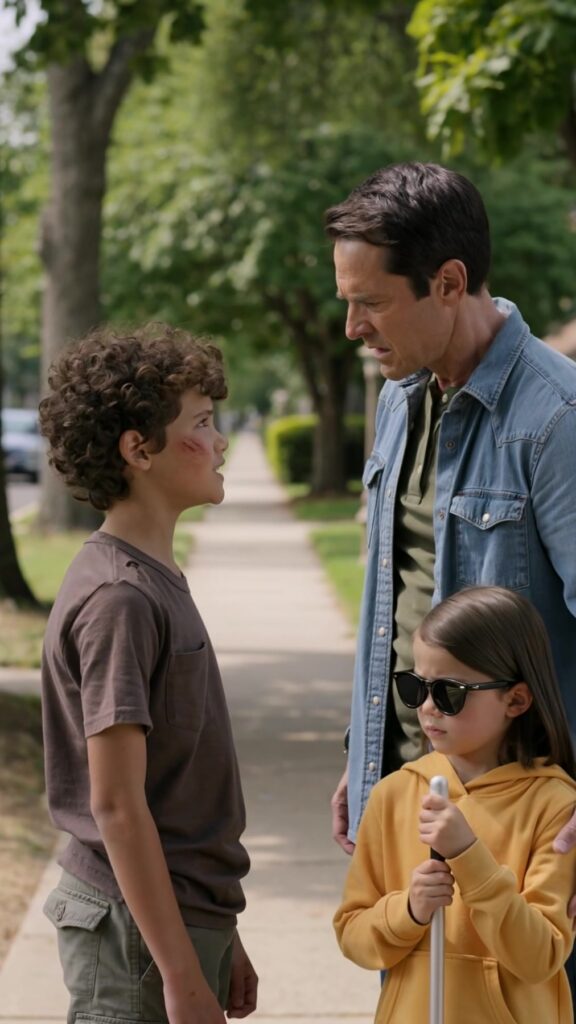
I walked it like a man walking a wire. One hand on Lily’s elbow, one eye on the curb cuts and mailboxes. My daughter moved with the careful rhythm she’d learned in therapy: tap, slide, pause. Yellow hoodie zipped to her chin despite the heat, dark glasses hiding eyes that had stopped meeting mine eleven months ago. The doctors said her vision had shut down to protect her mind. “Conversion disorder,” one specialist called it, as if giving it a name made it less like a curse.
My wife, Mara, said Lily hadn’t seen anything since the crash. She said it with the clean certainty of someone who had survived and therefore earned the right to define the story. I believed her because belief was easier than the other thing—the thought that our family was being pulled apart by something more deliberate than trauma.
That afternoon, Lily’s cane clicked a steady warning, and I tried to keep my voice light. “We’ll get ice cream,” I said. “Chocolate, like you used to.”
Her mouth didn’t change. It never did when I offered the past. She nodded because she was polite, because she was trained, because she could imitate the daughter I remembered without ever letting me reach the real one.
We were halfway down Maplecrest Lane when a figure peeled away from the shade of a sycamore and stepped into our path. A boy—maybe ten, maybe twelve—stringy hair matted against his forehead, knees scabbed, shirt stained with something that might have been mud or worse. He looked like he’d been sleeping under porches, like he’d been learning hunger as a second language.
I angled my body in front of Lily automatically. “Hey,” I said, sharp enough to send him away. “Keep moving.”
He didn’t. He stood in the middle of the sidewalk as if he owned it, eyes fixed not on me but on Lily’s face. When he spoke, his voice was calm in a way that made my skin prickle.
“She can see,” he said.
The words hit with the force of a thrown stone. Heat rushed up my neck. I took a step forward before I realized it, hand flexing like I might grab his collar and shake the audacity out of him.
“What did you say?”
He didn’t flinch. His gaze remained on my daughter’s hidden eyes. “She’s not blind,” he repeated. “She just doesn’t want to look at you.”
For a moment, the street felt staged—too bright, too still. Even the sprinklers seemed to pause their soft hiss. Lily’s hands tightened around her cane until her fingers blanched, the plastic handle creaking faintly.
“You don’t know anything about my daughter,” I said, voice low. “Get out of our way.”
The boy’s mouth twitched, not quite a smile. “Ask your wife,” he said. “Ask her why she tells you what to believe.”
My anger stalled, replaced by a cold, heavy sensation that spread through my ribs. Mara. The crash. The police report I’d skimmed and then folded away because reading it felt like reliving my brother’s funeral. The neat conclusion: speed, wet pavement, a tragic loss of control. The kind of story that lets people move on.
“Who are you?” I demanded.
He blinked once, slow. “Someone who was there when your family decided what the truth would be.”
Lily made a sound then—thin, trapped. Not a sob. Not a gasp. Like a breath caught behind a locked door.
I turned to her, my heart suddenly pounding hard enough to ache. “Lily? Honey, what is he talking about?”
She stood rigid, chin tucked. Her glasses reflected the clean suburban sky, turning her into a stranger.
The boy took a step closer, and I realized with a jolt that his eyes were too old for his face. Not wise. Worn. The look of a kid who’d learned how quickly adults could rewrite reality.
“You think he did it,” the boy said to Lily softly, as if coaxing a frightened animal. “You think he took your uncle away.”
I felt my stomach lurch. “No one thinks that,” I said, too fast. “It was an accident.”
The boy’s attention snapped to me. “Was it?” he asked. “Or was it what she told everyone because the other story would ruin her?”
Lily’s cane tip scraped the concrete, a nervous half-step. I watched her shoulders rise as she breathed, each inhale shallow and quick.
“Stop,” I said, though I didn’t know who I was speaking to—him, myself, the moment. “If you want money, I don’t—”
“I don’t want money,” the boy interrupted. He dug into the pocket of his cargo shorts and pulled out something small that caught the sun.
A pink hair clip, shaped like a butterfly with a missing rhinestone on one wing.
The world narrowed. That clip had been part of Lily like freckles—always in her hair, holding back a stubborn strand. She’d worn it the day of the crash. Mara had sworn it was lost somewhere between the impact and the emergency crews, a detail I’d accepted because grief makes you accept strange gaps.
Lily’s breath hitched. The sound was unmistakably recognition.
“Where did you get that?” I asked. My voice sounded far away, as if I were shouting down a well.
The boy held the clip between thumb and forefinger. “It fell under the seat,” he said. “When she leaned forward.”
“When who leaned forward?”
He looked at Lily again. “When your mother climbed over,” he said quietly. “When she switched places before anyone came.”
The street tilted. I had to plant my feet to keep from swaying. Images tried to assemble in my mind—Mara’s scraped knuckles she couldn’t explain, the faint bruise across her collarbone that didn’t match the seatbelt line she described, the way she’d insisted on speaking to the police alone while I sat with Lily and listened to sirens.
“That’s a lie,” I said, but the words came out thin.
The boy’s gaze didn’t move. “Your brother was driving,” he said. “Then he wasn’t. And she needed you to believe the version where you’d never look at her the way Lily does.”
My chest tightened as if something inside it was trying to claw out. “How would you know?”
“Because I was the one who found the clip.” His voice softened, and for the first time I heard something beneath the steadiness—fear, buried deep. “Because I was watching from the bike trail. I saw her pull the girl’s hood up. Not to keep her warm. To cover her eyes.”
Lily trembled. The tremor ran from her shoulders to her hands, vibrating the cane. She lifted her head slightly, and for one terrible second I thought she might look at me through the glasses.
She didn’t. Instead she spoke, and the sound of her voice—unused, strained—was like glass bending.
“He was screaming,” she whispered. “Uncle Ben was screaming.”
I sucked in air. My throat burned.
“Lily,” I said, barely able to form her name. “Why didn’t you tell me?”
Her fingers slipped from the cane and curled into fists at her sides. “Because she said you’d leave,” she said. “She said you’d hate her. She said you’d hate me.”
Mara’s voice echoed in my mind—soft, convincing. We have to protect Lily. We have to keep the story simple. She can’t handle the details. You can’t handle the details.
The boy extended the hair clip toward me, arm steady. “You keep asking why she won’t see you,” he said. “It’s because when she opened her eyes, you were holding her mother like nothing happened. And she didn’t know how to make you look at the right person.”
I reached for the clip with fingers that wouldn’t stop shaking. Plastic met skin. The butterfly’s broken wing bit into my palm.
Lily turned her face slightly toward me—not fully, not yet. Her mouth tightened as if she were trying to hold herself together by force alone.
“Dad,” she said. “I didn’t go blind. I just… I just couldn’t watch you love her after what she did.”
The quiet street filled suddenly with sound I’d ignored: a distant lawnmower, a dog barking behind a fence, the soft rush of blood in my ears. Ordinary life continuing around a truth that had been sitting in our home like a covered mirror.
I looked at my daughter—at the glasses, the hoodie, the cane—and understood with a sick clarity that her blindness had been a wall, not a wound. A wall between her and a father who kept standing on the wrong side of the accident.
Behind us, somewhere far too close, a car door slammed. I didn’t need to turn to know who it was. I felt Mara’s presence the way you feel a storm coming: pressure dropping, air changing, breath shortening.
The filthy boy stepped back into the shade as if he’d delivered a message and did not intend to be caught holding it. Before he vanished behind the sycamore, he said one last thing, barely louder than the sprinklers.
“You can’t unsee it,” he murmured. “That’s why she made your daughter pretend she couldn’t.”
Lily’s hand found my sleeve, hesitant, small. It was the first time she’d reached for me in months. Her grip was not forgiveness. It was an anchor.
I held the broken butterfly clip in my fist and faced the sound behind us, knowing the sidewalk would never be quiet again, and that the next step I took would not be about ice cream or normalcy or pretending.
It would be about choosing which truth I could live with—and which lie I was finally ready to let die.