The harbor wore its silence like a shroud. Fog rolled in low and thick, crawling over rusted bollards and the black mouths of empty warehouses, swallowing every light that tried to keep it at bay. Beyond the breakwater the sea made no sound anyone could trust; even the gulls had abandoned the night. It was the kind of cold that didn’t bite so much as settle into the bones and wait.
At the end of Pier Nine, where the planks were slick with salt and old oil, a fire burned in a dented steel drum. Five men sat around it with their backs to the water as if they expected it to climb out and take a seat. Leather and denim, chain and steel, helmets on the boards beside them like trophies. Their bikes were lined up in a row, dark hulks with chrome that caught the firelight and turned it into sharp knives.
Everyone in the harbor district knew them, even if they pretended not to. The Dock Dogs. That was what people called them when they dared to speak. It wasn’t a name the men used, but it stuck because the docks belonged to them in the way a yard belongs to the thing that has marked it.
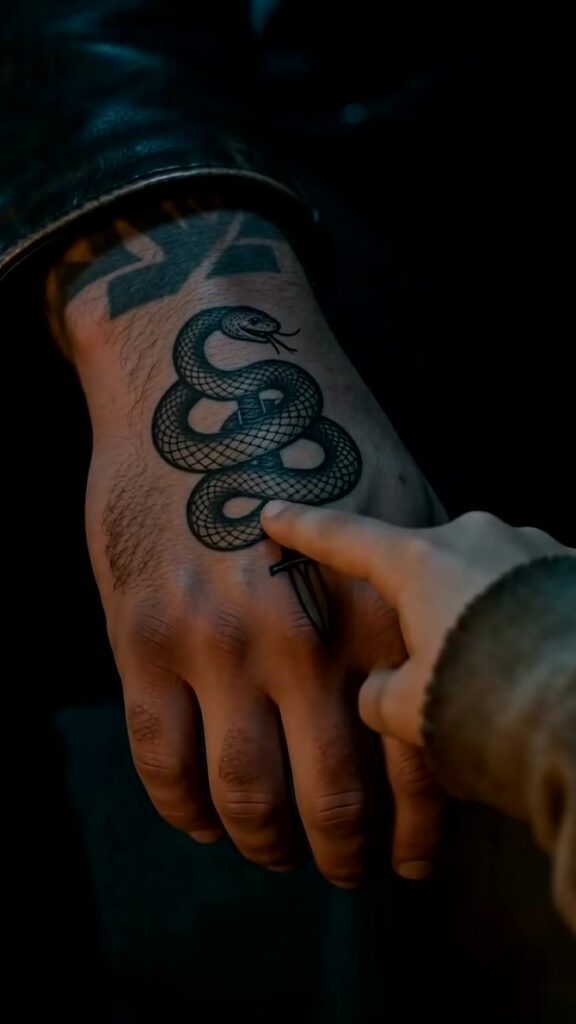
Marcus sat closest to the barrel. He wasn’t the biggest; he didn’t have to be. He had a kind of stillness that made the others orbit him, a gravity that didn’t announce itself. The fire painted his face in restless orange, revealing the old scar on his jaw and the ink that crawled up his neck—an anchor wrapped in a serpent, the tail disappearing under his collar. When he moved, the tattoo shifted like it was alive.
“Fog’s thick,” one of the men muttered, rubbing his hands. He was called Lyle, all elbows and nervous energy, his eyes flicking toward the shadows between warehouses.
“Fog’s good,” said another, Cain, who always sounded amused even when he wasn’t. “Keeps the honest ones home.”
Marcus didn’t answer. He stared into the drum as if the flames were telling him something in a language only he could hear. The docks had their own noises—metal clinks and distant engines—but tonight even those seemed softened, muffled by the cold breath of the sea.
That was why the footsteps caught them: a soft, steady tapping on wet wood. Not the heavy stride of a drunk sailor or the hurried scuttle of a runner. Something lighter. Something that didn’t belong.
Lyle turned first, shoulders tightening. “Marcus… something’s wrong.” The words came out almost like a confession.
The others looked. At the edge of the fog, where the pier met the yawning dark of the harbor road, a shape formed. It took on edges slowly, as if the world was reluctant to admit it was there.
A child.
She walked without hurry, her small boots making careful sounds on the boards. The firelight reached for her and found dirty clothes hanging loose on a frame too thin for the cold—an oversized sweater stained at the cuffs, a skirt that had lost its hem, leggings torn at one knee. Her hair was tangled, damp from the fog, stuck in clumps against her cheeks. Yet her shoulders were squared. She came straight toward the barrel as if she knew exactly where she was going.
No one spoke. In the distance, a buoy bell rang once and then fell quiet again.
Cain let out a low chuckle that died before it found air. “Kid’s lost.”
“Or bait,” said Juno, the only one of them with a voice that stayed sharp. His hand slid under his jacket as if the motion was part of breathing.
Marcus watched her with eyes that didn’t blink. “Let her come,” he said, quiet as the water.
She did. Closer. Closer.
The heat of the fire touched her face and showed what the fog had hidden: smudges on her chin, a faint bruise blooming yellow along her temple, and eyes too clear for the rest of her—dark, steady, and fixed on Marcus like a compass needle.
She stopped right in front of him. The men were suddenly aware of their own size, their boots, their blades, the weight of their reputations pressed against a small body that did not retreat.
Marcus leaned forward, elbows on his knees. The fire lit the tattoo on his neck, the anchor and the serpent. He waited for fear to arrive. It didn’t.
The girl’s hand rose slowly. Not shaking. Not pleading. One finger extended and pointed at the ink on Marcus’s skin.
Silence tightened around them like a rope.
“My father had this,” she said. The words were quiet, but they didn’t vanish into the fog. They landed.
Lyle’s breath caught. Cain’s grin vanished as if someone had slapped it off. Juno’s hand froze under his jacket, uncertain whether to pull steel or keep it sheathed.
Marcus didn’t move for a beat too long. Something like annoyance crossed his face first, then something else he fought to hide. “Yeah?” he said, voice level. “And?”
The girl’s eyes shimmered in the firelight. Tears gathered, making them brighter, but she didn’t wipe them away. She didn’t look down. Her chin lifted a fraction, and her voice hardened until it sounded older than her face.
“He told me what you did to him.”
The fog seemed to lean in, hungry.
Marcus’s gaze flicked, just once, to the others. Cain shifted, boots scraping the boards. Lyle stared at the fire as if it might provide an exit. Juno’s jaw tightened until a muscle jumped near his temple. The fifth man, Rook, who seldom spoke and never laughed, lowered his eyes.
Marcus leaned closer, and the firelight carved deep shadows under his brow. “Name,” he said. It wasn’t a question. It was a command he was used to seeing obeyed.
The girl drew in a breath that trembled in her chest. “Nell.” She swallowed. “Nell Barron.”
That name did something to Marcus. It passed over his face like a shadow from a passing ship. The harbor was full of ghosts, but only some had names.
“Barron,” Cain murmured, almost to himself. “No way.”
Marcus ignored him. His voice stayed steady, but the steadiness had effort now. “You’re alone?”
“I was,” Nell said. “Until I found you.”
“Found me,” Marcus repeated softly, and there was a note in it that wasn’t amusement. “You walked into the Dogs’ fire like you owned the pier.”
Nell’s finger remained pointed, unwavering, at the anchor wrapped in a serpent. “He said it was a promise,” she said. “A promise you all made when you were younger. He said it meant you’d never turn on each other.”
Rook’s head lifted a fraction. The fire popped, a small explosion of sparks that rose and died in the fog.
“Your father talk a lot,” Marcus said. “Dead men talk plenty when they’re not dead. Is he dead?”
For the first time, Nell’s mouth trembled. “Not dead,” she answered, and the relief in the words made her tears spill. “Not yet.”
Marcus’s eyes narrowed. “Where is he?”
“He’s under the old net loft,” Nell said. “Where the floor is rotten. Where nobody goes.” She spoke like she’d rehearsed the directions until they became a spell. “He can’t walk. His leg… his leg is wrong.” Her voice cracked and then, with visible effort, she sealed it again. “He said you would know. He said if I showed you the tattoo, you’d understand.”
Marcus’s throat worked. He looked away for half a second, toward the water. The fog made the harbor lights look like distant candles at a funeral.
Cain spoke, rough now. “Marcus, that was years ago.”
Marcus didn’t answer Cain. He looked back at Nell. “What did he tell you I did?”
Nell’s tears kept falling, but her gaze did not blur. “He said you left him,” she said. “He said you watched while they broke him, and you didn’t stop it.” Her finger shifted, not accusing, but certain. “He said you let the serpent eat the anchor.”
The phrase hit like a punch. Juno’s eyes widened, recognizing it as something private, something spoken only among those who had once sworn oaths with blood on a pier just like this one.
Marcus’s hands clenched so hard his knuckles shone pale. For a moment, the fire seemed too small to hold what rose in him. “Who,” he asked quietly, “is ‘they’?”
Nell’s finger finally dropped. She reached into the pocket of her oversized sweater. The men tensed as one, expecting a weapon, a trick. What she pulled out was smaller than any blade: a folded scrap of paper, edges softened by sweat and worry. She held it out to Marcus.
He didn’t take it right away. Then he did, slowly, as if it might burn. He unfolded it with fingers that suddenly looked less like fists.
On the paper was a list of names, written in a hand that had shaken and then steadied through pain. Five names.
Marcus. Cain. Juno. Lyle. Rook.
And beneath them, one more name scratched so deeply the paper nearly tore: ELIAS.
Marcus stared at it until the firelight caught the wetness at the corner of his eye. When he spoke, his voice was different—lower, stripped of its practiced cruelty. “Your father,” he said slowly, “is Elias Barron.”
Nell nodded once. “He said you’d pretend you didn’t remember,” she replied, and there was no childlike softness in it. “He told me you would, because it’s easier to forget when you’re the one who walked away.”
Behind Marcus, the harbor groaned. Somewhere in the fog, a ship shifted against its moorings like a giant turning in its sleep.
Marcus stood. The sudden movement made the others flinch. He towered over Nell, but his shadow did not swallow her. He looked at the list again, then at the child in front of him like she was an apparition the sea had returned.
“How did you get past the yard?” Juno asked, suspicion cracking his composure. “There are men at the gate.”
Nell’s mouth curved, not into a smile, but into something like grim knowledge. “They let me through,” she said. “Because they’re not your men anymore.”
That landed even harder than the name.
Marcus’s eyes snapped up. “What did you see?”
Nell pointed past the fire, past the bikes, toward the warehouses swallowed by fog. “Lights,” she whispered. “In the net loft. Men with radios. And someone laughing like it was a game.” She blinked tears away at last, smearing dirt across her cheek. “My father said there’s a reason you live at the edge of the harbor. He said it’s because you’re scared of what’s buried in the middle.”
Marcus’s jaw tightened. His gaze moved from one biker to the next. “Elias was one of us,” he said, and it sounded like he was reminding himself as much as them. “He wore the ink. He swore the oath.”
Cain exhaled. “We all did.”
Marcus looked down at Nell. “If you’re lying,” he said, the old menace rising out of habit, “you’ll regret it.”
Nell’s voice came out steady again, a knife wrapped in a child’s throat. “If I’m lying,” she replied, “then go back to your fire and let him die. But if I’m not… you’re already too late.”
The fog pressed in, cold and wet. The fire crackled like it was listening. Marcus stared at the small girl who had walked into a legend without fear, and something in him shifted—the kind of shift that happens when a man realizes the past has finally found his door.
He folded the paper carefully, like it mattered. Then he shrugged off his jacket and draped it over Nell’s shoulders. Not gently. Not cruelly. Just decisively, as if making a choice before he could reconsider.
“Get on my bike,” he said.
Nell hesitated only long enough to look up at him. “You’re going to him?”
Marcus’s eyes were hard, but there was a fracture in that hardness now, a glimpse of something older and raw. “I’m going to what I should’ve done the first time,” he said. He glanced at the others, voice turning into steel again. “Dogs. Move.”
The five dangerous bikers rose as one, shadows stretching long across the pier. Their engines didn’t roar yet. They waited, listening, as if the harbor itself might object.
Nell climbed onto Marcus’s bike, small hands gripping the leather strap on the seat. She leaned forward into the fog, not away from it.
Marcus swung his leg over, started the engine, and the silence of the harbor broke at last—not with laughter, but with the low growl of machines heading toward whatever waited in the rotten net loft, where a promise had been betrayed and a child had come to collect the debt.
Behind them, the fire in the barrel guttered and flared, as if trying to decide whether to die or follow.