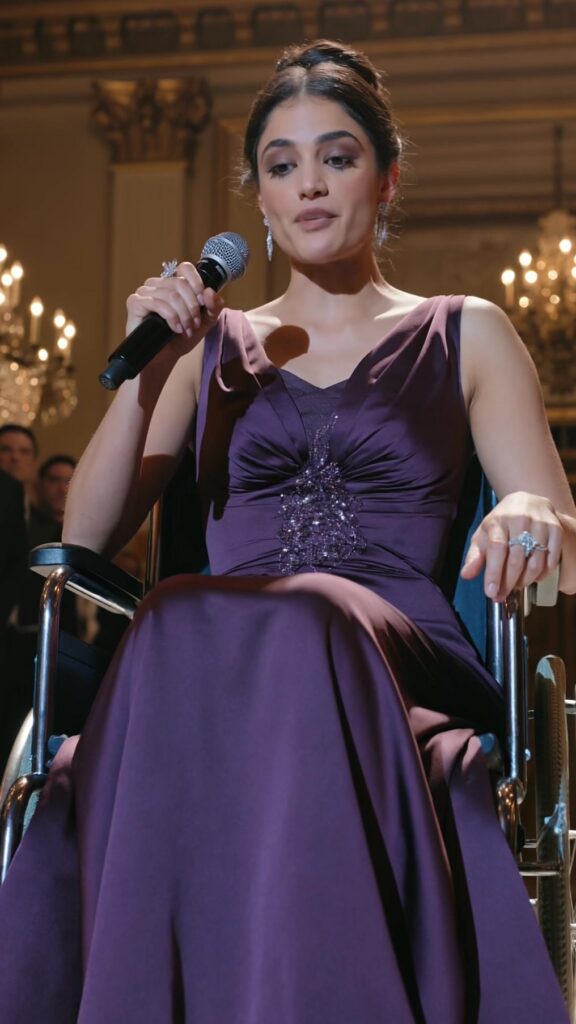
The chandeliers scattered light like shards of ice across the ballroom, turning every diamond, every polished cufflink, every smile into something sharp. A string quartet played too softly for anyone to admit they were listening. The kind of music chosen not for beauty, but for camouflage—something to hide the sound of secrets being swallowed.
Clara sat on the dais where the podium had been moved to accommodate her chair. Deep purple fabric pooled over her knees like spilled ink, and the microphone rested close enough to catch her breath if she chose to offer it. She did not. Her hands were still, her posture deliberate, as if every angle of her body had been planned to remind the room that she belonged there. Not as a symbol. As a decision.
Below the platform, on the marble steps where brides posed for photos and heirs posed for power, Everett Halden knelt with his head bowed. His tuxedo fit like a promise, black and expensive, the kind of suit that suggested he had never been denied anything and had never forgiven the world for implying he might be.
He lifted his face toward her with the careful expression of a man who had rehearsed remorse in a mirror. His mouth parted as if the air itself were an accusation.
“Clara,” he said, and his voice shook.
Not with love. With a fear so old and familiar it had shaped his entire life: the terror of being seen.
The front tables—bankers, attorneys, donors—fell into that watchful silence the wealthy perfected early. They had come expecting a coronation. Everett had ensured their expectations. Ten minutes ago his lawyer had already circulated the talking points: a transition of leadership, smooth and inevitable, with Everett at the center like a well-tailored fact.
Then Clara rolled onto the dais with the board behind her and the voting proxies stacked neatly on her lap, and inevitability became a thing that could bleed.
Everett’s hands trembled as they hovered over the step, not quite touching the marble, as if even the floor might reject him. “Please,” he said. “We don’t have to do this like… like this. Not in front of everyone.”
Clara leaned forward slightly. The movement was small, but it drew the room inward. They had all heard stories about Clara after the accident—how she had “withdrawn,” how she had “struggled,” how she had “chosen privacy.” Their words had been soft and sympathetic, the way people spoke when they wanted tragedy to stay decorative, distant, and quiet.
Clara’s voice came out even and clear. “You don’t want it in front of everyone,” she said, “because everyone is the only witness you respect.”
A murmur rippled like a disturbed surface of water. Everett flinched, then smoothed his expression again, reaching for that practiced gentleness that had once undone her.
It had been in a hospital room years ago, when the smell of antiseptic and flowers had mixed into something nauseating. She had been learning how to breathe with pain. He had sat on the edge of her bed, kissed her knuckles, and looked at her with eyes full of sorrow that turned out to be self-pity.
“I need someone easier,” he had whispered. “Just for a while. Until things settle. Until people stop… looking.”
As if her body had been a scandal. As if her survival had been an inconvenience.
The hardest part had not been the lost sensation, the months of physical therapy, the humiliations of relearning ordinary tasks. The hardest part had been the clean way he walked away while promising he was doing it for both of them. He made her absence sound like kindness.
So Clara vanished. Or rather, she let society believe she had. She stopped appearing at the events where he needed a flawless partner. She stopped answering calls from friends who were not brave enough to be loyal. She let the gossip settle like dust over her name.
In the quiet he mistook for defeat, she built.
She learned how the company truly worked—where the signatures mattered, which board member feared which scandal, what debts had been hidden in polite accounting. She rebuilt her own network, not through champagne and handshakes, but through patient conversations, favors remembered, and documents requested one by one until the picture became undeniable.
On the dais, she reached down and lifted a folder from her lap. Cream-colored, heavy-stock, sealed with a crest Everett had always treated like a holy symbol. Succession documents. Private, supposedly untouched.
Everett’s face emptied of color. His eyes fixed on the seal as if it were a blade.
“Those are locked,” he breathed, too softly for most of the room—but not for the microphones, not for the recorders, not for the moment that would be replayed later by people who pretended they had always doubted him.
Clara’s fingers broke the seal with no ceremony. “You told them I was too broken to lead,” she said, and her gaze swept the room. “You told them I was unstable. You told them I would embarrass the brand.”
The word brand tasted bitter, but she let it stand. They all understood that language. It was the dialect of erasure.
“So,” Clara continued, “I brought proof of what you did while you thought I was gone.”
She opened the folder and turned the first page outward, angled so the front row could see. For a heartbeat, the room struggled to understand. Then recognition flared in a dozen faces: a marriage certificate. Dated six months after Clara’s accident. Signed. Filed. Official.
Everett’s throat worked as if he were swallowing glass. “That’s—”
Clara did not let him finish. “You married Lydia Cross,” she said, naming the woman who sat three tables away, spine rigid in a silver gown. Lydia’s smile had already fallen apart. Her hands clutched her clutch like a flotation device.
It was not the marriage alone that made the room inhale. It was the contradiction. The lie. Everett had sold his single-hero narrative to every investor who loved a clean story: the devoted partner cast aside by tragedy, forced to shoulder an empire alone.
Clara turned another page. “And then,” she said, “you hid her, because marrying a lobbyist’s daughter without disclosure violates the board’s conflict policy.”
Another page: emails. Another: bank transfers. Another: a contract awarding a consulting retainer to Lydia’s firm with a signature that was not authorized. Clara’s voice stayed calm, but the room began to feel like it was tilting.
Everett rose from his knees in a sudden, desperate motion, reaching for the podium as if he could physically block her words. Security shifted. Board members stood. The quartet stopped mid-bow, their silence an unplanned drumbeat.
“Clara,” Everett pleaded, and now the tremor in his voice finally carried something like panic. “Listen. I can fix this. We can— we can settle. I’ll give you—”
“No,” Clara said, and it was the simplest word in the world, delivered like a verdict.
She lifted her gaze to the crowd. “He thought kneeling in front of me would save him,” she said. “Because he believed I wanted an apology more than I wanted truth.”
Clara’s hand moved to a second stack on her lap—voting proxies, each one signed, notarized, gathered with the patience of someone who had stopped believing in mercy. “Some women,” she added, “do not dream of apologies.”
Everett’s eyes flicked to the board, searching for allies. He found faces carefully arranged into neutrality, because neutrality was how powerful people survived other people’s downfalls.
Clara leaned toward the microphone, and the sound carried cleanly to every corner of the room. “By the authority granted to me as majority proxy holder,” she said, “I call the vote. Effective immediately, Everett Halden is removed as acting chairman.”
A few gasps escaped despite the discipline of money. Lydia made a small sound—half protest, half sob—but no one moved to comfort her. Comfort was expensive; it was reserved for those still useful.
Everett stood frozen, his hands curled at his sides. His kneeling had been meant to be theater, a performance of humility to rewrite the narrative. But Clara had written a different script, one where the audience mattered and the stage lights did not soften edges.
He took a step toward her. “You’re doing this because you hate me,” he whispered, and there it was at last: the insult masquerading as insight, the belief that her actions could only be emotional, never strategic.
Clara regarded him with a stillness that felt older than this room, older than their shared history. “I’m doing this,” she said, “because you built your life on the idea that my suffering was less important than your comfort.”
She slid the folder to the board secretary, who accepted it like a live wire. Then Clara turned her chair slightly, aligning herself with the room rather than with him.
“You asked me to disappear,” she said, her voice lowering. “You were ashamed of what I looked like beside you. You wanted a woman who wouldn’t remind your friends that bodies break.”
Everett’s face twisted, and for a second the polished mask slipped. “I was trying to protect—”
“Yourself,” Clara finished.
Security stepped in, not touching him yet, but forming a polite wall that contained his options. Everett looked past them, around them, as if searching for the world he used to command. But the room had already reoriented. Power always did, quick as a flock turning.
Clara’s final words were not shouted. They did not need to be. “This is not revenge,” she said. “It’s accounting.”
And then, as the board began the formalities and the murmurs rose into something hungry, Clara rolled back from the microphone—steady, unhurried—leaving Everett standing alone on the marble steps where he had knelt, discovering too late that humility performed for escape was not the same as responsibility accepted for truth.