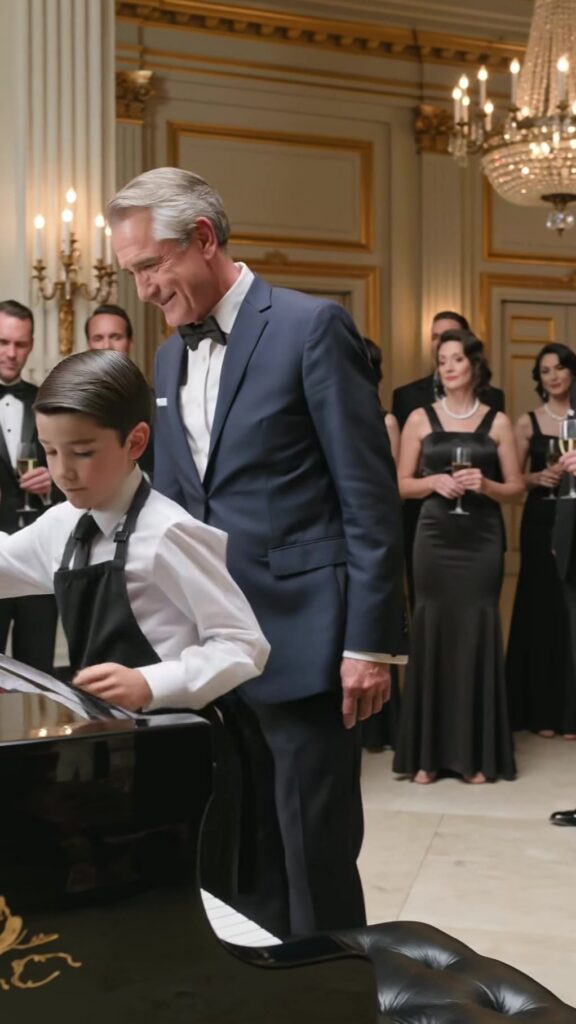
The waiter’s son was never supposed to touch the piano. In the Marrow House ballroom, that rule wasn’t posted on a sign, but it lived in the air—stitched into the velvet drapes, sealed in the polished marble, and enforced with looks sharper than any knife in the kitchen.
Silas felt it the moment he crossed the threshold with his father’s tray balanced on one palm. He was fourteen, thin as a reed, dressed in borrowed formalwear that smelled faintly of starch and someone else’s cologne. His black apron hid the tremor in his legs as he threaded between gowns that whispered like surf and tuxedos that stood like barricades.
No one saw him. That was the bargain of the uniform: you got to walk through glittering rooms untouched, so long as you agreed to be invisible. People accepted champagne from his tray without meeting his eyes. A man laughed too loudly at his own joke. A woman tilted her bracelet-heavy wrist to check a watch that cost more than the building Silas lived in.
At the far end of the room waited the piano—black, glossy, imperial. It sat under the chandelier as if crowned, its lid propped open like a mouth ready to sing. Silas tried not to look. He had learned to keep his longing quiet, the way some people learn to keep prayers quiet. But the piano pulled at him like gravity.
He remembered its twin from a different life—his mother’s battered upright in a rented room above a bakery, where sugar and yeast mixed with the smell of old wood. She had kept the window cracked even in winter, insisting that music needed air. “Don’t play for applause,” she used to tell him. “Play because you can’t keep the sound inside you.”
Then she disappeared, and his father stopped speaking her name. The upright was sold. Silas learned to carry trays and swallow questions. Music became something he held in his body, fingertips remembering what they weren’t allowed to touch.
Tonight, his father was working the other side of the ballroom, face set in the careful blankness of someone who couldn’t afford mistakes. Silas had been told—softly, once—that the piano was off-limits. Not because it would break, but because the room would. “Don’t,” his father had said. One word, heavy as a lock.
Silas told himself he was only walking past. But when he came level with the piano, he felt a presence beside it: an older man in a navy suit, hair silvered at the temples, standing with the stillness of someone listening to something no one else could hear. He wasn’t laughing. He wasn’t talking. His gaze rested on the keys as if they were a grave he visited too often.
Silas stopped. The tray on his palm suddenly felt enormous, as if its weight were made of all the things he hadn’t said in years.
“Sir,” Silas heard himself ask, voice low and polite, “may I play?”
The silver-haired man blinked as if brought out of a dream. Around them, the room’s noise swelled—clinking glass, soft gossip, a burst of laughter—and then, inexplicably, dulled. The nearest guests turned their heads with mild amusement, the way people turn toward a small disaster they expect to be entertaining.
For a heartbeat the man seemed ready to refuse. Then his mouth curled into a thin, indulgent smile. He lifted a hand in casual permission, like tossing a coin to a street performer. “If you’d like,” he said, as if granting Silas a harmless moment.
Silas set the tray down on a side table, careful not to rattle the glasses. He sat on the bench. It was colder than he expected, slick under him. His shoes didn’t quite reach the pedals the way they should; he adjusted, sliding forward, spine straight. His hands hovered above the keys, trembling, and then stilled as if they belonged to someone older.
He didn’t choose a simple melody. He couldn’t. The music that had haunted him came with teeth.
His fingers fell.
The first notes cut clean through the ballroom like a thrown blade. The sound was not loud, but it was absolute—bright and merciless, each tone placed with terrifying precision. Conversation snapped off mid-syllable. A glass halted halfway to a man’s lips. Someone near the dance floor turned so abruptly the champagne in her flute shivered to the rim.
Silas played fast, but not in the sloppy sprint of a child showing off. He played like someone unlocking a door he had been forced to stare at for years. The melody surged, split, returned, twisted into dizzying variations. It was beautiful in the way storms were beautiful—impossible to ignore, impossible to control.
In the piano’s polished lid, the chandelier’s crystals quivered with each vibration, turning the light into wavering shards. Guests stared as if their wealth had failed them, as if money could purchase every kind of excellence until the moment it couldn’t.
Silas did not look up. He didn’t need to. He could feel the room rearranging itself around him. He could feel the gaze of his father somewhere in the crowd like heat against his skin. He could feel, too, the silver-haired man beside the piano—feel him shifting closer, breath catching in broken rhythms.
Because this music was not a party piece. It was a map.
It was a composition Silas should never have known. It lived in his bones because his mother had played it in their small room with the cracked window, not as performance but as confession. She never wrote it down. She never taught it directly. She simply played it again and again, and Silas’s hands, hungry, had stolen it from the air.
The older man’s face drained of color. His eyes widened, fixed on Silas’s moving hands as if watching a ghost take shape. He mouthed something without sound. When the music turned a corner—into the brutal, dazzling section that felt like climbing while bleeding—his lips parted and a tremor ran through him.
He recognized it. Not just the skill. The exact wound of the notes.
Silas struck the final chord and held it until it thinned into silence.
The ballroom did not applaud. Applause belonged to entertainment. This was something else. The quiet that followed was not politeness; it was shock, like the hush after a gunshot when no one knows who has been hit.
Silas lifted his hands from the keys and stared at them, as if expecting blood. He felt hollowed out, as though the song had taken something it had been owed for years.
Then the silver-haired man stepped forward. His composure—so carefully built, so expensive-looking—fractured. Tears stood in his eyes, unshed and shining. His voice, when it came, was barely more than breath.
“I’ve been looking,” he said, and the words sounded like they had been trapped behind his ribs for a decade. “I’ve been looking for you.”
Silas blinked, startled. “You… you know that piece?”
The man’s throat moved as he swallowed. He glanced at the guests as if they were suddenly very far away. “I wrote it,” he said. “For her.”
Silas felt the room tilt. “For my mother?” he asked, though he didn’t know why he believed it. The name of his mother, the shape of her absence, had become too heavy for strangers to touch.
The man nodded once, as if the motion cost him. “She played it in private,” he whispered. “Only once, before she vanished. There was a child then. I was told the child didn’t survive.” His gaze locked on Silas’s face with an intensity that felt like fingers gripping a bruise. “But you are here.”
A sound cracked through the silence—glass shattering on the marble.
Across the room, the staff supervisor—Ms. Corvin, all pinched mouth and iron posture—stood with a tray at her feet, plates and stemware scattered like casualties. Her expression was not astonishment. It was terror, raw and unmasked. She stared at Silas as if he had just spoken a forbidden name in a church.
In a rush that made her respectable shoes skid, she crossed the ballroom, grabbed Silas by the arm, and yanked him from the bench. Her grip was painfully tight, fingers digging in like claws.
“No more,” she hissed, voice broken. “We’re leaving. Now.”
Silas stumbled, confused. “What are you doing?”
Ms. Corvin’s eyes flicked to the silver-haired man, then to the watchers gathering courage to speak. Her lips trembled as she leaned close enough for only Silas to hear. “He cannot know who you are,” she whispered. “If he knows, they will come. And this house has buried worse than music.”
Silas felt his father’s hand clamp onto his other arm—firm, desperate, protective. His father’s face was ashen, eyes pleading without words. Somewhere behind them, the silver-haired man said Silas’s mother’s name—softly, like a prayer or a summons.
Silas let himself be pulled toward the service corridor, the ballroom’s glitter receding as if it had been a dream. Over his shoulder, he saw the piano under the chandelier, lid still open, waiting.
The boy who was never supposed to touch it had just awakened something that had been asleep on purpose.
And as the door swung shut, sealing off the stunned silence, Silas realized the final chord had not ended the song at all.
It had started it.