On the day the heat turned the cobblestones soft in the mind, the cart looked like a painted promise: stripes of mint and strawberry, a brass bell that chimed like laughter, a plastic canopy bleached by seasons. It stood at the edge of Market Street where the tourists drifted, following maps and appetites, while the town’s own children learned which windows were meant for them and which were not.
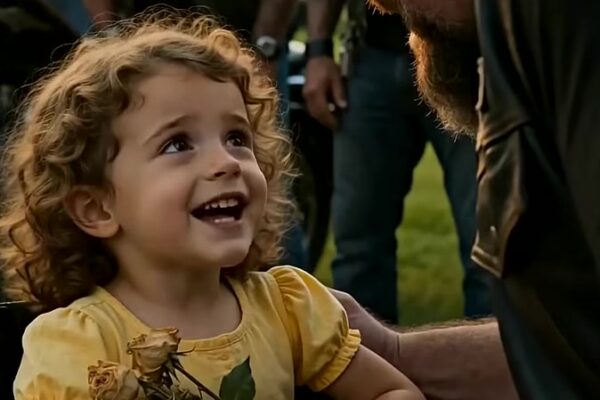
The girl came barefoot, not because she liked the feel of stone but because shoes were the kind of thing that vanished first when a family was always moving. Her dress had once been yellow; now it was the color of tired paper. The wind worried at her hair until it fell like a curtain over her face, and she pushed it away with the back of her hand as if she were used to being told to step aside.
She didn’t speak. She only looked at the menu board with its pictures of swirls and sprinkles, at the glass jars of wafer sticks, at the pale coins in the tip tray that gleamed like small suns. Hunger has a way of making a child’s gaze too steady, too old. It can turn a simple want into an accusation she never meant to make.
The vendor—young then, with forearms browned by summer and a smile he wore like a uniform—caught her staring. He’d learned to read faces. He knew the look of children who had money clenched in their fist, ready to order; he knew the look of children who had been sent by parents as an errand; and he knew, with a heaviness in his chest, the look of children who were only passing through desire on their way to disappointment.
“Hey,” he said gently, bending a little so his shadow didn’t swallow her. “What flavor do you like?”
She flinched at being addressed, as if spoken to was itself a kind of danger. Her eyes flicked down to the ground, then up again. “I… I don’t need any.” It was the lie she’d practiced.
He opened the freezer, and the cold breathed out like relief. “Everyone needs something when it’s this hot.” He pretended to study his inventory, as though choosing for himself. In truth, his mind was calculating: how much mix he had left, how many cones in the sleeve, how close he was to closing time and the thin supper he’d planned—just bread, maybe.
He pulled a cone and filled it with a spiral so tall it leaned, absurd and triumphant. He crowned it with a cherry he’d been saving for customers who tipped well.
When he held it out, the girl didn’t take it. Her hands hovered halfway, stopping short, fingers curling inward like they’d been trained to retreat.
“It’s yours,” he said. “A gift.”
Something in her face broke—surprise, and something like shame that kindness could exist without a price. She accepted it carefully, as if she expected it to vanish the moment her skin touched it. The first lick made her close her eyes. Relief washed through her so plainly it hurt to witness.
“Thank you,” she whispered. And then, as if she were signing a contract with the universe, she added, “One day I’ll pay you back.”
He laughed because it was easier than admitting he believed her. Adults laugh at promises they can’t imagine fitting into the world’s shape. “Just enjoy it,” he told her, and he watched her walk away with her treasure, white streaking her wrist, cherry-red on her tongue.
By the next morning, he had a line again, a child tugging a father’s sleeve, a couple arguing over whether pistachio tasted like soap. He thought of the girl once, briefly, when he saw a smear of melted vanilla near the curb. But summer has its own cruel rhythm: each day demands attention like a debtor. By noon, she was gone from his mind.
She was not gone from hers.
Years unfolded like receipts—thin, endless, stained. The town changed. Chains arrived with glossy signs and cartoon mascots, and people began to treat ice cream like something that came from a freezer aisle rather than a man with tired eyes and a cart he pushed uphill. The vendor’s smile stayed, but it grew practiced. His hands got rougher. He learned how quickly joy could be priced out of a street.
Then the summers got harder. Rain came when it wasn’t supposed to. Heat came too fast, then disappeared. Rent for the storage space rose. Insurance rose. The milk supplier demanded payment up front. He tried promotions, extra toppings, brighter umbrellas. He worked longer hours until his back ached and his wrists burned from twisting cones. Still, the line dwindled, the coins in the tray fewer each week.
He began selling pieces of his life to keep the cart rolling—first the old radio he listened to at night, then his father’s watch, then the ring he’d once imagined giving someone he no longer spoke to. Pride is a currency that empties silently.
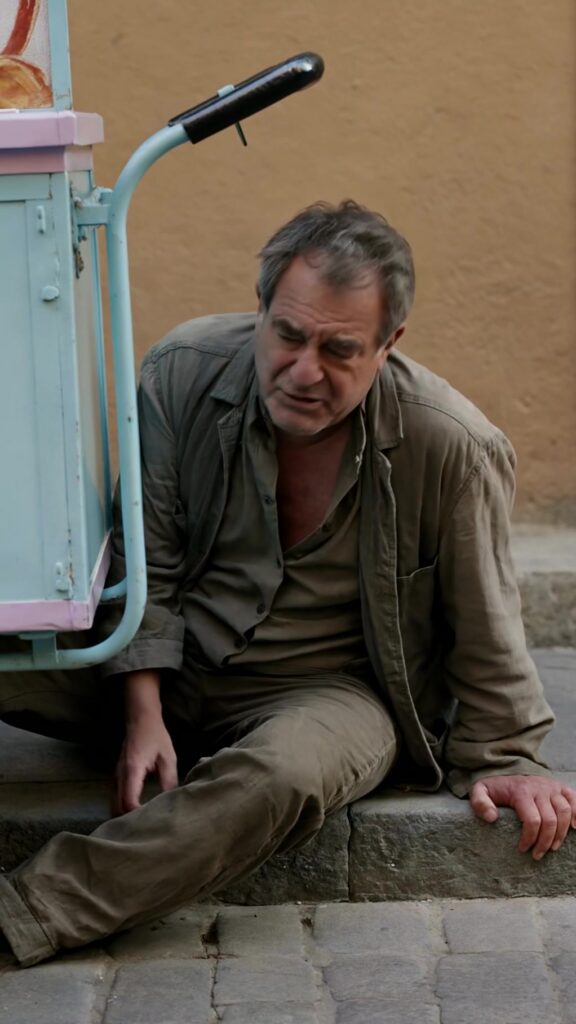
By early autumn, when the air smelled of wet leaves and the tourists thinned to locals with errands, he sat beside his cart like a man waiting to be erased. He had counted his debts so many times the numbers had turned unreal. He had made calls that went unanswered. He had written letters that came back stamped with polite rejection.
When a friend stopped by—one of the last people who still asked how he was rather than what he sold—the vendor didn’t have the strength for lies.
“It’s over,” he admitted, voice rough as sugar crystals. “I’m bankrupt. They’ll take the cart. Then I don’t know… I don’t know where I’ll sleep.”
The street swallowed the words and carried them away, down alleys, past storefronts, into the indifferent afternoon. He didn’t notice the black sedan easing to a stop two streets away. He didn’t see the woman inside it go utterly still, phone at her ear, gaze fixed on the pastel canopy as if she were looking at a ghost that had suddenly remembered her name.
“Say that again,” she said quietly into the phone. Her voice wasn’t soft from gentleness but from control, the kind that holds back a storm.
When the answer came, her eyes sharpened, the way a knife catches light. “He went bankrupt,” she repeated, tasting the words like something bitter. She ended the call without goodbye and stared through the windshield at the small figure slumped beside the cart.
Not pity rose in her. Decision did.
“Turn around,” she told the driver. “Right now.”
Twenty minutes later, the sedan returned and parked close enough that passersby turned their heads. The vendor looked up reflexively, already bracing for the kind of wealthy customer who asked for discounts as if it were a joke. He tried to stand, embarrassed by his own sagging posture, by the cart’s chipped paint, by his hands that smelled faintly of old vanilla no matter how often he washed them.
Footsteps approached—measured, unhurried, expensive. The woman who came into view wore a deep blue suit that fit like authority. Her hair was pinned neatly, her face composed, but her eyes were not calm. They held a tremor, as if something in her was struggling not to run.
“Sir,” she said, and the title sounded strange—formal, respectful, as if she were the one approaching a monument. “May I have a moment?”
He nodded, unsure, throat tight. “Of course. If you want something, I…” He gestured weakly to the menu, to flavors he knew she probably didn’t care about.
“I don’t need a menu,” she replied. She opened her handbag and placed a folded napkin on the cart’s counter like an offering.
It was old, the paper softened and yellowed, the edges frayed from being held too often. He stared at it, confused. Napkins were everywhere; they came and went like customers. Why would anyone save one?
Her fingers trembled slightly as she nudged it toward him. “Please,” she said. “Open it.”
He unfolded the brittle paper slowly. Inside, a flake of hardened sugar clung like a fossil. And beneath it, in faded ink, was a line written in uneven, determined handwriting—childish, but fierce in its intent.
One day I’ll pay you back.
The vendor’s breath caught as if the air had turned to ice. His hands began to shake, not from cold but from the sudden weight of memory pressing down all at once. A barefoot girl. A faded dress. Eyes too old. A promise whispered over melting vanilla.
He looked up, searching the woman’s face. Time had changed her features, smoothed some edges and sharpened others, but in the shape of her mouth, in the way her eyes held stubborn light, recognition sparked. His lips parted, soundless.
She tried to smile, but tears rose anyway, quick and hot, spilling past the composure she wore like armor. “Do you remember the little girl who couldn’t afford ice cream?” she asked.
He swallowed hard. “I… I remember.” His voice came out broken. “I didn’t—” He stopped, because what could he confess? That by the next day he’d forgotten her face in the rush of life? That he’d given away kindness the way people toss bread to birds, never expecting the sky to answer back?
“You gave her the last cone you had that afternoon,” the woman said, her words steady even as her eyes shone. “I didn’t understand it then. I only knew I’d never tasted anything so sweet.”
The vendor stared, breath trembling. The street seemed to tilt. “It was just… a cone,” he whispered, as if saying it small could keep the moment from crushing him.
“No,” she said, and her voice sharpened with a grief she’d carried for years. “It wasn’t.” She leaned closer, lowering her tone as if sharing a secret meant only for him. “After I walked away, you closed early because you didn’t have enough to buy dinner for yourself.”
The vendor’s eyes widened. Shame surged up his throat. He remembered the empty cash box, the ache in his stomach he’d tried to ignore, the long walk home pretending the evening air was enough. He remembered telling himself it was fine, that he was still young, that a missed meal was nothing.
He hadn’t known someone had seen. He hadn’t known someone had counted the cost.
“How…” he began, but the question scattered. How had she found him? How had she carried this scrap of paper through storms and years?
She straightened, wiping a tear with the side of her hand, and the gesture made her suddenly look younger, like the child she’d been. “Because when you’re forgotten by the world,” she said, “you learn to remember every person who refuses to treat you as invisible.”
She reached into her bag again and pulled out a thick envelope, then another. Documents. A contract. A check that made his vision blur when he saw the amount.
“I run a company now,” she said. “Not because life was kind. Because I was stubborn. And because that day, you proved kindness could exist even when you were hungry.” She placed the papers carefully on the counter, beside the old napkin, as if arranging evidence in a trial. “Your debts are paid. The cart is yours, and it will stay yours. If you want, we can restore it—new equipment, new permits, everything. No loans. No traps.”
The vendor shook his head in disbelief, a sound escaping him that was half laugh, half sob. “I don’t deserve this.”
“You do,” she replied, not loudly, but with a force that left no room for argument. “And I’m not doing this because I’m generous.” She held his gaze, tears still bright. “I’m doing it because I keep my promises.”
For a moment, the street noise faded—the distant engine hum, the murmur of pedestrians, the rustle of leaves skittering along stone. There was only the cart, the napkin, the woman in blue, and the man who had once traded his dinner for a child’s relief and then let the memory slip away with the next day’s heat.
He bowed his head, and when he spoke, his voice was raw with the years he’d spent thinking his life amounted to nothing more than melted sweetness and empty cups. “I forgot you,” he confessed. “By the next day… I forgot.”
Her smile trembled, but it held. “I didn’t,” she said. “Not for a single night.”
She picked up the bell attached to the cart’s handle and rang it once. The bright note cut through the air like a beginning. People turned. A child tugged at her mother’s sleeve. A couple slowed. The vendor looked up, startled, as if the sound had called him back into the world.
“Open,” she told him, gently but firmly. “Not for me. For them. For you.”
His hands, still shaking, reached for the cone sleeves. The motion was familiar as breath. He felt something inside him—small, stubborn—refuse to disappear.
And as the first customer stepped forward, the vendor understood, with a sudden ache, that forgetting was never the end of a story. Sometimes it was only the middle, waiting for the day a promise returned to collect its due.