The bell above the jewelry store door gave a tired, reluctant chime, as if even metal was weary of announcing new trouble. Outside, the streetlights bled into puddles and the rain stitched the night together in frantic, slanted lines. The woman who stepped in looked like the storm had been trailing her from town to town, refusing to let her dry.
Her gray hoodie clung to her shoulders, heavy and darkened by water. Her jeans were ripped at one knee, and the rip had frayed into a white, trembling fringe. Her hair hung in ropes, dripping onto the polished tile. She did not browse. She did not glance at the velvet trays or the wedding rings that sat like tiny promises behind glass. She walked straight to the counter as if she hated the route but had memorized it anyway.
Eli Mercer looked up from a repair he’d been pretending to focus on. He ran the only jewelry store in three blocks of this fading downtown—half the shops were vacant now, their windows papered over like eyes that refused to witness anything else. Eli had made a trade of carefulness. Gems, metal, and measurements. Control. Yet his own hands were never steady when the rain came, because rain always reminded him of sirens and wet asphalt and a child’s mitten on a roadside curb.
The woman didn’t introduce herself. She placed a necklace on the counter, the chain pooling like liquid gold. At its center rested a locket, oval and old-fashioned, engraved with faint vines. It was too elegant for her. Too clean against the ruin of her clothes, as though it had been kept safe in a pocket pressed close to a heart.
“How much will you give me for this?” Her voice was flat from exhaustion, as if she had run out of the energy required for pride.
Eli barely met her eyes at first. He had learned not to stare at desperation; people mistook attention for hope, and hope had a way of turning ugly when it didn’t pay out. He took the necklace between thumb and forefinger and lifted it toward the light. The gold was real. Not plated. The hinge on the locket was older work, better than most of what came through his door these days.
“Fifty,” he said, defaulting to caution. Defaulting to distance. “That’s what I can do.”
She stared at the locket as if it were a mouth refusing to speak. Her hands hovered near the counter, fingers trembling, then curled into fists. For one brief moment, Eli thought she might snatch it back and flee. Instead she swallowed and nodded once, a motion so small it seemed more like surrender than agreement.
“Okay,” she said. “Deal.”
Eli reached into the register, counted bills, slid them across. The transaction should have ended there—one more quiet exchange of value for need, one more item that would be cleaned, priced, and displayed beneath warm lights to be bought by someone with dry sleeves. But something about the locket—its weight, its familiar curve—made Eli’s hand hesitate. He didn’t mean to pry. He told himself he was checking for a maker’s mark, verifying the condition. The truth was simpler and stranger: he wanted to see what someone like her kept that close to their chest.
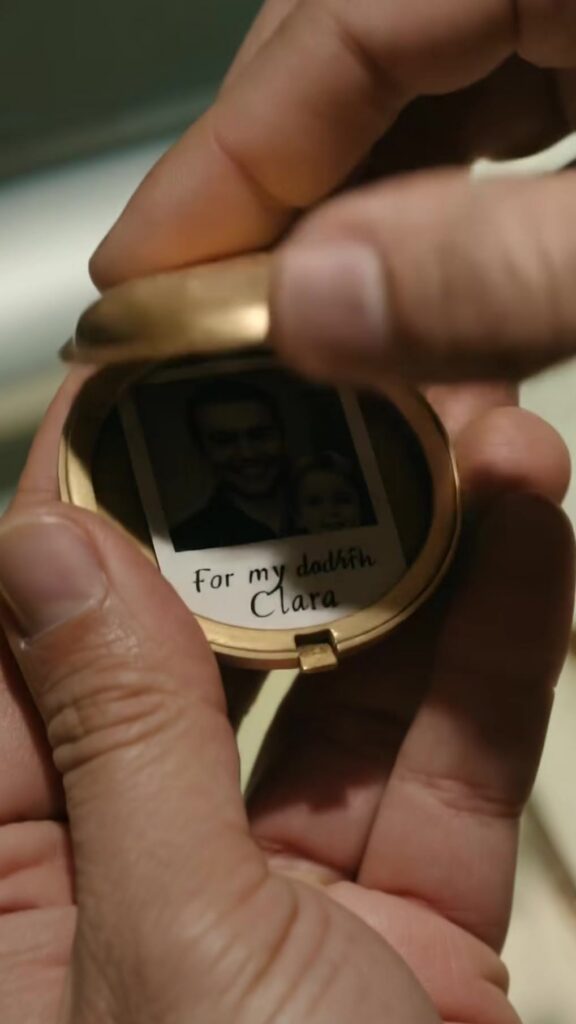
He pressed the tiny catch. The locket opened with a soft click that sounded like a locked room yielding.
Inside was a photograph, old and slightly blurred, the colors faded into the gentle bruises of time. A man with a crooked smile held a little girl on his hip. The girl’s hair was tied into two uneven pigtails. She grinned at the camera with the reckless confidence of someone who believed the world was built to keep her safe.
Beneath the photo, the engraving had worn but not vanished: For my daughter, Clara.
The store’s hum—its lights, its quiet music from a radio in the back—seemed to drop away. Eli’s lungs refused air. His vision narrowed until there was only that name, carved into gold he had once chosen with care.
He had paid for that inscription himself.
His fingers went numb around the locket. A memory surged so sharp he tasted it: Clara at eight years old, begging him to let her wear the necklace to school even though it was “for special occasions.” Her laughter as he fastened it around her neck. “So you’ll always know it’s me,” she’d said, tapping the locket with a solemn little finger.
Then the rainy night. The overturned car at the intersection. His own voice shouting her name into the downpour until his throat tore. The months after, the flyers, the candlelight vigils, the police who slowly stopped calling. The way the world accepted her absence with infuriating ease.
Eli looked up, his eyes stinging. “Where did you get this?”
The woman had already folded the money into her pocket with automatic precision. She turned toward the door as if she could outrun questions the way she hadn’t been able to outrun the weather. Eli’s chair scraped back. He came out from behind the counter too fast, bumping his hip on the edge. The bell over the door shook as she pushed it open, and the rain breathed in like a waiting animal.
“That necklace—” Eli’s voice cracked. He didn’t care how he sounded. “It belongs to my daughter. She’s missing. That locket— I had it made.”
She froze on the threshold, rain already threading through her hair again, darkening the fabric of her hoodie as if the storm claimed her the instant she stepped outside. For a heartbeat she didn’t turn around. Her shoulders tightened, and Eli saw something pass through her posture—a decision, a calculation, a fear.
When she finally faced him, water ran down her cheeks in streams so steady it was impossible to tell what was rain and what wasn’t. Her eyes weren’t confused. They weren’t guilty in the way thieves sometimes were, all bravado and excuses.
They were terrified.
“If Clara is your daughter,” she said, each word dragged out as if it cut her tongue, “then why did she make me promise never to bring this back to you?”
Eli’s blood went cold in a way no winter could manage. “She… what?”
The woman glanced down the sidewalk as if expecting someone to step out of the dark and close a hand around her throat. Cars hissed by, their tires whispering over wet pavement. The street smelled of soaked leaves and old oil. She lifted her chin, forcing herself to meet Eli’s stare.
“I didn’t steal it,” she said quickly. “I swear to you, I didn’t. She gave it to me.”
“When?” Eli demanded. He stepped closer, rain splashing up onto his shoes. “Where is she?”
The woman’s breath hitched. “Not here. Not safe. And if you make me say it out loud in the street, you’ll get her killed.”
Eli clutched the open locket so tightly its edge bit into his palm. “My daughter has been gone for nine years. If you know where she is—” His voice failed him. “If you’ve seen her, you don’t get to walk away.”
She flinched at the word walk, like she’d walked away from too many burning buildings. “You think I want to?” she whispered. “You think I came in there because I wanted to sell the last clean thing she ever touched?”
Eli stared at her, trying to fit her into a story that made sense. She didn’t look like a criminal mastermind. She looked like a person who had been held underwater and released only long enough to gasp. Yet she had his daughter’s locket. She knew Clara’s name without being told. And she carried the kind of fear that came from someone who had seen what happened when promises were broken.
“Tell me,” Eli said, lower now, forcing steadiness the way he forced it when setting stones. “Who are you?”
The woman hesitated, then spoke as if she were stepping onto thin ice. “My name is Mara.”
She glanced back toward the shop window, where warm light spilled into the rain like a lie about safety. “Clara saved my life,” Mara said. “And in exchange, she made me swear I’d never lead you to her. Not because she hates you—” Mara’s voice shook. “Because she thinks you’re the only thing they can use to find her.”
Eli’s chest tightened until it was hard to breathe. “They?”
Mara nodded once, a miserable motion. “People who don’t lose what they take. People who keep it.” She swallowed, and her gaze flickered to the locket in Eli’s hand. “She told me if I ever got desperate enough to sell it, it meant the end was close. For me.”
Eli’s mind raced, stitching fragments into something horrifying. Nine years of silence. A girl who grew up somewhere hidden, somewhere controlled. A promise designed not to protect Eli from pain—but to protect Clara from anyone who could be turned into a leash.
“Why come to me?” Eli asked, though he suspected the answer.
Mara’s mouth trembled. “Because I ran out of things to sell,” she said, barely audible beneath the rain. “And because I think they’re looking for me now. I didn’t know the locket was yours until you opened it. But when I saw your face…” She took a shaky breath. “I think maybe the promise wasn’t meant to last forever. I think maybe Clara wanted a door left unlocked. Just in case.”
Eli closed the locket with a click that sounded like a verdict. He looked at Mara—soaked, shaking, hunted—and realized she hadn’t come to his store for money alone. She had come because the story was reaching its breaking point, and she was dragging what little truth she had left into the light.
“Come inside,” Eli said, voice rough. “Now. We don’t do this in the open.”
Mara didn’t move. “If I step back in,” she whispered, “and you call the police—”
“I’m not calling anyone,” Eli snapped, then softened, because he heard how wild he sounded. “Not yet. Not until I understand. Not until I can keep her safe.” He held out the locket like an oath. “You brought me the only proof I’ve had in almost a decade. Whatever this is, Mara… you’re not carrying it alone anymore.”
For a moment, the rain seemed to hesitate, as if even the storm leaned in to listen. Mara stared at Eli, measuring him, searching for the smallest sign of betrayal. Then she stepped backward into the pool of warm light spilling from the store, leaving the night’s teeth just outside the door.
When the bell chimed again, it sounded less like an announcement and more like the beginning of a confession.