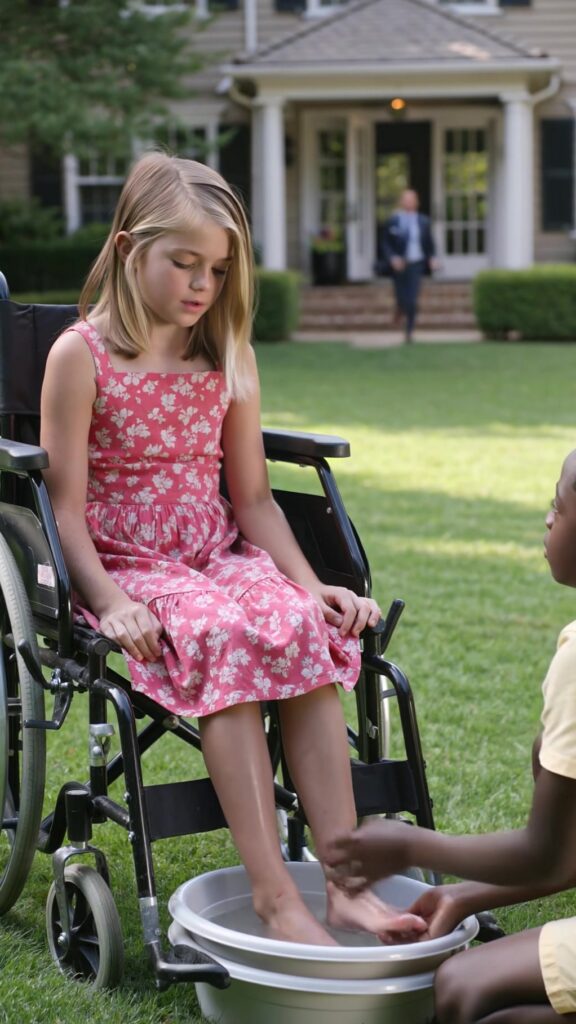
The first person to make her feet move again was not a doctor. It wasn’t the neurologist with the careful hands and the rehearsed sympathy, nor the physical therapist who spoke in milestones and fractions of inches. It wasn’t the surgeon who drew diagrams that looked like tidy little promises. It was a barefoot boy kneeling in the grass, a plastic basin between his knees, speaking as if calm were a tool he’d learned to use.
Harper sat in her wheelchair where her father had rolled her out, the late afternoon gilding the yard in a kind of beauty that felt like mockery. The lawn was bright and trimmed; the hydrangeas stood like cloudbanks along the fence. There were wind chimes on the porch, and they rang softly whenever the breeze shifted—as if the house were trying to sound cheerful over the weight inside it.
Her feet, pale and still, rested on the footplates. She stared at them with the disoriented certainty that they belonged to someone else. She knew every freckle, every faint scar. She could describe the shape of her toes the way you remember a childhood bedroom. Yet they were distant now, as if the space between mind and body had been replaced by glass.
“Harper,” her father had said, voice tightened by months of effort, “I know it’s strange. But I want you to try. Just… try.”
Try was what everyone asked for. Try was a word with edges. Try was what he said when he thought he might lose her in slow motion.
She had wanted to refuse. She had wanted to scream at the sky, at the porch, at the neat garden that didn’t deserve to look so alive. But then the boy had stepped forward, barefoot and serious, his yellow shirt faded by sun and soap. He carried the basin like it mattered, like it held something fragile.
He didn’t introduce himself with a handshake or a grin. He simply set the basin down on the grass beside her chair and poured warm water from a kettle her father had brought out, steam rising in thin, trembling sheets.
“My name’s Eli,” he said. The words were plain. Then, as though he were repeating something someone had told him, he added, “You don’t have to be brave the way adults mean it. Just let me do one thing.”
Harper’s father hovered behind her, unsure whether to stop it or to bless it. He had the look of a man who would hand his heart to anyone who asked, if it might help his daughter.
Eli dipped his hands into the basin, tested the temperature, and then lifted Harper’s foot with careful gentleness. He didn’t treat it like a broken object. He treated it like a sleeping thing.
As he washed, his fingers moved with a practiced rhythm—press, circle, release. Warmth traveled up her ankle, not as a sudden spark but as a slow insistence. The water rippled milky gold under the sun. The whole world, for a moment, seemed to narrow to the basin and the boy’s hands and the fact that he wasn’t afraid of touching her.
“Don’t panic if you feel anything,” Eli said quietly. “It can come like a wave. You don’t fight waves. You let them pass.”
Harper swallowed. Her throat felt tight, as if hope itself were something that could choke you. “Doctors told me it’s… complicated,” she managed.
“Complicated isn’t the same as impossible,” Eli replied. He didn’t say it like a slogan. He said it like a verdict.
Her father made a sound—half laugh, half sob—then pressed his hand over his mouth, as if he might spill something out that would scare the moment away.
Eli continued, thumbs pressing into the arch, fingers kneading along the tendon above the heel. Harper watched, hypnotized. She expected nothing. That was the safest way to live now: expect nothing, and you won’t have to mourn it.
Then, without warning, her big toe shifted.
It wasn’t dramatic. It was a small twitch, a shy movement like the first stir of a leaf after winter. But Harper felt it. She felt it from the inside, not just as something seen. A thread tugged, and some silent part of her answered.
She gasped, air scraping her lungs. “Wait.”
Eli didn’t look surprised. He didn’t smile. He only nodded once, as if the world had behaved exactly as he expected it to.
Harper’s eyes flooded. “I— I felt that. I felt… something. It’s different.”
Behind her, a chair scraped on the patio. Her father’s footsteps thudded across the lawn, faster than Harper had heard him move since the accident. In the corner of her vision she saw him coming, navy suit jacket flapping open, tie loosened like he’d forgotten how to breathe.
“Harper?” he called, voice breaking. “Harper, what did you—”
Eli raised his hand slightly, a small gesture that stopped him more effectively than any command. “Let her watch,” he said, still calm. “If everyone talks at once, it scares the body. It thinks it’s in danger.”
Danger. Harper had lived inside that word for months. She’d felt it in the hospital lights, in the cold metallic taste of imaging gel, in the pity disguised as optimism. Her body had learned danger and held it like a lesson.
Eli lowered his hands into the basin again. The water was cloudy now, skin warmed into it. His fingers swept the bottom as though searching for something. Then he lifted a thin silver clasp from beneath the surface, water streaming from it in shining threads.
Harper froze. The clasp was delicate, hinged, with a tiny engraved swirl on the inside. She knew it the way you know a name you’ve tried to forget.
It had been hers once—before the accident, before the hospital, before the months of “try.” An ankle bracelet her mother had given her on her thirteenth birthday, the last gift before her mother vanished from their lives like a curtain pulled shut. Harper had mourned it in a quiet, secret way. She had searched for it after the crash and never found it, assuming it had been lost with everything else.
“Where did you get that?” Harper whispered. The bracelet trembled in Eli’s wet palm. It looked too real to be here, in this yard, in this moment.
Eli’s gaze finally lifted to hers. His eyes were the color of river stones. “You dropped it,” he said. “Not on the road. Not in the wreck. You dropped it somewhere else. Somewhere you thought you couldn’t go back to.”
Her father stopped a few feet away, breath ragged. His face had gone ashen. “Eli,” he said, and Harper heard something new in his voice—recognition sharpened into fear. “What are you doing here?”
Harper looked from the boy to her father. The yard tilted slightly, as if the world were trying to rearrange itself around a truth she hadn’t been told.
Eli didn’t answer right away. He turned the clasp so the engraving flashed in the sun: a small spiral, the same symbol Harper’s mother used to draw on birthday cards, on the fogged bathroom mirror, on Harper’s wrist with marker when she wanted to make her laugh. A promise of return, her mother had said. Circles always come back.
“I’m here because she asked me to be,” Eli said at last. “She didn’t trust doctors with everything. She said you’d do what you could, but you’d protect the wrong things.”
Harper’s heart slammed. “My mom?”
Eli closed the bracelet carefully, as if locking a memory into place. “She left more than you think,” he murmured. “And she took less than you were told.”
Her father’s hands curled into fists, then opened again, helpless. “I was trying to keep her safe,” he said, voice raw. “I was trying to keep you safe.”
Safe. Another edged word. Harper stared at her feet. She tried to move her toe again, and this time it obeyed—small, unmistakable. A second wave followed the first, warmth climbing like dawn.
She looked at Eli, trembling. “Why can I move now?”
He leaned closer, lowering his voice as if the grass itself might be listening. “Because your body remembers the day you stopped trusting the ground,” he said. “And because someone finally asked you for trust without demanding it.”
The wind chimes rang again, soft and startled. Harper’s father sank to his knees in the perfect green yard, suddenly looking like a man who’d been carrying a secret until it bent his spine.
Eli held the bracelet out to Harper. “Put it on,” he said. “Not because it’s magic. Because it’s yours. And because you’re allowed to come back to yourself.”
Harper took it with shaking fingers. The silver was cold against her skin. The clasp clicked shut around her ankle like a sentence completed.
Then she looked down at her feet—her own feet, not strangers—and, with tears sliding hot down her cheeks, she moved them both, just an inch at first, as if testing whether the world would let her. The grass brushed her soles when Eli lowered them. The sensation hit her like lightning and like home.
Her father made a broken sound, reaching out but not touching, afraid he might interrupt whatever fragile bridge had appeared between loss and return.
Harper lifted her eyes to Eli. “Where is she?” she asked.
Eli’s calm wavered for the first time, just a ripple in still water. “Closer than you think,” he said. “But not where he told you to stop looking.”
And in the backyard that looked too beautiful for sadness, Harper realized the movement in her feet was only the beginning. Something else, long numb, had started to wake up too: the part of her that knew the truth had been buried, not lost—and that someone, barefoot in the grass, had come with warm water and steady hands to dig it up.