The woman would later wish she had kept walking, would replay the precise moment her shoe paused on a cracked slab of sidewalk as if the concrete itself had snagged her heel. Memory is merciless like that: it does not haunt you with what you did, but with what you almost didn’t do.
Margot Ellis was sixty-seven, the sort of woman who folded her grocery bags before putting them away and labeled her spice jars in small, tidy handwriting. She lived three streets over in a ranch house that always smelled faintly of lemon cleaner and old paperbacks. That afternoon, the air was damp with thawing frost, the grass blackened at the edges, the trees stripped down to their pale bones. Her bright scarf—red, knitted by her sister before her sister moved to Arizona and stopped calling—lifted and shifted in the wind.
The neighborhood was the kind people described with the same words they used for a church: quiet, orderly, safe. Mailboxes stood in obedient rows. Lawns were trimmed even in winter, as if the owners could not bear a blade of grass out of place. Curtains drew shut at dusk with a synchronized politeness.
Margot was returning from the corner pharmacy where she’d picked up ointment for her arthritis and a birthday card for a grandson who lived in another state. She was halfway past the white two-story house with blue shutters when the first scream cut through the afternoon like a nail driven into wood.
“Help! Someone please—”
The sound came from inside the house. Not muffled enough to be a television. Not theatrical enough to be a joke. It was raw, ripped from a throat that had found the edge of its own panic. Margot stopped so abruptly she almost lost balance. She tightened her gloved hand around her handbag as if it could anchor her in place.
The second scream followed, higher, frantic. “Please! No!”
Her face, she would later be told, went gray. She stared at the house as if it were suddenly unfamiliar, as if the blue shutters had turned their eyes toward her.
Margot’s first instinct was the old one: don’t get involved. The reflex of decades of headlines and whispered cautions. Yet another part of her—perhaps the part that had raised children, perhaps the part that had once broken up a fight in a school hallway when she was a substitute teacher—pushed her feet forward.
She took two steps toward the walkway leading to the porch.
And then the front door swung open.
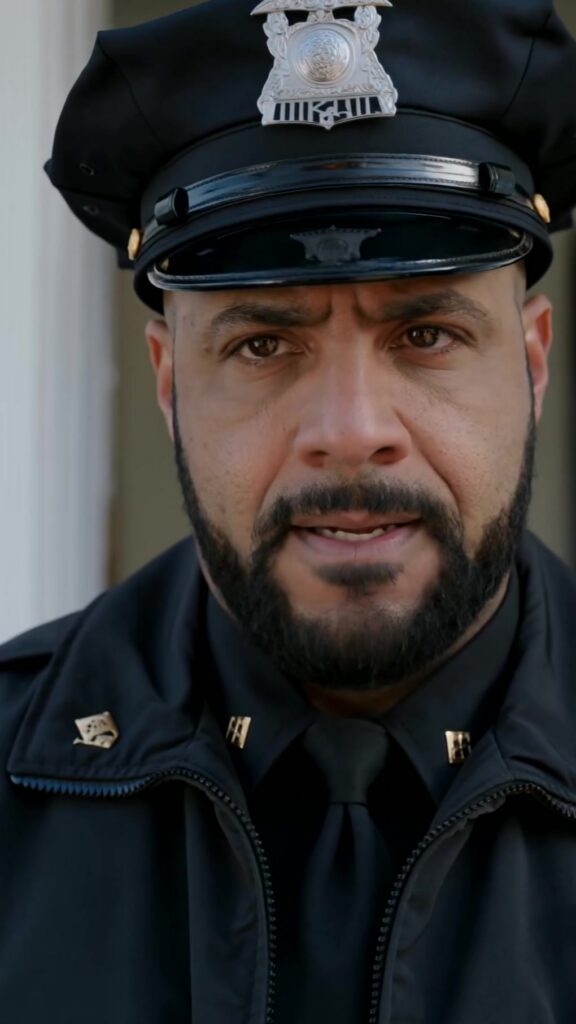
A police officer stepped out into the daylight. He was large in the way men grew when they were used to being obeyed: broad shoulders, heavy boots, a belt crowded with equipment. His face was calm to the point of boredom. He wasn’t rushing, wasn’t calling for backup, wasn’t scanning the street for threats. He simply stood at the top of the porch steps, blocking the doorway with his body.
Behind him, in the dark gap of the open door, Margot caught a glimpse of another uniform, a second officer turned sideways, half-hidden, as though he didn’t want to be seen.
The screaming stopped so suddenly that the silence felt unnatural, like the world had been switched off.
That was what made Margot afraid before the officer even spoke. Fear inside a house should not vanish when help arrives. It should unravel into sobs, into explanations, into relief. Silence meant someone had been forced to stop.
The officer looked directly at her. Too directly. Not the glance of a public servant gauging whether a passerby needed assistance—more like the look of a man who had noticed an inconvenient witness.
He descended one step. His hand rested near his radio, not touching it, just close enough to remind her it existed.
“Ma’am,” he said, voice flat, “relax. Everything’s under control.” He paused. His eyes did not soften. “And if you value your safety… you didn’t hear anything.”
Margot’s breath caught. Her mind tried to assemble the words into something harmless and failed. The warning was too naked. Too personal.
“I—I thought I heard—” she began, then stopped, because her tongue suddenly felt like a stranger’s. She looked past him into the dark of the house and imagined someone on a floor, hands over their mouth, being stared down into quiet.
The officer’s expression did not change. He tilted his head in a way that implied patience, the kind of patience a predator has when it knows its prey is boxed in.
Margot took a step backward. “Of course,” she said, though she wasn’t sure what she was agreeing to.
She turned and walked away too quickly for dignity. The polite neighborhood, once a comfort, now felt like a stage set: houses like painted facades, lawns too neat to hide in. She could feel the officer’s gaze on her back as if it were a hand pushing her forward.
Her heart hammered. She told herself to keep moving. Do not look back. Pretend you did not stop. Pretend you are nothing.
And then she heard it.
Not a scream.
A soft, rhythmic tapping, like a small knuckle against glass.
Margot’s head turned before she could stop it. Her eyes climbed to the second floor, to a window partly curtained. For a second there was nothing but reflection, pale sky and bare branches. Then a small hand appeared, pressed against the pane from the inside.
It was a child’s hand. Tiny fingers splayed. Skin pallid against the glass.
Margot froze mid-step. Her mouth opened. She could see the outline of a face behind the curtain, but not clearly—just a suggestion of eyes wide in the shadow, watching her with the kind of desperate focus that did not belong to childhood.
The tapping came again, urgent now, and the hand slid downward, leaving a faint smear as if the palm were damp.
Margot’s stomach turned to water. A surge of anger rose in her, sharp and sudden, frightening in its clarity. If the police were here, why was a child asking for help? Why did the scream stop like a switch? Why was the officer warning her like a criminal?
The front door creaked behind her. She heard the heavy weight of boots on porch boards.
Margot forced herself to move, but not away. She pivoted as if she’d forgotten something, as if she’d simply realized she’d dropped a glove. She faced the house again, lifted her chin, and searched the street for anyone—any neighbor, any dog walker, any open curtain. Most windows were blank. One set of drapes twitched and settled. Someone had seen, and someone had decided to disappear.
Her hand went into her coat pocket and closed around her phone. The screen was cold. Her fingers shook so hard she nearly fumbled it. She could not call the local precinct; the uniform on the porch belonged to it. She could not trust the number that would route her complaint right back to the man who had just threatened her.
Boot steps stopped behind her. The officer’s shadow stretched across the sidewalk, overlapping hers like a stain.
“Ma’am,” he said again, closer, voice still controlled. “You need to keep walking.”
Margot turned her head just enough to look at him. His face was still calm, but now she saw the faintest edge of irritation at the corner of his mouth, the impatience of someone whose authority was being tested by an old woman in a red scarf.
In the upstairs window, the child’s hand remained pressed to the glass, unmoving now, as if it had become the only truth in this tidy, quiet world.
Margot swallowed. She thought of her grandson’s birthday card in her bag, the cheerful balloons on the front, the silly joke inside. She thought of her own children, grown and far away, and how she used to check their windows at night to be sure they were safe. She thought of the cruelty of memory, how it would show her this second forever.
She did not keep walking.
She raised her phone where the officer could see it and, with her trembling thumb, began to dial a number she hadn’t used in years—one she’d once memorized for a student’s safety program. Not the police. Not local. An outside line.
“Put that away,” the officer said softly, and for the first time the calm in his voice cracked enough to reveal something underneath.
Margot met his gaze. “There’s a child in that window,” she replied, surprised by the steadiness of her own words. “And someone screamed.”
For a heartbeat the neighborhood held its breath. The bare trees stood still. The wet grass glittered dully. The world balanced on the edge of what Margot would choose next, and what the officer would do to stop her.
Upstairs, the little hand tapped once more, a sound so small it should have been swallowed by the air—and yet it landed in Margot’s chest like a plea she could not pretend not to hear.
Later, she would wish she had kept walking. Later, she would understand why every curtain had stayed closed.
But in that moment, with the officer’s shadow swallowing her feet and the child’s palm flat against the glass, Margot Ellis pressed “call,” and the ordinary life she might have had slipped quietly out of reach.