Sunlight lay across the outdoor café like a clean tablecloth—too bright, too honest for a street that had learned to hide its bruises. White porcelain cups gathered in small constellations, each one left with the lazy confidence of people who never counted coins before ordering. The pastries were sculpted more than baked, glossed with sugar, untouched except for a polite bite that proved a point. Even the air seemed expensive: cinnamon, citrus, and the faint sting of perfume carried on a warm breeze.
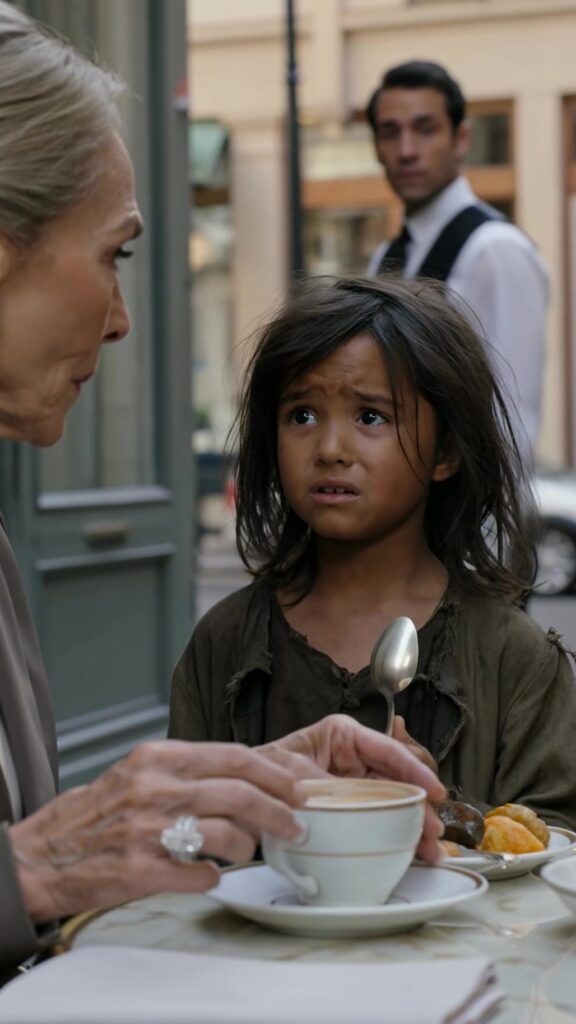
The child at the edge of it all looked like a smudge that hadn’t been wiped away. Dust clung to her knees and the hem of her dress. Her shoes did not match. She did not wander from table to table asking for crumbs. She did not even stare at the food for long. Her gaze was fixed on hands—on rings, bracelets, the glint of metals that spoke a language she’d been taught in whispers.
In her fist, she carried an old baby spoon, its silver dulled to the color of moonlight behind clouds. It wasn’t clean. It wasn’t pretty. The bowl was faintly stained, as if time itself had eaten from it. But the girl held it upright as though it were a candle she could not let go out.
Her mother’s last instruction had not been a prayer or a promise. It had been a rule delivered through clenched teeth while the room smelled of antiseptic and rain. “If you ever see that ring,” her mother had said, fingers cold around her wrist, “you show the spoon before you tell anyone who you are. Before you say your name. No matter what they offer you. No matter what they threaten.” Then her mother had tried to say more and couldn’t, as if the rest of the sentence had been stolen from her lungs. An hour later, the woman who had been everything was gone, and the rule became the only inheritance the girl could carry without being robbed.
Today, the ring appeared like a flash of memory turned solid. At a table near the center, an elderly woman sat alone, wrapped in elegance as if it were armor. Her hair was pinned into a white wave, her lips painted the calm red of someone accustomed to winning. When she lifted her cup, a gemstone caught the sun—a dark stone with a pale halo, set in gold shaped like a twisted vine. It shone once, and the child’s legs stopped as if the light had frozen her.
She crossed the space between tables. Every step felt louder than it should have, but no one looked up; the café had trained its patrons not to notice small disruptions unless they were spectacular. The girl stopped at the edge of the woman’s shadow and waited until her throat stopped trying to close.
“Excuse me,” she said. The words came out thin, as if she was unsure she was allowed to take up air. “Ma’am.”
The older woman lowered her cup with a slight click, the sound of impatience. Her eyes scanned the child quickly: the grime, the hollow cheeks, the spoon. “No,” she said without asking what was being requested. “I don’t carry cash.”
The girl did not move to plead. She did not glance at the pastries. Instead she opened her hand and lifted the spoon so the light struck it. The engraved handle flashed briefly—two looping initials, old-fashioned and careful, with a small crest between them, worn by decades of handling.
At the neighboring table, a waiter who had been arranging napkins paused mid-fold. He was young, but the way his shoulders stiffened suggested an older fear living beneath his uniform. His eyes fixed on the spoon as if it were a weapon.
The elderly woman’s expression changed as fast as a door slamming shut. The annoyance drained away, leaving a kind of sharpened alertness. Her fingers tightened around the cup. The gemstone ring—so confidently displayed a moment earlier—suddenly looked less like jewelry and more like a brand.
“Where did you get that?” she asked. Her voice stayed smooth, but the last word frayed.
The girl swallowed. She remembered the rule. She kept her own name behind her teeth like a secret coin. “My mother kept it,” she said carefully. “She said I had to show it if I ever saw your ring.”
The waiter stepped closer, unable to stop himself. He leaned as if to inspect the spoon, then hesitated, as though touching it might burn. “That engraving,” he murmured, and his face emptied of color. “I’ve seen that crest.”
The older woman’s hand began to tremble—not the tiny tremor of age, but a violent shaking that rattled the saucer. She slid her chair back half an inch. Her gaze flicked from the spoon to the child’s face and back again, as if trying to reconcile a ghost with a heartbeat.
Other sounds in the café seemed to thin out. A conversation died mid-sentence. A spoon in someone else’s cup stopped clinking. Even the street noise outside felt muffled, as if the entire block had leaned in.
The waiter reached, then caught himself. “May I?” he asked the girl, not the woman, and waited until the child nodded. He took the spoon with both hands and turned it. Under the bright sun, he angled the bowl just so. Something appeared—marks so faint they could have been scratches from years of scraping porridge. But they were deliberate. Letters pressed into metal, one set engraved neatly, another carved later by an impatient hand.
The waiter’s lips parted as he made sense of them. The older woman’s mouth opened too, but her voice came out as a breath. “Don’t,” she whispered.
He read anyway, because once you see a truth etched into silver, you cannot pretend it isn’t there. “First name: Elowen,” he said, the polished engraving. Then his eyes dropped to the crude addition, the one that looked like it had been scratched in with a pin while someone cried. “Second name: Mara.”
The elderly woman stumbled backward as if the words had struck her. Her chair scraped the stone. Her gloved hand flew to the gemstone ring, twisting it, trying to pull it free. It stuck for a moment—gold refusing to let go—then slid off with a sudden release. She held it between thumb and forefinger like a small creature that had bitten her. “That name…” she said, and the confidence she wore began to crack. “That was buried.”
The girl’s stomach did not growl. Her hunger was elsewhere, gnawing at the hollow place her mother had left behind. “My mom said you would know,” she said. “She said the spoon would make you listen.” She paused, the rule pressing against her teeth, begging to be broken. “She didn’t want me to come,” she added softly. “She wanted me to run. But she couldn’t run anymore.”
The waiter stared at the child as if seeing her properly for the first time. His voice dropped. “Mara Elowen,” he said, testing the names together like a key in a lock. “Those were the names from the fire, weren’t they? The one they called an accident.”
The elderly woman’s eyes filled—not with tears of regret, but with the bright, startled wetness of someone cornered. “You don’t understand,” she said, but her words were already losing the power to command. Around them, the café held its breath, sensing a story about to rip through the silk quiet.
The girl reached out for the spoon again, and the waiter returned it like a sacred object. The child closed her fingers around the tarnished handle until it left dents in her palm. She lifted her chin. Her name was still locked away, unsaid, but it stood behind her eyes like a storm. “My mother told me to show this,” she said, voice steady now. “And then to ask you one question.”
The gemstone ring lay on the table between pastry crumbs and cooling coffee like evidence. The older woman stared at it as if it were a verdict. The child leaned forward, not to beg, not to eat, but to claim the moment she had been carrying since the last breath in a hospital room.
“Which of you decided she had to disappear,” the girl asked, “and why did you leave the spoon behind?”
The silence that followed was no longer rich. It was terrified. And in that silence, the woman who had sat in sunlight like a queen began to look, for the first time, like someone who had been waiting years for the dead to find her.