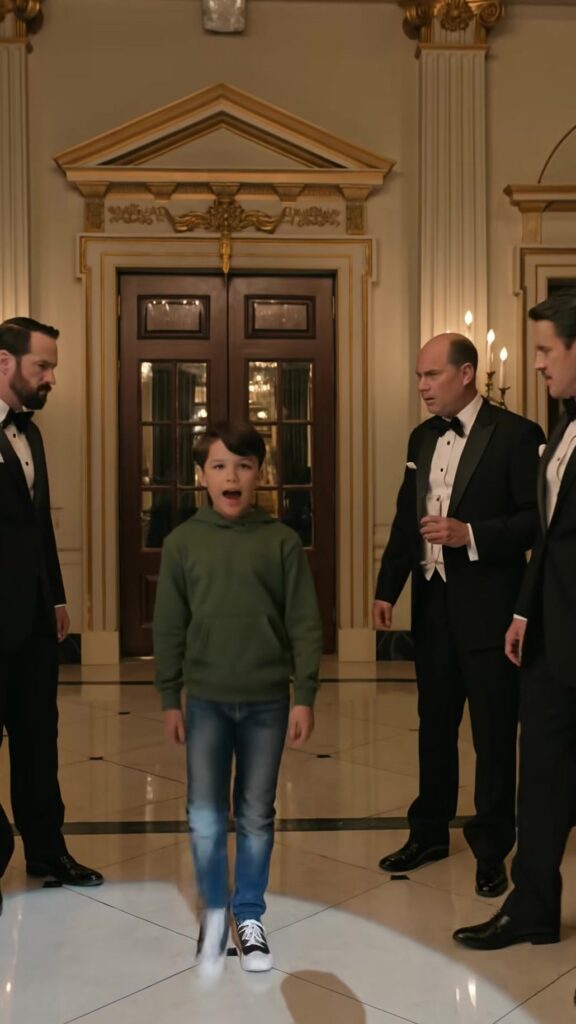
The Carradine Ballroom had been built to make ordinary people feel small. Its ceiling floated like a painted sky above a hundred crystal drops, and the chandelier at its center didn’t merely shine—it performed, scattering gold across tuxedos and silk gowns the way a monarch scatters favors. On nights like this, the city’s money came to admire itself. Yet the air was wrong from the first note of the string quartet, dense with a hush that had nothing to do with etiquette.
Gideon Vale stood beneath the chandelier as if it were a gallows. He was a man who had bought whole blocks with a signature and made mayors blink with a phone call. Tonight, he gripped a microphone so tightly the knuckles shone white through his skin. His shoulders trembled, not with age—he was too young for that—but with something uglier: helplessness. Beside him, on a small platform dressed with white roses, stood his daughter, Mira, in a pale blue dress that made her look like a storybook promise. Her eyes stayed open, unblinking, as if she were afraid that even blinking would make the world change again.
Gideon tried to speak, failed, tried again. When words finally surfaced, they were raw, scraped from somewhere inside him that had never been touched by negotiation. “My daughter hasn’t spoken since her mother vanished,” he said, the microphone amplifying every fracture in his breath. “I have paid for the best in every city. I have flown her to clinics that don’t advertise their addresses. I have prayed in places I used to scoff at.” He swallowed, and it sounded like stone. “If anyone can bring back her voice… I will sign away every asset I own. Everything.”
It wasn’t the offer that silenced the ballroom; it was the way he said it, as if he meant to strip himself bare in public and didn’t care who watched. People looked down at their champagne. A few lifted their phones as if documenting tragedy could keep it from touching them. Somewhere near the back, a woman pressed a napkin to her mouth and shook her head, not in disbelief but in recognition. The city’s rumor mill had churned for a year: that Celeste Vale had walked into her private gallery one evening and never walked out; that there had been a scream no one could place; that Gideon’s security cameras had “malfunctioned” for twelve minutes at precisely the wrong time. And after that night, Mira’s voice had disappeared as if it had been stolen with her mother.
At Gideon’s side, Mira remained still. The dress hid how thin her wrists had become. The only movement in her was a slight, involuntary flutter at her throat, like a bird trapped beneath skin. Gideon glanced down at her, and the rage in his face collapsed into despair. “Please,” he said, and the word sounded like it had never fit in his mouth before. “Please.”
The crowd shifted. Not to offer help, but to make room. A seam opened down the marble aisle leading to the platform, as though the room itself had decided to breathe. A boy walked into that seam with his hands at his sides. He couldn’t have been more than fifteen. A green hoodie hung from his shoulders, and his jeans were faded at the knees, the kind of clothing that did not belong beneath chandeliers. His hair was damp from the night air, curls clinging to his forehead. He moved without hesitation, not arrogant, not timid—simply certain in a way that made grown men feel suddenly unsteady.
Whispers rippled and died. Gideon’s head snapped toward him. The guards at the edge of the platform began to step forward, but some instinct made them pause, as if the boy had crossed an invisible threshold where force would look like cowardice.
“Stop,” Gideon said, the word cracking like a whip. His eyes were wet, but the heat in them returned fast, furious. “This isn’t a stage for your games. Get out.” He made a sharp gesture, the kind that normally sent people scattering.
The boy didn’t flinch. He looked past Gideon—past the microphone, past the flower arrangements—and focused on Mira as though she were the only person in the room. When he spoke, his voice was calm, almost gentle. “I’m not here to embarrass you,” he said. “I’m here because she’s been holding her breath for a year.” He lifted his gaze to Gideon. “I can help her speak again.”
A thin laugh escaped someone near the bar, quickly strangled by the weight of everyone else’s attention. Gideon took a step forward, towering, furious, humiliated by hope. “You can’t,” he hissed. “Do you have any idea what I’ve done? The people I’ve brought in? The money I’ve burned?” His voice rose, rougher, as if he could frighten reality into obeying. “She has been examined by world authorities. You’re a child.”
The boy nodded once, as if agreeing with a fact that didn’t matter. “I’m Eli,” he said, and then, quieter, “My mom used to clean the gallery your wife built. The one with the mirrored hallway.” Gideon’s expression altered in a way that turned the ballroom colder. The mirrored hallway. A detail the tabloids didn’t have. A detail only people inside the Vale house would know.
“How do you—” Gideon began, and the question died as if it had been cut. Mira’s eyes, which had been fixed on nothing for months, slid toward Eli. It was a tiny movement, but it struck the room like lightning. Her lip parted. Something flickered behind her stare—fear, yes, but also recognition, like a door that had been braced shut suddenly shuddering.
Eli took one more step forward, slow, deliberate, hands open. He didn’t reach for her. He didn’t ask her to perform. He simply lowered himself to her height, so the chandelier’s gold fell over his hoodie like an unwilling blessing. “You don’t have to say anything for them,” he murmured, so softly the microphone didn’t catch it. “Just for you. Just enough to let the air out.”
Mira’s small hands, which had been clenched at her sides, began to tremble. A tear loosened from the corner of her eye and traveled down her cheek with exhausting patience. Gideon stared as though he’d been stabbed. He reached toward her, stopped himself, fingers hovering in midair. The entire ballroom seemed to lean forward, holding its collective breath, a hundred rich bodies suddenly helpless before the fragile truth of a child’s shaking hands.
Eli glanced up at Gideon, and his calmness finally cracked to reveal something like steel. “You promised everything,” he said, not demanding, simply stating. “But this isn’t about money. It never was.” He turned back to Mira. “What happened in the mirrored hallway wasn’t a ghost story. It was a choice. And you’ve been keeping the secret so everyone else can keep dancing.”
Gideon’s face drained, as if the chandelier had taken its light from him. The microphone slipped slightly in his grip. “No,” he whispered, but the word had no authority left. The room’s wealth, its polished laughter, its tailored confidence—none of it mattered now. Under the chandelier, the most powerful man in the city began to come apart, thread by thread, because a boy in a hoodie had said the one sentence that reached the place money could not touch.
Mira’s throat worked. Her lips moved. The first sound that came out wasn’t a word. It was a small, broken exhale—air returning to a body that had been holding it hostage. And in that sound, the ballroom felt the beginning of an ending, the moment when silence stops being protection and becomes a verdict. Gideon sank to his knees as if the floor had finally claimed him, and Eli waited, still and patient, for Mira’s voice to find its way home.