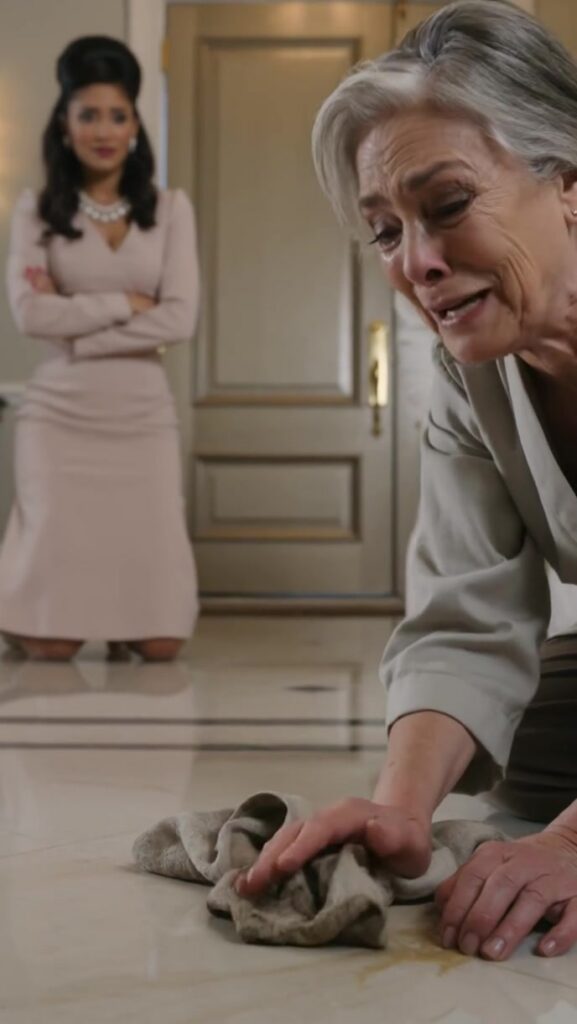
The hallway had been built to impress strangers. A sweep of marble that reflected the chandelier like a frozen lake. Walls lined with framed faces that smiled as if they’d never known trouble. Even the air had a practiced elegance—waxed wood, faint lilies, the sterile coolness of a home where people spoke softly so the silence could be heard.
Elena knelt in the center of it, the crown of her gray hair bent toward the floor. A bucket of sudsy water sat beside her knee, and her hands—thin, veined, unsteady—worked a rag over the stone in short, stubborn circles. She had scrubbed floors before; she had scrubbed this one when it was new, when her husband still walked its length with his shoulders square, proud of every inch. But this was different. This was not care. This was penance demanded by people who lived in a house but did not understand it.
“You missed a spot.”
The voice was bright, polished, and sharp enough to cut glass. Celeste stood over her in a fitted dress the color of dark wine, hair pinned in a flawless twist. She looked like a magazine cover dropped into a family portrait. She didn’t have to shout; the hallway made every word sound official. Elena kept her eyes on the marble, the rag slipping as her fingers cramped.
Celeste flicked something from her hand. A damp towel, gray with tracked-in dirt, slapped Elena’s shoulder and slid down her arm. “Use that. If you can still make a mess with those tears, you can still clean it.”
The towel’s weight felt heavier than it should have. Elena’s breath snagged. She did not turn. She did not pick it up right away, as if her body hoped the moment would pass if she didn’t acknowledge it. Her throat tightened until her voice came out in a rasp. “This… was my husband’s home.”
Celeste laughed, a small sound that carried too far. “And now it’s ours. You should be thankful I’m letting you stay at all.” She glanced past Elena toward the staircase, where Miles stood like a man caught mid-fall. He had Elena’s eyes—soft, uncertain—and his father’s jaw, clenched as if he could bite through his own regret.
“Miles,” Elena whispered without looking up. It was a plea and a name and a prayer all at once.
He didn’t answer. He shifted his weight, hands empty and useless at his sides. He looked at the portraits instead of her, as though their painted gazes might tell him how to be a son without becoming an enemy.
Elena’s tears slipped quietly down her cheeks and dropped into the bucket, distorting the clean surface. She reached for the dirty towel. Her fingers trembled so badly that it took two tries to grasp it. Humiliation was not loud; it was the way your own home became a stage and you became a prop.
The front door latch clicked.
All three of them froze, each for their own reason. In a mansion, arrivals were announced—drivers, assistants, ringing phones. This was simply a door opening, a casual interruption that felt like thunder. The cool air from outside rolled in, carrying the scent of rain and airport asphalt.
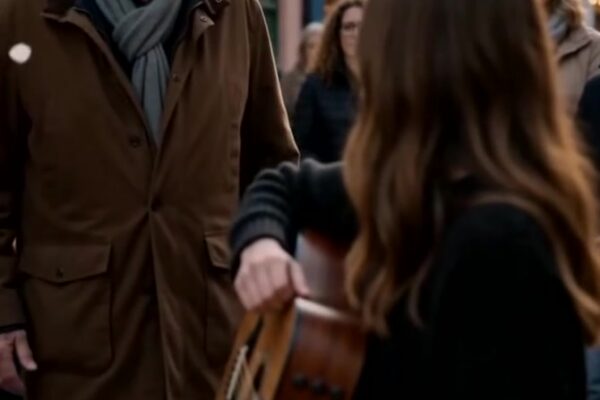
A man stepped into the hallway with two travel bags, his shoulders broad beneath a worn coat that looked expensive for reasons that had nothing to do with logos. His hair was iron-gray, his face drawn with the kind of fatigue that came from long flights and longer decisions. For a heartbeat he didn’t move, as if he’d walked into the wrong house.
Then his eyes found Elena on the marble.
The bags slid from his hands and landed with a soft thud, careful even in his shock. His gaze traveled from the bucket to her reddened knuckles to the towel on her arm. The air changed. The silence tightened until it felt like it could break bones.
“Dad?” Miles said, the word falling out of him. Not loud. Not triumphant. Simply stunned.
Celeste’s posture adjusted instantly, a smile assembling itself like a mask. “Mr. Hartwell. You’re home earlier than—”
The man raised a hand, not to stop her so much as to hold the room still while he looked. His eyes didn’t soften. They sharpened.
“Interesting,” he said, and his voice was low, controlled, the kind of calm that comes right before a storm makes landfall. He took a step forward, not toward his son, not toward Celeste, but toward Elena. “Because the woman on that floor is the one whose name I placed on every property record connected to this house before my plane even touched the ground.”
Miles went pale so fast it was as if the color had been drained out of him with a syringe. Celeste’s smile faltered; a muscle in her cheek twitched as she recalculated. Elena lifted her head slowly, as if her neck had forgotten how. The chandelier’s light caught the moisture on her lashes.
“That’s not possible,” Celeste said, and the brightness in her tone cracked. “Miles told me the estate—”
“Miles told you what was convenient,” the man replied. He didn’t look at his son when he said it. That was somehow worse. He reached into his inner coat pocket with deliberate patience and drew out a thick envelope, edges stiff, sealed. He held it at chest height like evidence in a courtroom.
“Or should I show you whose signature finalized it this morning,” he added, “while you were deciding how low you could push my wife before she broke?”
Elena’s breath left her in a small, broken sound. “Arthur,” she whispered. Her husband had been Arthur Hartwell once. She had buried him—or thought she had—ten years ago when the last call ended abruptly in a foreign country and a grief counselor used the gentle language people reserve for tragedies they cannot undo.
Now Arthur stood in their hallway like a ghost made solid by anger. He knelt beside her, ignoring the marble, ignoring the chandelier, and touched her wrist with careful fingers. “Get up,” he said, not as an order but as an act of restoration. “Not for them. For you.”
Elena tried. Her knees protested, her hands slipped, but Arthur’s grip steadied her. When she stood, her shoulders were rounded from years of making herself smaller. Arthur’s hand remained at her back, firm and warm, a reminder of a life she had been forced to mourn.
Miles stared at them as if he were watching a past he’d been denied return to. “Dad… where have you been?” His voice shook. “We thought—”
Arthur’s eyes finally met his. The look was not without love, but it was weighted with consequence. “I was alive,” he said. “And I was paying attention. I let the world believe a story because I needed to know which parts of my family were built on loyalty and which were built on paperwork and pressure.” His gaze flicked to Celeste. “Congratulations. You’ve been very informative.”
Celeste’s chin lifted, attempting dignity. “This is ridiculous. I’m engaged to your son. I belong here.”
Arthur shifted the envelope in his hand. “Belonging isn’t something you seize by humiliating an old woman in her own home.” He slid the envelope open with one thumb and pulled out a sheaf of documents, crisp and final. “These are filed. Recorded. Irreversible. This house is Elena’s. The guesthouse, too. The accounts that maintain the staff.” He paused just long enough for the meaning to settle. “You have no claim here. Not through Miles. Not through intimidation. Not through performance.”
Miles swallowed. “What are you doing?”
“Correcting,” Arthur said. “And teaching.” He handed the papers to Miles without letting go of Elena’s hand. “Read them. Then decide what kind of man you are. A man who stands silent behind cruelty, or a man who knows the difference between love and convenience.”
Celeste’s eyes darted across the hallway, searching for allies in portraits and polished stone. Finding none, she reached for her phone. “I’ll call my lawyer.”
Arthur nodded once, almost kindly. “Do. And while you’re at it, call whoever packed your things. You have one hour to leave. If you need a ride, I’ll have the driver take you. I’m not interested in spectacle—only distance.”
The word distance hit Celeste harder than any shouted insult could have. Her face tightened, the mask slipping to show a flash of fear. She opened her mouth, then closed it. Pride battled survival. Survival won. She turned sharply, heels clicking like punctuation, and walked toward the stairs to gather what she could salvage of her story.
When she was gone, the hallway felt different. Still grand, still cold in its marble, but less like a museum and more like a home waiting to be lived in again. Elena looked at Miles—her son, her only child—who stood with the documents trembling in his hands.
“I didn’t know how to stop it,” he whispered, voice breaking. “I thought if I kept the peace, it would… pass.”
Elena’s eyes were wet but steady. “Peace that costs your mother her dignity isn’t peace,” she said softly. “It’s cowardice dressed up as patience.”
Arthur squeezed her hand once, as if anchoring her to the moment. “We can talk,” he told Miles, his tone no longer thunder but not yet forgiveness. “We can rebuild what’s worth rebuilding. But nobody will kneel in this house again unless it’s to tie a shoe or plant a garden.”
Miles nodded, tears gathering, shame and relief mixing in his face. He lowered the papers as if they were heavy. “I’m sorry,” he said, and this time he looked at Elena. He didn’t look away.
Elena exhaled, the air shuddering out of her like a door finally opening after years stuck. Behind them, rain began to tick softly against the tall windows, a steady sound that washed through the mansion’s cold silence.
Arthur picked up the bucket and rag himself and carried them toward the kitchen as if that, too, needed to be rewritten. Elena watched him go, the hallway’s portraits observing a new scene: not a woman on her knees, but a family standing in the wreckage of what they’d become, forced at last to choose what they would be next.