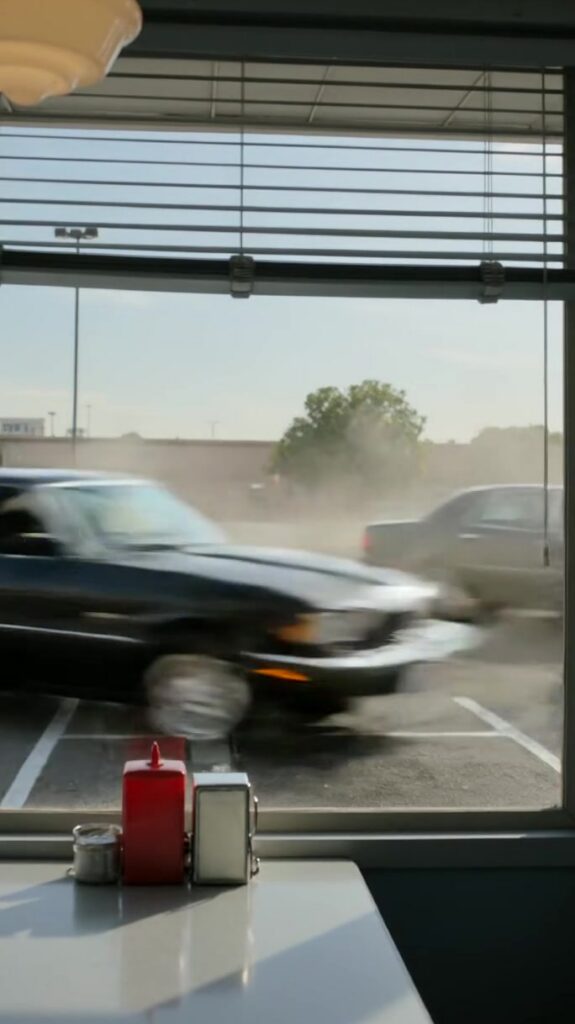
At first, no one noticed the sound because the bar was built to swallow noise. It sat at the edge of the river docks where freight cranes coughed and tugboats groaned, where men came to forget their names and women came to borrow new ones. The place was called the Lantern, though the only light inside came from a tired neon beer sign and the occasional flare of a phone screen.
No one noticed the crash because crashes were common. A shoulder bumped a server. A stool hooked a boot. A glass sailed like a brief comet and shattered near the old man’s shoes. For a heartbeat, the shards glittered on the sticky floor, and laughter rose—automatic, sharp, careless—like a reflex.
“Hey! Watch it, grandpa,” someone called, not even turning all the way. A few heads swivelled long enough to assess: an old man in a worn wool coat, too heavy for the season, seated alone at a corner table as if he’d been there since the building was raised. His hands were steady, folded around a cup he hadn’t finished. He didn’t flinch at the glass. He didn’t curse. He didn’t even blink.
That calm irritated the room more than a spill ever could. In the Lantern, emotion was a currency. Anger paid for space. Fear purchased safety. But calm? Calm was a counterfeit bill, and it made people want to prove it fake.
At the bar, the newcomer—everyone called him Bishop because he wore a bishop’s ring he hadn’t earned—turned his big shoulders toward the corner. Leather creaked. His crew followed his gaze like it was a leash. Bishop had the kind of presence that made conversations shrink. He was not old, not young, but carved by years that left their marks where they could be seen: knuckles, jaw, the side of his neck where a pale scar climbed into his hairline.
“You deaf?” Bishop called, stepping over the glittering shard-field as if stepping over rules. “Or too proud to say sorry?”
The old man raised his eyes. They were pale and unhurried, the color of river mist at dawn. He looked at Bishop the way a man looks at weather—measuring, accepting, knowing it will pass.
“You’re in my way,” Bishop added, because he was used to the room rearranging itself around him.
The old man said nothing. He slipped his hand into his coat pocket and pulled out a phone that did not match the rest of him: matte black, clean, modern, the kind of device someone used for more than calling grandchildren. A few people noticed then, not because the phone was unusual, but because of how he held it. Not fidgeting. Not searching. Certain.
He tapped once, pressed the phone to his ear, and spoke as if the Lantern were suddenly empty enough for a whisper to travel.
“It’s me,” he said. “Bring them.”
Two seconds of nothing followed, a pocket of quiet that seemed to pinch the air. The bartender paused mid-wipe. The jukebox song reached its chorus and, absurdly, sounded too bright. Bishop’s grin faltered as if he’d misheard the script.
“Who’s ‘them’?” Bishop asked, with a laugh meant to keep the room on his side. “You calling your kids? Your nurse?”
The old man ended the call. He set the phone down gently beside his cup, as if it were a chess piece placed to force the next move. Still he didn’t rise. Still he didn’t reach for a weapon. That was what unsettled people: he wasn’t preparing to fight. He was preparing to receive.
Outside, the street was usually a slow bloodstream of trucks, smokers, and strays. But the first car arrived like a sudden clot—engine snarling, brakes biting. Then another. And another. Black sedans that didn’t belong near the docks. They didn’t wander. They didn’t hesitate. They slid into place with the precision of practiced hands.
When the front door swung open, cold air swept in and carried the faint scent of rain and gasoline. Men entered—not loud, not looking for a good time. They moved with the synchronized restraint of people who had been trained to keep their hands at their sides until told otherwise. Dark jackets. Earpieces. The bar’s chatter died in a cascading hush.
Bishop took a step back without meaning to. His boots scraped over the glass, and the sound was small but unmistakable. The room had shifted, and everyone felt it: whatever this was, it wasn’t chance. It was a pattern returning.
“You know something I don’t?” Bishop asked. His voice tried to keep its swagger, but the edges had gone thin. He looked from the men at the door to the old man in the corner, searching for the trick, the angle, the humiliation that would restore his footing.
The old man met his stare. Calm. Steady. A stillness deep enough to drown in. He didn’t smile, but there was something in his gaze like recognition, as if Bishop had walked into a room where the old man had been waiting with the lights off.
“Sit down,” the old man said, and his tone carried no threat—only certainty.
Bishop’s laugh came out late. “I don’t take orders—”
“You do,” the old man interrupted, and that interruption struck like a slap because it was spoken not with anger but with memory. “You did.”
Something moved behind Bishop’s eyes. Confusion, then irritation, then a flicker of fear he tried to bury. He opened his mouth to protest, to demand names, to call the bluff. But the men who’d entered had already spread into positions that turned the Lantern into a room with no corners to run to. Their attention wasn’t on Bishop’s crew. It was on Bishop.
“Who are you?” Bishop asked, quieter now, as if volume might summon consequences.
The old man’s fingers traced the rim of his cup. “I’m the reason you’re still breathing,” he said.
A laugh tried to rise from someone near the back and died before it formed. Bishop swallowed. He stared hard at the old man’s face, hunting for the hook of familiarity. It wasn’t the eyes. It wasn’t the voice. It was the way the old man didn’t need anyone’s approval. The way the room kept bending toward him.
“Stop with the riddles,” Bishop said. “What do you want?”
The old man leaned forward slightly, not like a predator, but like a judge leaning in to read a verdict. When he spoke the one sentence, it landed with the weight of a door slamming shut.
“They called you ‘Evan’ before the river took your badge.”
Everything in Bishop’s body went rigid. The name hit him like a knuckle to the throat. Evan. A name he hadn’t heard in years, a name he’d buried under leather and ink and the metallic smell of fear. He remembered fluorescent lights. A wet alley. His own hands trembling over a man’s wallet—no, over evidence. He remembered a lieutenant with a silver tie clip saying, “Do this, and you’ll never have to worry again.” He remembered a body in the river that wasn’t supposed to surface. He remembered signing papers he didn’t read and being told his new life would be clean if he never looked back.
He remembered the last thing he was told, the threat disguised as advice: Forget your first name. Forget your badge. Forget the man who recruited you. Because if you remember, you’re useful. And if you’re useful, you can be used again.
Bishop—Evan—looked at the old man and the men standing behind him, and for the first time the biker’s bravado cracked all the way through. His crew shifted uneasily, sensing the invisible hand tightening around their leader’s throat.
“You’re dead,” Bishop whispered, because that was the only defense his mind could offer. “They said you were dead.”
The old man’s expression did not change. “They say a lot of things,” he replied. “And you believed them because belief was cheaper than truth.”
Bishop’s palms prickled. The glass under his boot crunched again, loud in the silence. He realized the old man hadn’t called for help. He’d called for a collection.
“You can’t just—” Bishop began, but his voice failed him. He looked around at the patrons, hoping for allies, for witnesses, for anyone to make this a bar again instead of a courtroom. Faces turned away. No one wanted to be chosen by this moment.
The old man picked up his phone once more, not to call, but to show. On the screen, a single photograph waited: a younger Bishop in a police uniform, arm slung around a man whose face was blurred by motion, except for the unmistakable silver tie clip. Under the photo was a line of text—an address, a time, and the words: YOU OWE.
“You’ve been collecting debts for other people,” the old man said softly. “Tonight you pay your own.”
Bishop’s throat worked. The Lantern’s neon sign buzzed. Outside, rain began to fall, tapping the windows like fingernails. The men in dark jackets did not draw weapons. They didn’t have to. They were the kind of inevitability that made weapons irrelevant.
At first, no one noticed the broken glass. Now, no one noticed the laughter that had died. All anyone could hear was Bishop’s breath turning ragged as the past he’d buried rose up, dripping river water, and took him by the collar.
The old man stood for the first time. He was not tall, but the room made room for him. He nodded once toward the door, a simple motion that carried command.
“Let’s go, Evan,” he said, using the name like a key in a lock. “You’re going to remember everything. And then you’re going to tell me where the rest of them are.”
Bishop didn’t move at first. His legs seemed to belong to someone else. Then, as if the sentence had switched off whatever story he’d been living, he took one unsteady step forward, and another. The men fell in around him. The door opened. The rain waited. And the Lantern, swallowing its noise again, returned to what it had always been: a place where people came to forget—until forgetting was no longer allowed.