No one noticed her at first, because the Hawthorne Conservatory trained people to notice only what belonged.
The hall was a bowl of light. Chandeliers spilled it over tuxedoes and satin gowns, over wrists banded with watches that cost more than some neighborhoods, over laughter that never reached the eyes. A quartet of donors posed by the marble staircase, their smiles practiced like scales. Waiters threaded through them carrying trays of champagne and tiny foods that were more decoration than meal.
The girl came in behind a deliveryman who held the side door for a second too long. She was small enough to slip past his elbow, thin enough to be mistaken for a shadow. Her coat, once green, had turned the color of street dust. The buttons didn’t match. Her shoes clung to her feet like tired hands, soles bending where they shouldn’t. A smear of grime crossed one cheek, as if the city had tried to claim her and she’d rubbed it away without water.
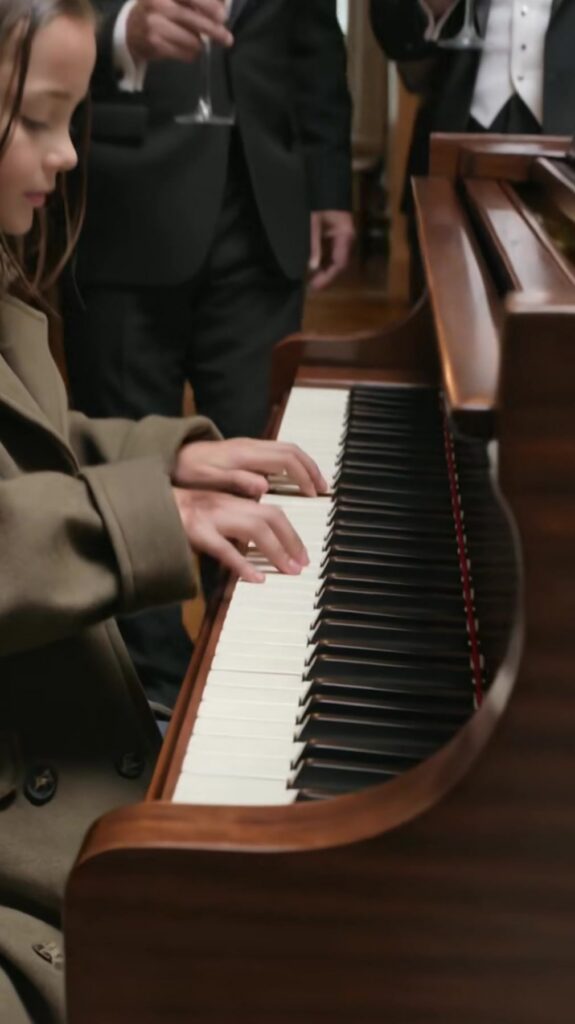
She stood near a column and watched the room as though it were a painting she didn’t understand. Her fingers flexed in the air—not anxious, more like remembering a shape. Behind the laughter, a grand piano waited on a small stage, its lacquered surface reflecting the chandeliers. It was an instrument polished into arrogance, closed like a mouth that did not speak unless commanded by someone approved.
She drifted toward it with a carefulness that looked like humility but was really hunger—hunger for warmth, for attention, for something other than cold brick and empty pockets. People stepped around her. A woman’s perfume brushed past, expensive and sharp. A man’s cufflink snagged her sleeve for a heartbeat, then released her as if touching her might stain the metal.
At the edge of the stage, she hesitated. The fundraiser had a program. A woman in a black dress with a headset moved like a hawk, scanning for threats to schedule and image. But the girl climbed the two small steps anyway, quietly, as if she had done it a thousand times. Her shoes hardly made a sound.
Someone finally saw her. It was a laugh first, the way a laugh can be a weapon without needing a sentence. Then another laugh, then a ripple of amusement that passed politely from table to table. Heads turned. Eyes narrowed, taking inventory: the dirty coat, the fraying hem, the hair tied back with something that might once have been ribbon.
The girl sat on the piano bench. It was too tall for her; her feet didn’t reach the floor. She adjusted herself by sliding forward until her knees tucked close, like a child on a swing trying to touch the ground. She looked out at the room, blinking under the bright chandeliers.
“I’ll play,” she said. The words came out steady, though her throat moved like she’d swallowed something hard. “Just… please… I need food.”
Laughter spread again, softer now, as if people were embarrassed by their own cruelty but unwilling to stop. A man near the back shook his head as though it were a charming interruption. Someone murmured, “Security?” like requesting another glass.
And then he stepped forward.
Julian Hawthorne didn’t need an announcement. He carried authority the way other people carried coats—without thinking, without apology. He was not old, but time clung to him in crisp lines at the eyes and mouth. His suit fit him like armor. When he moved, conversations thinned and fell quiet in his wake.
He approached the stage, his gaze fixed on the girl as if she were a flaw in the evening’s design.
“You’re not staying here,” he said. He didn’t raise his voice. He didn’t have to. “This is not your place.”
The room held its breath. The woman with the headset started forward, relief flickering across her face—problem solved by the man who owned the building, the name on the crest, the legacy in the walls.
The girl didn’t climb down.
She looked at Julian Hawthorne as if she saw something behind him, something the rest of them couldn’t. Her hands hovered above the keys, fingers curved, prepared. Not defiant. Not pleading. Prepared.
“Please,” she said again, smaller. Then she turned toward the piano. The lid was open. The keys were bright under the lights, each one a small promise.
She played.
One note.
Then another.
The sound cut through the room like a sudden draft in a sealed house. It wasn’t loud. It didn’t need to be. It was so clean it made everything else seem messy. The second note didn’t follow the first the way a child guesses at melody. It followed the way memory follows pain—unavoidable, exact.
People stopped shifting in their seats. A waiter froze mid-step, the champagne in his tray trembling. Even the chandeliers seemed to steady, as if the building itself was listening.
The girl’s hands moved, small and sure. The music was not showy. It wasn’t the sort of piece meant to impress donors. It was a thread, spun carefully, drawing a pattern that felt older than the room. There was something in it that made the air tighten: a lullaby turned into a warning, tenderness carrying a blade.
Julian’s raised hand—ready to signal security—lowered slowly. His face, which had been composed like stone, softened into something dangerously close to fear. He took a step closer to the stage. Then another.
When the girl reached a sequence—three notes that leaned into each other like whispered names—Julian stopped walking as if someone had struck him.
His mouth opened. No sound came out at first. Then: “Who taught you this?”
The girl kept playing, but her eyes flicked toward him for a heartbeat. “My mother,” she whispered, as if speaking would break the fragile bridge the music had built.
Color drained from his face. Under the chandeliers, his skin looked suddenly thin, almost translucent. “That’s not possible,” he said, and it was not arrogance now. It was an old man’s terror wearing a younger man’s body.
The girl’s hands continued. The melody turned slightly, like a road curving toward an unseen cliff. Julian moved closer, close enough that the piano’s shine reflected his stunned expression. His fingers hovered over the rim of the instrument, not touching, as if afraid that contact would turn the moment into a lie.
“She told me…” the girl said, and for the first time her voice wavered. She swallowed, and the music softened beneath her words. “She told me… if you ever hear this—”
She stopped playing.
The last note hung in the air longer than it should have, refusing to fall. In that silence, the room seemed to remember it was filled with people again; someone’s breath hitched, someone’s bracelet clinked, too loud.
The girl turned fully on the bench to face Julian Hawthorne. Her eyes were dark and steady. Up close, her grime looked like the kind that came from travel, from sleeping in places that weren’t meant for sleeping. There was a bruise along her jaw hidden beneath dirt. There was also something else: a familiarity that did not belong between a powerful man and a hungry child.
She studied his face as if comparing it to a photograph she carried in her mind. Then she said, softly enough that only he—and the piano, and perhaps the walls—could hear, “—you’d know I found you.”
Julian’s throat worked. His gaze dropped to her hands, those careful fingers, and then to the line of her cheekbones, the tilt of her mouth. He looked as though he were trying to put a shattered mirror back together with bare hands.
“What is your name?” he asked, and in the question was a plea he would never have allowed himself in front of donors.
The girl hesitated. In the audience, someone shifted, uneasy, the spell breaking at the edges. The woman with the headset hovered, her smile gone, her eyes darting between Julian and the child as if measuring disaster.
The girl answered anyway. “Elara.” She let the name settle between them like a coin dropped into a deep well. “My mother said you would pretend not to hear. But she said the song would make you listen. She said you’d remember her.”
Julian’s lips parted around a word that didn’t come. His eyes glistened with something he tried to trap behind his lashes. “Lena,” he breathed, not to the girl, not to anyone, but to the memory that had just walked into his house wearing a dirty coat.
The room waited for him to restore order, to summon security, to turn this into a story that could be laughed about later over brandy. He did none of that. He stood there, motionless, as if the floor had become water beneath him.
Elara slid off the bench, her feet finally meeting the stage with a small thud. She was trembling now that the music had stopped. Hunger and fear returned to claim her shoulders. Yet she did not step back from him.
“She died,” Elara said, blunt as winter. “She said you’d make that happen, or you’d let it happen, because men like you don’t get dirt under their nails. She said if I played, you’d know it was her speaking. And if you didn’t help me…” She didn’t finish. She didn’t need to.
Julian Hawthorne looked out at the crowd—at the donors, the patrons, the people who smiled when he smiled. For once, he saw them as strangers. Then he looked back at the girl, at the way her fingers still curled as if the keys were beneath them, at the stubborn courage in her exhaustion.
He reached into his inner pocket. The room flinched, expecting a phone, an order, a dismissal. Instead he pulled out a handkerchief—white, monogrammed—and held it out to her like a flag of surrender.
“Come with me,” he said, and his voice was changed. It was quieter, but it carried something heavier than authority: consequence. “You’re going to eat. And then…” His eyes tightened, as if bracing for the pain of what came next. “Then you’re going to tell me everything she told you.”
Elara did not take the handkerchief immediately. She looked at it, at him, at the room that had laughed at her hunger. Then she took it with both hands, careful not to stain it further, and for the first time since she slipped through the side door, she allowed herself to breathe as if she might survive the night.
Behind them, the grand piano sat silent, its keys still bright, holding the echo of a mother’s message—three notes that had reached across years and blood and locked doors, and had finally, unmistakably, made a powerful man listen.