The restaurant glowed with warm amber light, soft enough to hide tears if someone wanted to. It softened sharp edges: the knives beside folded napkins, the worried furrow of the host’s brow, the glossy cheeks of couples pretending dinner was effortless romance. It turned everything a little kinder, a little farther away.
It was the kind of light a person could step into and become somebody else for an hour.
Lina knew the paths between tables by heart. The owner called them “lanes,” as if the dining room were a little city and she were a careful driver. Her sneakers made no sound on the carpet, and she held the tray with both hands the way her mother had taught her: elbows close, chin up, eyes down until you must meet someone’s gaze.
Red roses lay in neat rows on the silver tray, their stems wrapped in paper and tied with thin gold ribbon. They looked like small fires. Lina’s job was simple: offer a rose to guests who looked like they might say yes, collect a few bills, bring them back to Mr. Rafiq, and try not to be in the way.
Most people didn’t look at her for long. They looked past her, like she was part of the décor. She didn’t mind. She preferred it that way. Being unseen made it easier to observe, and observation was how you learned where danger lived.
At the corner table, where the amber light pooled thickly against the window, a woman sat alone with a glass of red wine. Not lonely—Lina could tell the difference—but contained, like a letter sealed too carefully. She wore a black blazer that made her shoulders look sharp and certain. Her hair was pinned back with deliberate neatness, and her lips were the color of pomegranate skin.
She looked untouchable, as if even the warmth of the lamps needed permission to land on her.
Lina felt the familiar pinch of nerves. Lone diners could be kind or cruel in equal measure. She approached anyway, because her mother had said kindness was a muscle: it only grew by being used.
“Would you like a rose, ma’am?” Lina asked softly.
The woman glanced up as if she’d been pulled from somewhere far away. For a moment her eyes didn’t focus; then they did, and a faint smile appeared, practiced but not unkind.
“Sure,” she said. “One rose.”
Lina lifted a rose carefully from the tray. The ribbon brushed her fingers, and she felt the tiny thorn through the paper—a reminder that pretty things asked for blood sometimes.
Then the woman reached across the table to place money beside her plate.
And everything stopped.
The woman’s hand was pale and steady, but what held Lina wasn’t the gesture. It was the ring.
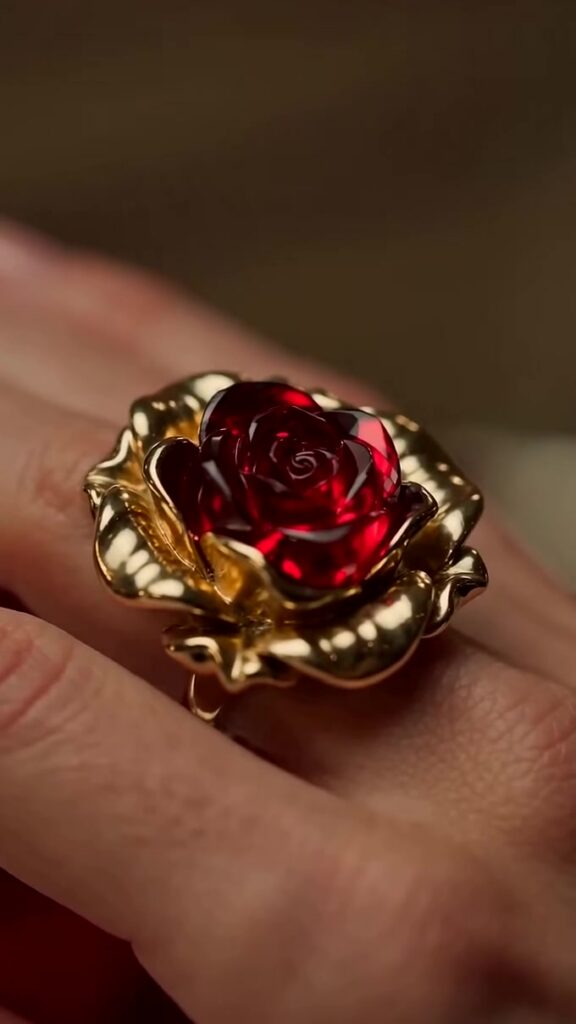
Large gold petals curled around a deep red stone, a rose trapped forever in metal and fire. The restaurant’s amber light turned the gem dark as dried wine. The ring looked heavy enough to anchor a person to any promise.
Lina’s fingers locked mid-air. Her breath caught so sharply it hurt. Her eyes stayed on the ring the way eyes stayed on a flame when you’d forgotten you were too close.
“Ma’am…” she whispered.
The woman’s brow creased. “What is it?”
Lina pointed, her finger trembling in spite of her. “That ring. It looks like my mom’s.”
The woman’s expression didn’t change at first. Confusion, then mild impatience—an adult’s reflex against interruption. “What did you say?”
Lina leaned closer, as if distance could explain the impossible. “Same gold petals. Same red stone. Exactly the same.”
The woman’s hand paused over the bill. Her fingers curled slightly, guarding the ring without meaning to. She lowered her wine glass slowly, and something behind her eyes shifted, the way a storm shifts air pressure before you see the clouds.
“No,” she murmured. Not to Lina, but to something in her memory. “That can’t be.”
Lina nodded too quickly, eager and frightened all at once. “My mom used to kiss it every night,” she said. “Like it was—like it was a person.”
The woman’s breathing changed. Her shoulders lost their sharpness. The amber light, so forgiving to everyone else, revealed a tremor in her throat.
“What is your mother’s name?” she asked, each word careful, like stepping on thin ice.
Lina swallowed. The name sat in her mouth like a secret coin. “Elena.”
The woman went still. It was as if the restaurant had turned its music down, as if the clink of glasses had been muted by a hand over the world.
All the color drained from her face. Her eyes—dark, heavily lined—widened until Lina could see the small red veins in the whites.
For the first time, the woman looked at Lina properly. Not as an interruption, not as a child in a uniform sweater slipping off one shoulder. She looked at Lina the way you look at a photograph you didn’t know you still owned: with recognition that hurts.
The woman’s gaze traced Lina’s features: the almond shape of her eyes, the curve of her mouth, the tiny beauty mark near her left cheek that Lina’s mother called “a dot from God.”
The woman’s hand began to shake around the ring. Her thumb rubbed the gold petals as if she could erase them by touch.
“How old are you?” she asked. Her voice was a thin thread, pulled tight.
“Ten,” Lina answered.
The word seemed to strike the woman’s chest. Her lips parted. A sound tried to form and failed. Ten was not just an age; it was a number that measured absence with cruel precision.
Lina felt suddenly too visible. She wanted to run, to disappear between the tables and the polite laughter and the safe amber glow. But her mother’s instruction was a stone in her pocket, heavy and undeniable.
She swallowed hard and recited the line she had practiced on the bus, on the walk home, in the mirror when she didn’t want to. “My mom said if I ever saw that ring… I had to ask why you disappeared.”
At the word disappeared, the woman’s eyes flooded instantly. Tears slipped free, quick and silent, vanishing in the forgiving light as if ashamed to exist.
She rose halfway from her chair, as though pulled by invisible strings, then stopped, caught between standing and collapsing. Her fingers pressed against the table edge. Her shoulders shook once, a small betrayal of the composure she wore like armor.
“Because I’m your—” she whispered.
The sentence broke apart on her tongue. She looked at Lina as if Lina were both a miracle and an accusation.
Lina’s heart thudded loud enough that she wondered if nearby diners could hear it. The room around them continued: someone laughed too loudly, a fork scraped a plate, the pianist in the corner played a tender chord that sounded like an apology. Yet Lina felt sealed inside a smaller world where only the ring, the name, and the woman’s trembling mouth mattered.
“Say it,” Lina breathed. It wasn’t a demand. It was fear asking for a shape.
The woman’s gaze dropped to the ring again. The red stone caught the lamp’s glow and flashed like a wound reopening.
“Elena…” the woman whispered, and the way she said it told Lina everything she needed to know about longing: it was a thing that could survive years and still feel new enough to kill you.
She lifted her eyes. “I didn’t disappear,” she said, voice ragged now. “I was taken away.”
Lina’s brow wrinkled. “Taken?”
The woman nodded, tears collecting again, stubborn and bright. “I left this ring with your mother because it was the only promise I could make and keep. That I would try to come back.” She swallowed, and the swallow looked like pain. “But trying isn’t the same as returning.”
The amber light around them flickered as a waiter passed, and for a moment Lina saw the woman not as untouchable but as cracked glass held together by will.
“What’s your name?” Lina asked. Her voice was small, but it didn’t break.
The woman’s lips trembled into something like a smile and something like grief. “Mara,” she said. “My name is Mara.”
Lina repeated it silently, tasting it like a new word. Then she looked at the ring again, at the rose-shaped gold petals that matched the roses on her tray, at the red center that looked like a trapped heartbeat.
“My mom said,” Lina began, and hesitated. Her rehearsed line ended there; the rest was her own. “She said the ring meant you would recognize me. So you couldn’t pretend.”
Mara pressed a hand to her mouth, a sharp inhale shuddering through her fingers. “I’m not pretending,” she whispered. “I swear to you, I’m not.”
Lina’s fingers tightened around the rose she still held, forgotten between them. The paper crinkled. Somewhere, a candle guttered and steadied. The restaurant stayed warm, forgiving, amber—soft enough to hide tears if someone wanted to.
But Lina didn’t want to hide anything anymore.
She set the rose down on the table, right beside Mara’s shaking hand and the ring that had dragged the past into the present. “Then tell me,” Lina said. “Tell me everything. Start with why my mom kissed it every night like a prayer.”
Mara closed her eyes as if bracing for impact, then opened them, and in that look Lina saw the beginning of a story that had been delayed for ten years.
“Because,” Mara said, voice low and breaking, “she was kissing the place where I would have held her. And the place where I should have held you.”