The room felt flawless in the way a sealed box feels flawless: no dents, no fingerprints, no proof of human hands. Light skimmed the polished floor like a pale tide. A quartet of speakers tucked into corners exhaled soft music that never dared rise above a murmur. Glasses caught the glow and returned it in obedient glints. People stood in clusters at precise angles, their laughter measured, their smiles calibrated to the second.
Everything had a place—napkins folded into sharp triangles, orchid stems arranged with botanical discipline, name cards aligned as if the air itself enforced a grid. Even grief, if anyone carried it in, had been asked to check itself at the door.
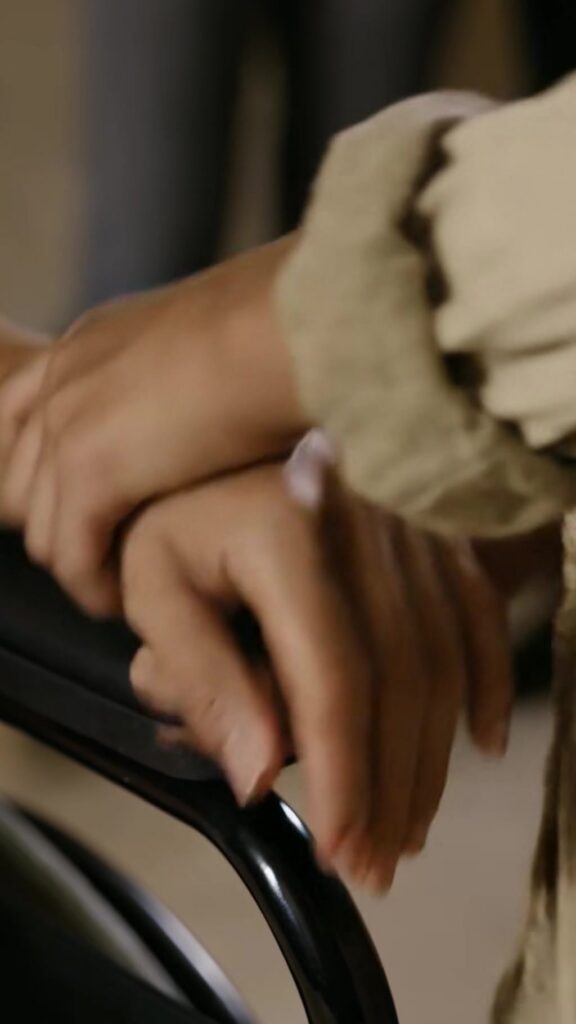
At the center, like the keystone in an arch, sat Mrs. Lark. Her wheelchair was more sculpture than mobility aid, its frame sleek and dark, the wheels glossy as grand piano lacquer. She wore pearl earrings that never trembled and a dress in a shade of blue that looked expensive because it looked unafraid. A silk shawl draped her shoulders as though it had been trained to fall that way.
People approached her in a slow orbit, paid their respects, received a nod and a sentence, and drifted away relieved to have touched the sun without burning. Her composure made the room seem even more perfect, as if she had decreed it so by existing inside it.
On the far wall a banner announced the occasion: The Meridian Foundation Gala—an evening of generosity, legacy, and promise. Those words were echoed by the donation screens that flashed silent numbers, climbing and climbing as if money could outrun time.
The door opened.
It was not dramatic at first. The hinge did not squeal; nothing crashed. Air shifted. A thin line of colder light crossed the threshold and fell across the nearest champagne bucket. Conversations carried on, smiles held. Then a small figure stepped in and the room’s order noticed it had been challenged.
She was a little girl, perhaps seven, in a faded coat too big for her arms. The sleeves hid her hands until she pushed them out, fingers pale and slightly red as if she’d been outside longer than anyone should be. Her hair was braided unevenly, as though someone had tried quickly and then stopped. She did not have the shining look of children invited to galas. She had the wrong shoes, the wrong posture, the wrong kind of quiet.
For a moment she was a mistake the room tried to correct by ignoring it.
A man near the doorway glanced toward security, but the guards were absorbed in a conversation of their own, attention softened by the evening’s smoothness. Someone chuckled softly, an amused sound at the harmless oddity. A woman with glittering nails leaned toward her companion, mouth hidden behind a flute of sparkling wine. The child was discussed without being addressed, as if she were an interesting centerpiece someone had forgotten to label.
The girl did not hesitate. She walked forward.
She moved in a straight line through the room, and something about that—about her refusal to bend around the clusters of adults—forced people to step aside. Shoulders shifted, skirts swayed, shoes scraped quiet arcs on the floor. Whispered questions followed her like thread.
Who is that?
Where did she come from?
Is she with someone?
Her gaze did not flit like a lost child’s. It fixed on the center, on the woman in the wheelchair, as if a compass needle had found north. When she reached Mrs. Lark, she stopped so close that her shadow folded over the hem of the blue dress.
Mrs. Lark’s smile, practiced for donors and photographers, rose with effortless charm. “You’re lost, sweetheart,” she said lightly, voice carrying just enough to make the nearest listeners feel included.
A small ripple of laughter answered—gentle, polite, safe. A child being a child. A brief interruption in perfection that would be corrected in seconds.
The girl did not smile back. She stepped closer and reached out with her uncovered hand.
The touch was not timid. Her fingers closed around Mrs. Lark’s hand with a certainty that made the pearls on Mrs. Lark’s wrist catch the light sharply. For the first time all evening, Mrs. Lark’s composure registered a microsecond of surprise.
The laughter died as if someone had pressed a palm over the room’s mouth.
“Don’t move,” the girl said.
Her voice was small but steady. Not rude, not pleading—an instruction. The kind given by someone who believed it would be obeyed.
Several heads turned toward security again, but no one moved quickly. The moment had become too strange to interrupt without being the one who broke it.
The girl drew in a breath. She stared at Mrs. Lark’s eyes as though reading them.
“One…” she began.
Mrs. Lark’s smile held, but the corners tightened, as if it had been pinned in place.
“Two…”
The music seemed to thin. The room’s air felt suddenly heavy, like the surface tension on water right before it breaks. Mrs. Lark’s fingers twitched against the child’s grip, a reflex quickly stilled.
“Three…”
The girl leaned closer. She rose on the balls of her feet so her mouth could reach the line of Mrs. Lark’s ear. The whisper that followed was swallowed by the room’s silence. No one heard the words. They only saw the effect.
Mrs. Lark’s face changed in a single breath.
It was not the theatrical gasp of embarrassment, not the dramatic shock people performed when surprised. It was something deeper—the collapse of a structure that had been reinforced for years. Her pupils widened. Color drained from her cheeks. The smile fell away as if it had never been real.
Her throat worked once, and no sound came.
Then she spoke, and her voice was not the voice of a benefactor at a gala. It was raw, hoarse, a sound scraped from somewhere private. “Where did you hear that name?”
The child did not answer aloud. She loosened her grip but did not let go. Her gaze softened, almost sad. She said quietly, “You told me to count. You said it would help you remember.”
“No,” Mrs. Lark whispered, and it was not denial of the child—it was denial of the room itself. Her eyes searched the girl’s face with frantic precision, collecting details: the uneven braid, the shape of her chin, the faint scar near her eyebrow that looked like an old accident. “That’s not possible.”
The crowd held its breath. Someone’s glass trembled and chimed softly against another. A donation screen flickered, the numbers indifferent.
The girl’s expression did not accuse. It carried the calm of someone who had already made peace with what others were still refusing. “You always hated the counting,” she murmured. “But you did it for me.”
Mrs. Lark’s hand tightened around the child’s fingers so suddenly the pearls pressed into the girl’s skin. Her composure, that shining armor, cracked with an audible inhale. “I buried you,” she said, the words falling wrong and heavy. “I watched the coffin—”
The child shook her head once. “You watched a box,” she corrected. “You never looked at me. You were busy being flawless.”
A murmur rose, no longer amused. Names and theories drifted like smoke. One of the guards finally started forward, but Mrs. Lark lifted her free hand with a sharp, commanding gesture that stopped him mid-step. It was the gesture of a woman who did not accept interference.
Her eyes shone now, not with the polished brightness of chandeliers but with something wet and human. “What do you want?” she asked, and the question sounded like a surrender.
The girl glanced around the room—at the orchids, the aligned place cards, the perfect smiles that had frozen into uncertainty. Then she looked back to Mrs. Lark. “To put you back where you belong,” she said simply.
Mrs. Lark’s breath hitched. “And where is that?”
The girl raised their joined hands, small fingers wrapped around a wrist that wore luxury like a second skin. “Not here,” she whispered. “Not in a room that pretends nothing breaks.”
For a moment the flawless room seemed to tilt. People shifted, uncomfortable, as though the floor had lost its certainty. Mrs. Lark stared at the child as if she were seeing a life she had sealed away. Her shoulders shook once beneath the silk shawl, and the motion was so foreign on her that it startled the onlookers more than any shout could have.
“I’m sorry,” Mrs. Lark said, and the apology did not float politely into the air—it fell, heavy, to the ground between them. “I’m sorry I let them tell me you were gone. I’m sorry I wanted to believe it.”
The girl’s eyes stayed steady. “Then stand up,” she said.
A sharp intake spread through the crowd. Mrs. Lark’s hands gripped the armrests. Her jaw clenched. It was absurd—she was the woman in the wheelchair, the untouchable symbol, the story everyone told about courage. Yet she looked suddenly like someone caught in a lie she had lived inside for too long.
Slowly, trembling, she shifted forward. Muscles in her legs tightened under the fabric of her dress. Her arms strained. She rose an inch, two, and the room seemed to stop blinking.
It was not graceful. It was not flawless. It was real.
With the child’s small hand anchoring her, Mrs. Lark stood.
Someone gasped. Someone else whispered a prayer as if witnessing a miracle. But the miracle wasn’t the standing; it was the breaking of the spell—the admission that perfection had been a costume all along.
Mrs. Lark swayed, and the girl steadied her without effort. “Good,” the child murmured. “Now you can walk out.”
Mrs. Lark looked at the crowd—the donors, the cameras lifting, the poised faces—then down at the child. Tears tracked silently along the lines that makeup had tried to erase. “And if I can’t?”
The girl’s mouth curved, not into a smile but into something like relief. “Then we count again,” she said. “One… two… three.”
The flawless room, at last, had a crack. And through that crack came the first honest sound of the evening: a woman’s uneven sob as she took a step toward the door, leaving the perfection behind.