The arena shimmered under brutal Texas heat, the kind that turned daylight into a blade. Mirages wavered above the hard-packed dirt, and the air carried a bitter grit that clung to tongues and eyelashes. Boots scuffed in the bleachers, and each shift of weight sent up a whisper of dust from the aisles. The announcer’s booth sat silent, as if even the loudspeakers had learned caution. People had come for spectacle, but what waited in the chute was something else entirely.
They called him Diablo, though no one said it lightly. In the weeks leading up to this afternoon, the name had moved through Texas rodeo circuits like a warning flare—spoken at diner counters, in tack rooms, over late-night beers where the bravado ran out before the bottle did. Diablo wasn’t merely mean. He was precise. He didn’t buck in blind panic; he bucked like a craftsman shaping disaster. He studied motion. He punished hesitation. Men left the ring with wrists bent wrong, ribs that clicked when they breathed, and a strange quiet in their eyes as if a part of them had stayed in the dirt.
When the gate crew rolled the chute forward, the crowd leaned in the way people lean toward a storm. Diablo’s hide shone like hammered bronze under the sun, muscles shifting beneath it in sharp ripples. He tore at the ground with a forehoof, snorted, and jerked his head against the bars hard enough to rattle the hardware. The sound ran through the stands like a cold river. A few laughed too loudly. Most didn’t speak at all.
Records, in rodeo, are meant to sound like triumph. With Diablo, the best anyone had managed was a number that felt like a curse. Eight seconds—one full ride, clean enough to score, long enough to count. After that, there were no close calls, only short, brutal lessons. The chute door would snap open, and time would collapse into chaos: a twist, a slam, a boot caught, a body tossed as if the air itself had turned hostile. The medics kept the gurney near the fence now. They didn’t pretend it was for show.
The waiting grew thick until a man appeared at the rail in a charcoal suit. His shoes were polished, his sleeves crisp, and the dirt avoided him like he’d paid it to. He looked wrong here—too clean, too deliberate. He climbed down with the careful patience of someone who never had to hurry, and he held up a pale envelope that seemed absurdly fragile against the harshness of the arena. His voice didn’t need a microphone; money makes its own sound. “One hundred thousand,” he said, letting the words settle into the dust. “To whoever can hold him—or put him down.”
A tremor went through the stands, not excitement exactly but the quickening of possibility. Heads turned. A few men straightened their shoulders, as if their bodies had remembered youth. But no one stepped into the open. It wasn’t that they didn’t want the money. It was that they had watched the tape, heard the screams, seen the way Diablo twisted his neck to look for the rider mid-buck like he was searching for a specific weakness. Fear doesn’t bargain with envelopes.
Then metal crashed somewhere behind the chutes, loud as a rifle shot. The sound cut through the hush and snapped every face toward the alley. A latch had swung loose, or perhaps someone had thrown it. A boy slid through the gap in the fence with the careless speed of someone half his size and twice his resolve. He couldn’t have been more than fifteen. Too lean. Too sunburned at the nose. He wore worn jeans and a battered hat that sat too large on his head, and his boots looked like they’d been borrowed from a bigger man. Laughter bubbled up, reflexive and cruel. Phones lifted. The arena loved a disaster it could film.
The boy didn’t look up at the crowd. He didn’t smile. He didn’t shout a name. He moved toward the chute like he’d walked that path in his sleep. One of the gate hands stepped in front of him, palm out, but the boy angled around without breaking stride. Another man grabbed his shoulder, and the boy shrugged free with a simple motion that didn’t waste effort. There was something unsettling in that economy, in the way he treated bodies and rules as minor obstacles. The suited man watched, one eyebrow rising, the envelope hanging at his side like bait.
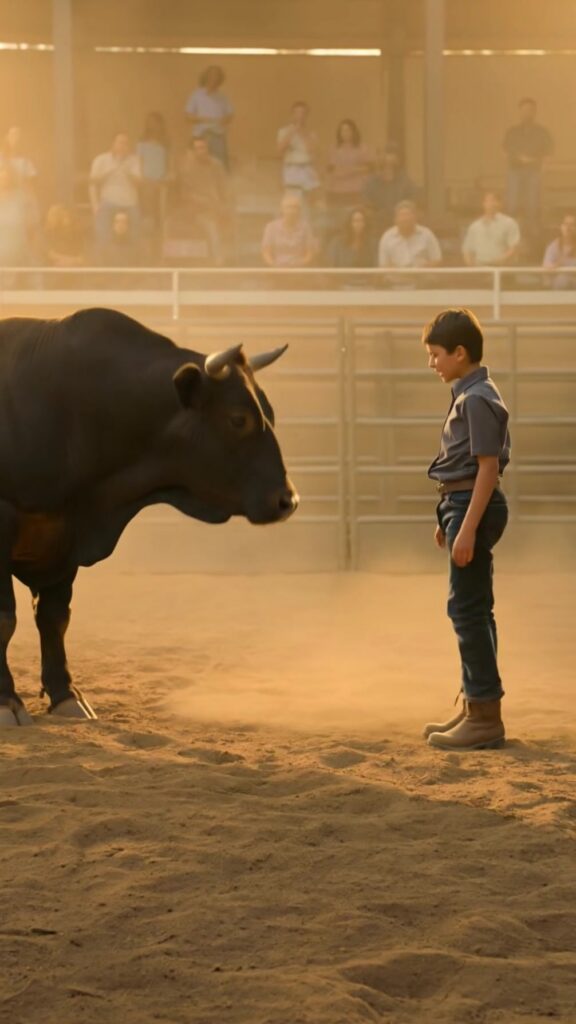
Up close, Diablo was bigger than rumor could hold. His breath steamed faintly despite the heat, a wet exhale that smelled of grass and rage. The bull’s eye was dark and bright at once, a bead of focus. The boy stopped at the bars and set one hand on the metal. He didn’t reach for the rope. He didn’t ask for chalk. He simply stood there, head tilted, listening as if the bull had spoken. The noise of the crowd softened, not because anyone had decided to be quiet but because attention had narrowed to that small, tense triangle: boy, chute, beast.
Diablo surged forward, then halted so abruptly the chain on the gate went slack. His nostrils flared; his shoulders rose and fell once. The bull’s head lowered as if he meant to charge the bars again—then it didn’t. He stared at the boy with a stillness that felt unnatural on that kind of animal. A murmur spread, thin at first, then thickening. Men who’d seen Diablo break riders blinked, uncertain. The boy lifted his other hand, palm open, and pressed it lightly to the warm curve of Diablo’s muzzle through the gap. A brave gesture, or a foolish one. Either way, it made the sun seem brighter, the shadows sharper.
“Get him out of there,” someone hissed from the rail. “He’ll die.” But the boy didn’t move, and Diablo didn’t strike. Instead, the bull released a slow breath, a sound almost like a sigh, and shifted his weight back. The gate crew exchanged looks, hands hovering near latches they were no longer sure they wanted to touch. The suited man stepped closer, his confidence faltering for the first time as he saw the impossible quiet take shape. The envelope trembled slightly in his fingers, whether from heat or something else.
The boy finally turned, not toward the crowd but toward the gate crew. His voice was low, barely audible, forcing them to lean in. “Open it,” he said. The words carried no thrill, no arrogance. Just command. The gate hand’s face tightened. He looked to the stock contractor, to the judge, to the suited stranger with the money, as if searching for permission to be terrified. Then, with a motion that seemed to cost him, he reached for the latch.
When the chute door swung wide, time didn’t explode the way everyone expected. Diablo stepped out, not charging but walking, hooves thudding softly. The boy moved with him, not running, not riding—simply keeping pace at the bull’s shoulder like a shadow that belonged. Diablo’s head swung once, as if to test the air, and the boy’s hand lifted in a small, steadying gesture. The bull turned, slow and deliberate, and the boy guided him toward the center of the arena where the dust lay unmarked, where all the earlier wreckage had been raked away like a lie.
The crowd’s laughter had dried up. People watched with their mouths slightly open, as if the heat had stolen language from them. The suited man climbed onto the rail, his suit finally picking up a smear of dirt at the knee. He shouted something about the rules—about controlling, about beating, about eight seconds—but his words rang hollow. In the ring, Diablo halted. The boy stood in front of him, close enough that one breath could fog the boy’s cheek, and lifted his chin. Diablo lowered his massive head until it nearly touched the brim of the boy’s hat.
For a long moment, nothing happened. Then Diablo bent one foreleg and sank to the dirt, a movement so controlled it looked rehearsed. The second leg followed. The bull knelt like a mountain conceding. Dust billowed and settled across their boots and hooves, and the arena seemed to tilt as the crowd tried to understand what it was seeing. The boy rested a hand on Diablo’s neck, fingers spread, steady as a brand. The suited man’s envelope slipped from his grip and fluttered down into the ring, landing in the dirt with a soft, useless sound.
Later, people would argue about tricks and training, about hidden wires and tranquilizers, about whether it was even possible. But the men who worked the chutes—men with scarred hands and old injuries—would remember the truth that didn’t fit a rumor: Diablo had been a challenge until someone arrived who didn’t want to conquer him. The boy didn’t beat the bull. He didn’t dominate him. He met him without fear, without hunger, without the sharpness that Diablo had always answered with violence. And in that moment, under the brutal Texas heat, the arena finally understood that power recognizes its own kind—and sometimes, it bows.