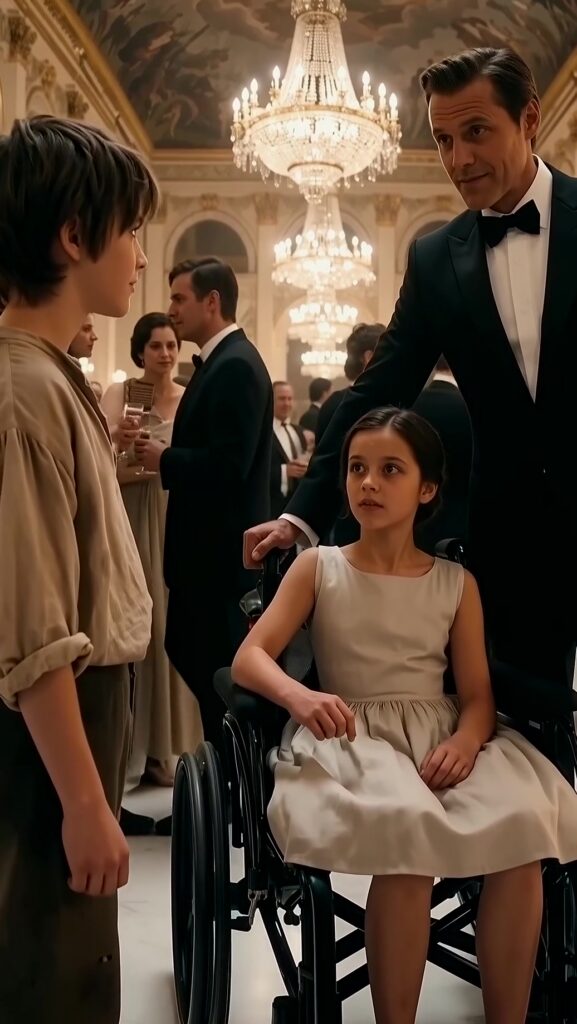
The room was full of life—too much of it, almost. Voices braided together in quick, confident strands. Shoes scuffed polished stone. Glasses clinked. A violin somewhere tried to sound casual and failed, as if even music understood it had been hired to perform a lie.
In the middle of it all stood Leon Marrow, immaculate in charcoal, the kind of man who could make a crowd feel organized simply by breathing in time. Investors angled their bodies toward him. City officials laughed a little louder when he spoke. Cameras found his face like compasses.
He had built this: the Marrow Foundation gala, the pledge board glowing with numbers that climbed like obedient vines, the banners that said RENEWAL and meant CONTROL. The room itself had been a derelict ward once—St. Dymphna’s Children’s Hospital, abandoned after the fire. Leon had bought the shell, rebuilt it into an event hall, and told the papers he’d returned light to a dark place.
Only he knew how much the darkness still remembered.
Beside him, Celeste Vane monitored everything with a hawk’s precision, her smile a thin blade. She wore her authority like perfume—subtle, everywhere. When a donor’s laughter lingered too long near Leon, she drifted in, redirected, rearranged. When a waiter stumbled, she had him corrected without touching him.
“You’re doing well,” she murmured to Leon, as if praising a trained animal. “Ten more minutes and we announce the new wing. Keep your voice steady. No surprises.”
Leon’s hand hovered near his breast pocket, where a silver chain lay against his chest like a private threat. He did not touch it. He never touched it in public.
A ripple ran through the doors at the far end of the hall—small, strange, like a thread pulled from a tapestry. People glanced up, then away, irritated at being interrupted. Leon didn’t look at first. He assumed it was another photographer, another late official, another person arriving with entitlement and an agenda.
But the ripple didn’t settle. It sharpened.
A child had stepped inside.
She was small enough that the crowd’s bodies could have swallowed her. Yet no one stopped her. No security hand rose. No staff member approached with practiced politeness. It was as if the room’s usual rules failed to recognize her presence, like an error the system couldn’t parse.
She walked forward at a steady pace, through knots of tuxedos and gowns that unconsciously parted for her. Not lost. Not timid. Certain—like she had been here before, like the floor remembered her feet.
Leon felt the shift before he saw her face. The air tightened. The lights seemed to hold their breath. The room’s busy life, so carefully curated, dimmed at the edges as if something older and truer had stepped into it.
Celeste noticed too. Her head turned. Her eyes narrowed with quick calculation, and her smile vanished without ceremony.
“No children are on the list,” she said, already moving. Her heels did not hurry, but her intent did.
She met the girl halfway, blocking her path with a posture that did not allow negotiation. “You can’t be in here,” she said sharply, voice low but cutting. “Leave. Now.”
The girl didn’t react. She didn’t flinch, didn’t blink faster, didn’t look up to plead. She simply stepped around Celeste as if Celeste were furniture.
Celeste’s hand rose, then paused in midair, fingers curled as though they had reached a boundary they could not cross. For the first time in years, Celeste looked uncertain of her own control.
The girl continued straight toward Leon.
Leon’s throat went dry. He could not have said why. He had spent his adult life excelling at cause and effect, at leverage and narrative. Yet this was neither. This was recognition, sudden and animal.
She stopped in front of him, so close that Leon could see the faint crescent of a scar under her chin, pale as moonlight. Her eyes were dark and steady—too steady for someone so young. She lifted her hand.
Resting on her palm was a silver locket.
The chain was fine, worn in one place where it had rubbed against skin for years. The locket itself was oval, engraved with a small compass rose. Leon knew the weight of that metal without touching it. He knew the tiny scratch near the hinge. He knew the way it refused to stay fully shut unless you pressed it exactly right.
His breath caught—an involuntary betrayal. Slowly, as if pulled by a magnet, his hand moved to his own chest. Beneath the tailored suit, beneath the public man, his fingers found his locket. Identical shape. Identical engraving. Identical wound of memory.
“That’s not possible,” he whispered, and the words sounded too loud in his own ears, though the room had not yet fully quieted.
The girl stepped closer. She opened the locket in her palm with a practiced thumb, like she had done it a thousand times to make sure it still contained what she needed.
Leon leaned in without meaning to. Inside was a photograph—creased at the corners, old despite the child’s young hand. A woman smiled at the camera with the kind of tired bravery Leon had once mistaken for weakness. Her hair was pinned back in a hospital bandana. Her eyes were bright with defiance. Behind her, barely in frame, a sign read ST. D. WARD 3.
Leon’s vision narrowed until there was only that face. The gala around him became a distant hum, like blood in his ears.
“Where did you get this?” His voice tightened, fraying at the edges.
The girl met his eyes. “My mom told me to find you.”
Silence began to spread—not sudden, but inevitable. Conversations faltered as people sensed the temperature changing. Heads turned. A waiter froze mid-step. Even the violin’s thin melody faltered into a strangled note.
Leon’s mind ran wild routes. The woman in the photograph had vanished from his world fifteen years ago. Not by accident. Not by illness. By design—his design, at Celeste’s urging, because she had been a complication, because she had known things that did not fit the story Leon had built his life upon.
“What’s her name?” Leon asked, and the question scraped something raw in him.
The girl answered with a single name.
It hit the room like a dropped glass. Leon felt it in his ribs. The past, which he had buried under foundations and donations and headlines, surged up with wet, choking force. He saw a corridor lit by emergency lamps. He smelled smoke and antiseptic. He heard a woman laughing once, softly, as if the world hadn’t already decided to crush her.
Celeste went pale. The color drained from her face as if someone had pulled a plug. Her hand found Leon’s arm, too tight, nails digging through fabric. “This is not happening,” she whispered, but it sounded like prayer, not certainty.
Leon stepped back, as if distance could make the moment smaller. It didn’t. The room seemed to lean in.
The girl wasn’t finished. With her other hand she reached into her coat—too heavy for her slight shoulders—and pulled out a folded note. The paper was creased, softened by handling, kept safe against a child’s body like a second heartbeat.
“She said you’d understand,” the girl said.
Leon took it slowly. His fingers trembled—another betrayal. He unfolded the paper and read.
The handwriting was unmistakable: sharp slants, a habit of underlining the important words as if daring the reader to look away. It was not a long note. It didn’t need to be.
It named what happened the night of the fire. It named who locked the stairwell door. It named who signed the reports that blamed faulty wiring instead of deliberate sabotage. It named the money that changed hands and the signatures that disappeared. It named Celeste.
And at the bottom, in a line that made Leon’s stomach turn to ice, it read: If you’re reading this, then you’ve met her. Don’t pretend she’s a stranger. She’s the part of you you tried to burn away.
Leon’s eyes lifted from the page to the girl’s face. In her features—around the mouth, in the set of the jaw—he saw a reflection of himself he could not deny. Not a mirror-polished resemblance, but something deeper, like bone recognizing bone.
Celeste’s grip on his arm became frantic. “Leon,” she hissed, her voice trembling now, “don’t—don’t do this here. We can handle it. We can—”
But the room had changed. The room that had been full of life—of curated laughter and obedient admiration—was suddenly full of something else: attention, sharp and hungry. People sensed a fracture in the story and wanted to see what bled through.
Leon looked down at the two lockets: one in the child’s hand, one heavy against his own heart. Identical twins separated by years and lies. He understood, with a sick clarity, what the note really was.
Not a plea. Not an explanation.
A summons.
He folded the paper carefully, as if it might cut him, and met the girl’s steady gaze. “Where is she?” he asked, and his voice sounded older than he felt.
The girl blinked once, slow. “She said you’d ask that,” she replied. “She said you’d finally be ready to remember.”
Leon swallowed. Around them, the gala waited, holding its breath. Celeste’s eyes darted, searching for an exit, for a lever, for anything she could still control.
The girl held out the locket again, open, the photograph facing him like evidence. “She told me to show you,” the child said softly. “So you couldn’t lie.”
Leon stared at the woman’s smile trapped in silver, and something inside him—something he had kept sealed behind money and charm—gave way with a quiet, terrible crack.
The room had been full of life.
Until it wasn’t.