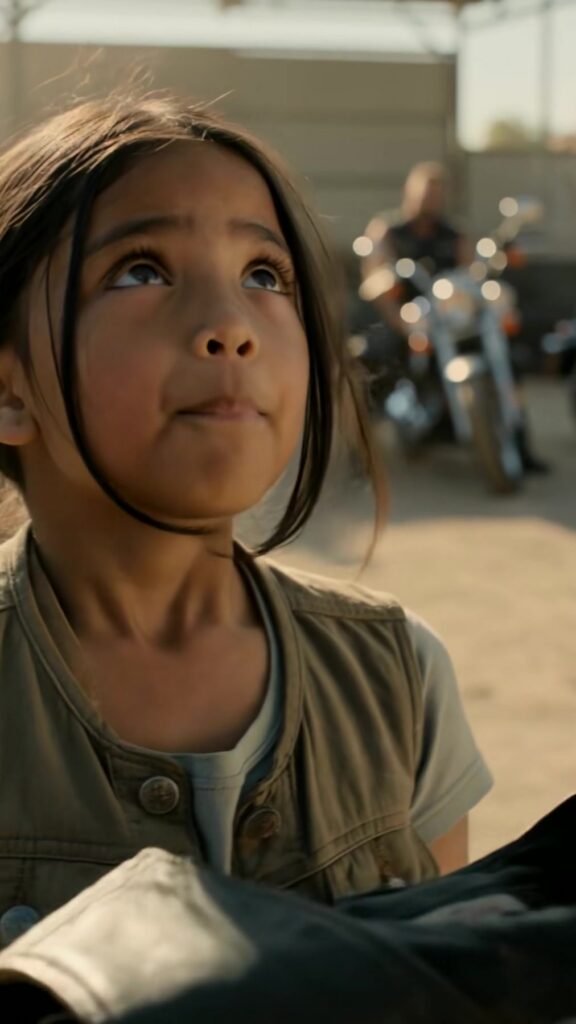
No one noticed her at first because the yard was built to erase small things. It swallowed sound, swallowed faces, swallowed the scrape of shoes on gravel under the scream of metal and the spit of torches. Men moved in practiced arcs between stacked containers and skeletal frames. Money changed hands without names. Laughter came in bursts as sharp as thrown bolts.
She was only a child at the edge of it—thin wrists, hair pulled back too tight, cheeks rubbed raw by cold wind and old tears. She wore a coat that had once fit someone else and boots that made her walk like she was learning the shape of her own feet. In her hands she held a folded vest, too heavy for its size. She kept it hugged to her ribs the way people held bread during hard winters.
She stepped past the fence line where the “KEEP OUT” sign hung crooked on a single nail. Nobody stopped her because nobody looked down. A few heads turned when her boot caught in a loop of chain and she stumbled, and when the vest slipped from her hands it landed in the dirt with a soft, wrong sound—cloth where only steel belonged.
A couple of young men near the cutting table saw it and snorted. One called out, “Wrong place, kid.” Another mimed shooing a stray cat. The laughter came quickly, easy as habit, because mockery cost nothing and made them feel taller.
She didn’t leave.
She crouched, brushed grit off the fabric with trembling fingers, and folded it again as carefully as if it could break. Then she stood and walked deeper into the yard, straight toward the far office where the only door had a lock that didn’t look ornamental.
Behind that door was a man the others called Marrow—not to his face, not usually. His real name was Asher Kline, but the yard had never cared for real names. He was broad-shouldered, sleeve rolled to the elbow, forearms tattooed in faded bands that hinted at allegiances long buried. He didn’t shout. He didn’t need to. When he spoke, even machines seemed to hear him.
Asher was in the doorway when she approached, a ledger in one hand, a cigarette forgotten between two fingers. He watched her the way he watched a crate being lowered from a crane—calculating where the weight would fall, what it might crush.
She stopped at a respectful distance. Her hands tightened around the vest until the cloth creased. “Please,” she said, and the word sounded like it had been used up already. “Buy it.”
Asher’s eyes flicked over her face, the dirt on her knees, the rim of dried blood where she’d bitten her lip. “What is this?” he asked, not unkindly, but with the blunt impatience of someone who had learned that sympathy was a luxury that got people killed.
“It’s real,” she said. “My daddy wore it.”
That made him pause. He had seen plenty of vests—safety vests, stolen vests, counterfeit vests with shiny plates and cheap stitching. But the way she held this one was different. The cloth was old, thick, and the edges were frayed in the honest way of something that had been used, not styled.
Asher took it from her. His fingers were careful, almost reluctant. He turned it slowly, letting the light hit the seams. The room behind him smelled of oil and stale coffee, but as he lifted the vest higher, the scent of smoke seemed to rise from it—cold smoke, the memory of a burned place.
“Why are you selling it?” he asked.
Her gaze dropped to his boots as if the answer might be written there. “My daddy…” She swallowed, and when she spoke again her voice was smaller. “He won’t wake up.”
The yard noise didn’t stop, not truly, but something tightened in the air. Even the men nearby, curious in the way predators are curious, quieted enough to listen. Asher felt the old reflex—distance, denial, dismiss it. It’s a vest. It’s a kid. It’s not your problem.
He opened it anyway.
Inside, the lining was patched in places where something sharp had torn through. Someone had repaired it by hand, not for looks but for survival. Asher’s thumb traced the stitches, and then he saw it: a symbol half-hidden beneath the inner seam, inked into the cloth like a secret tattoo.
A broken circle with a line through it. Three small dots below. The mark of a vanished outfit. Not a gang. Not quite a unit. A name that had been scrubbed out of official records and whispered only in rooms with no windows.
For a heartbeat, everything inside Asher went still. He could hear, with painful clarity, a different yard—snow, floodlights, the clank of chains. The crack of radios. The sound a door made when it sealed for the last time.
He looked up at the girl. “Where did you get this?” His voice came out low, the cigarette unlit between his fingers.
“From my daddy,” she said simply. “He said you would know.”
Asher’s jaw tightened. “What’s his name?”
She stepped closer, close enough that he could see the bruising around her wrists—as if hands had grabbed her too hard, or she’d held on to something that pulled away. Her eyes were dark, steady in a way that didn’t belong to children. “Eli Mercer,” she said.
Asher took a step back without meaning to. The office threshold pressed into his heels. That name hit him like a metal bar swung from behind—impossible, heavy, ringing through bone. Eli Mercer was a ghost he had buried with both hands. Eli Mercer had been dead for nine years, in a fire the city pretended had never happened.
“No,” Asher whispered. The word escaped before he could stop it.
“He’s not dead,” she said, and there was no argument in her, only fact. “He’s just not waking up.”
Asher stared at her, at the shape of her mouth when she said “daddy,” and something unwound in his chest. He had known Eli’s laugh. He had known Eli’s stubbornness. He had known the way Eli would look at a locked door and decide it was simply a problem that hadn’t met him yet.
“Where is he?” Asher asked.
She hesitated, finally, and he saw fear move through her like wind through dry grass. “In our apartment. He came home last night. He walked in like he’d never been gone.” Her voice wavered. “He hugged me. He told me to go to you if he didn’t wake up. Then he sat on the couch and… his eyes closed.”
Asher’s mind raced through possibilities—poisoning, injury, deception. And behind all of it, the symbol on the vest burned like a brand. That mark hadn’t been seen in years because anyone who wore it had been either silenced or bought. If Eli Mercer had returned wearing it, then someone had failed to finish a job. Or someone was sending a message.
“Who else knows?” Asher asked.
“No one,” she said quickly. “I didn’t tell the neighbors. I didn’t call the ambulance because Daddy said not to. He said they would take him away.” Her hands clenched at her sides. “I did what he told me. I came here. Like a good girl.”
The words cut deeper than he expected. Asher looked past her at the men in the yard, at the easy cruelty, at the way danger wore ordinary faces. He realized, with a cold rush, how close she had been to being swallowed by this place the moment she stepped in.
He folded the vest again and pressed it gently into her arms—not as a purchase, not as charity, but as something returned to its rightful keeper. Then he reached into his pocket and pulled out a roll of bills, more than the vest was worth, more than she could argue against. He tucked it into her coat pocket with the practiced speed of a man who knew how to do quiet things quickly.
“What’s your name?” he asked.
“Mara,” she said.
Asher nodded once. “Mara. You’re going to take me to him.”
Her eyes widened. “You’ll help?”
Asher’s gaze drifted to the symbol one last time, then to the yard beyond, where men were already returning to their noise now that the moment had passed. He felt the old life stirring like a beast that had been caged, like a debt that had never been paid.
“I owe your father,” he said. “And if someone brought him back just to put him down again, they picked the wrong yard.”
Mara held the vest tighter, as if it was the only proof she hadn’t imagined her father’s return. Together they walked out, unnoticed now for a different reason: because the yard preferred to pretend it hadn’t seen anything at all.
Behind Asher’s eyes, the past began to move, grinding its gears into the present. The symbol wasn’t supposed to exist anymore. Eli Mercer wasn’t supposed to exist anymore.
But here was the child who carried his name like a match in a dark room, and Asher knew—before they even reached the street—that nothing in his life was going to stay buried after tonight.