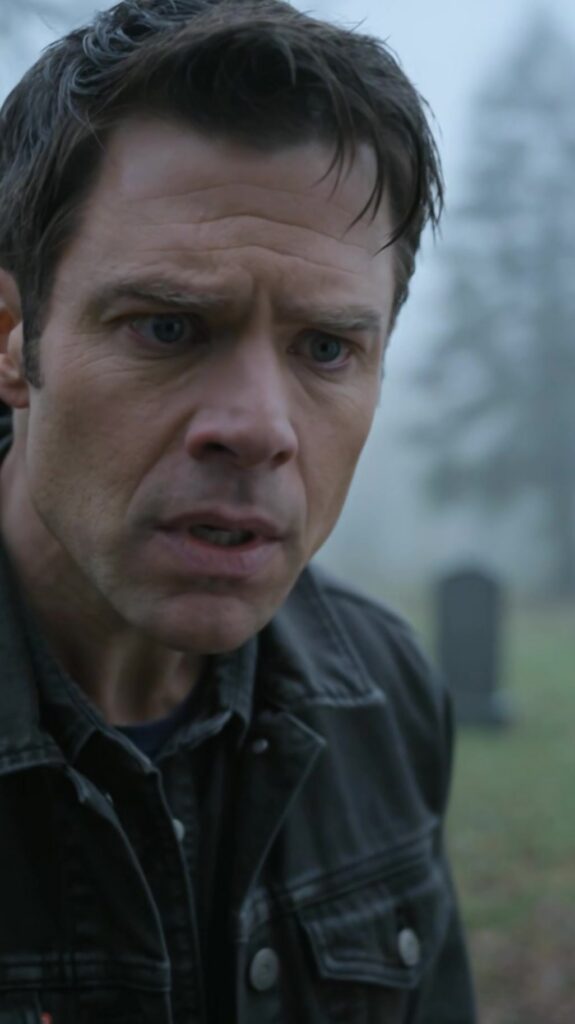
The cemetery felt wrong from the moment Daniel pushed through its iron gate. Not because of fog or wind or the usual theater of death—there was none. The sky hung clear and colorless, and the gravel path lay too neat, too undisturbed, as if footsteps had been banned. Even the birds seemed to have agreed on an absence. Daniel’s ears strained for the small honest noises of life—leaf-rustle, distant traffic, a dog—anything. The quiet here wasn’t peace. It was restraint.
Lena walked ahead of him with bare feet that should have been cold, should have been cut by stones, should have made her wince. She didn’t. Mud slicked her ankles like a second skin. Daniel had found her by the roadside an hour earlier, one thin child in an oversized coat, staring at the town sign as if it were an accusation. She’d told him her name with the flat certainty of someone reciting a fact that could not be bargained with. Then she’d asked to be brought here, to the graves “where the air goes dead.”
They stopped at the edge of the older section, where the headstones sagged and the inscriptions blurred into the grain. Lena didn’t hesitate. She crossed the grass as though following a map in her mind, and Daniel followed, his boots suddenly loud. She paused before a stone worn nearly smooth, and the wrongness sharpened: not a shiver, not a draft, but the feeling that the world had leaned in to listen.
“They aren’t gone,” Lena said. Her voice was soft, yet it struck the quiet like a dropped plate.
Daniel frowned and tried to make his face kind. “People say a lot of things at cemeteries,” he replied. “What do you mean?”
Lena didn’t turn. Her gaze stayed on the stone, as if she could see through it into the packed earth. “They follow me,” she said. “Always. Both of them.”
The word both made Daniel’s throat tighten, though he couldn’t have said why. He stepped closer, squinted at the weather-chewed lettering, and felt a slow, unpleasant recognition. Two names. Old. Faded, yet stubborn, the way some sins refuse to erode.
He hadn’t stood at this grave in twenty years. He’d told himself he couldn’t find it again. He’d told himself it was better that way.
“That’s not possible,” Daniel heard himself say, a lawyer’s reflex without the law. “If you mean—if you’re saying they talk to you, that’s…” He trailed off, because the alternatives were worse: a prank, a delusion, or an impossible truth that would pry open the sealed places in his head.
Lena knelt. Her small hands pressed against the stone with a tenderness that made Daniel’s stomach twist. She closed her eyes, as if listening to something close to the ground. When she spoke, her words seemed to come from the air itself, from the thick, held breath of the place. “They don’t like it here,” she whispered. “They say it’s too still. Like the world forgot to blink.”
Daniel took a step back. His heel struck a hidden root and he nearly stumbled, and the cemetery remained indifferent. “Who told you that?” he asked, hearing the tremor he didn’t want in his own voice.
Lena opened her eyes. They were not bright the way children’s eyes were supposed to be. They looked weathered, like river stones. “They did,” she said, simply.
Silence piled between them, thick as damp wool. Daniel looked again at the names, and memory rose like bile: the orphanage on the hill with its peeling paint; the smell of boiled cabbage; the strict hands; the hunger that made kindness feel like a trick. He remembered two boys who weren’t his brothers but might as well have been, because they’d shared stolen bread with him under the stairs. He remembered the way they laughed, even there. He remembered the night of the fire—how the alarms didn’t ring. How the doors were locked. How the staff told the older kids to “be brave” as if bravery could breathe for you.
He remembered running.
Lena’s finger traced a crack in the stone. “They want to go back,” she said.
Daniel’s mouth tasted metallic. “Back where?”
Lena rose slowly and pointed, not at the cemetery exit but beyond it, past the low wall, toward the road that led up the hill. “The home,” she said. She didn’t use the word orphanage. She didn’t need to. Daniel felt it anyway, like a hand closing around his ribs.
“That place was torn down,” he managed. “It doesn’t exist.” He wanted that to be the end of it, the simple relief of facts. He wanted to drag Lena away, take her to a warm diner, call the authorities, let someone else sort out her strange talk and her mud-caked feet.
But the cemetery’s wrong silence held him in place.
“It exists where they are,” Lena said. “And they’re tired.” She lowered her hand and studied Daniel as if he were another headstone whose writing needed deciphering. “They come with me,” she added. “They have nowhere else to go.”
Daniel heard his own pulse, loud and disobedient. He stared at Lena and saw, for the first time, the bruise-shadow at her temple shaped like an old burn. The scar at the base of her neck. The way her coat sleeves hid her wrists. He saw not just a child but a message carried forward in flesh.
“Why are you telling me?” he asked, though he already knew. Guilt always knows its address.
Lena tilted her head, and in that small motion she looked suddenly older than nine or ten—older than Daniel felt. “Because they’ve been waiting,” she said. “They said you would come when you couldn’t pretend anymore.”
“Waiting for what?” Daniel’s voice broke on the last word.
Lena stepped closer until Daniel could smell wet earth on her skin. She lifted her hand and, with careful inevitability, placed two muddy fingers against his wrist where his pulse beat. The contact was cold, not like a child’s hand but like stone left in shade. “For you,” she said.
The cemetery did not change. No wind rose. No crow cried. Yet something inside Daniel shifted—the latch on an old door, the snap of a sealed jar. He saw himself at sixteen, standing outside the burning building, smoke clawing at the windows. He saw the staff member screaming that the keys were missing. He saw himself holding those keys in his pocket, stolen earlier as a joke, a petty rebellion. He saw himself hesitate. He saw himself run, because he was a boy and terrified and convinced that if he went back he would die too.
He hadn’t told anyone. He’d built a life on top of that secret the way you build a house on rot and hope it holds. It had held—until now.
Lena’s eyes did not blink. “They don’t want revenge,” she said, as if answering thoughts he hadn’t spoken. “They want to be heard. They want someone to say their names out loud like it matters.”
Daniel looked at the stone again. He tried to read the worn letters. The names rose in him, half-remembered and aching. When he spoke them, his voice shook, and the wrong quiet seemed to lean closer, hungry for the sound. “I’m sorry,” he whispered, but the words were too small for the years they’d been trapped behind his teeth.
Lena nodded once, as though he’d finally done the first necessary thing. She turned toward the road leading up the hill. “Come,” she said. “They want to go home, and they can’t without you.”
Daniel hesitated at the edge of the grave, caught between the certainty of consequences and the thin, terrible hope that confession could be a kind of rescue. The cemetery remained wrong—too neat, too held, too still—until he took his first step after the barefoot girl. Then, somewhere in the trees, a bird finally called out, sharp and startled, as if the world itself had been waiting for him to move.
Behind them, the two names on the stone seemed less faded, not by ink or miracle, but by attention. They were not gone. They had never been.