No one expected anything to go wrong. The banner above the fairgrounds snapped lazily in a wind that smelled of dust and funnel cakes, and the loudspeaker’s cheerful crackle promised a night of familiar danger—danger you paid for and applauded because it stayed inside the fences.
The rodeo moved like a practiced prayer. Clowns darted and bowed. A barrel racer’s horse flew through the pattern with its mane streaming, and the crowd rose on cue, a single organism made of denim, soda, and anticipation. Behind the chutes, men in felt hats checked knots and buckles with the calm of people who had repeated the same ritual for decades and believed repetition could tame anything.
In the last stall, under a strip of harsh light, the bull stood quiet.
His name in the program was ASH KING, printed in bold as if the paper could contain him. He was bigger than the others, shoulders like a loaded truck, hide the color of old smoke. Most bulls stamped or snorted, irritated by the smell of sweat and metal. Ash King simply watched. His eyes held that unnerving stillness that made riders invent superstitions, as though the animal understood not just movement but motive.
“That one’s different,” someone always whispered. And someone else always replied, “They’re all different. That’s the point.”
Tonight, the announcer played it up, stretching the name into a promise. “Ladies and gentlemen, buckle in. This one is a legend.”
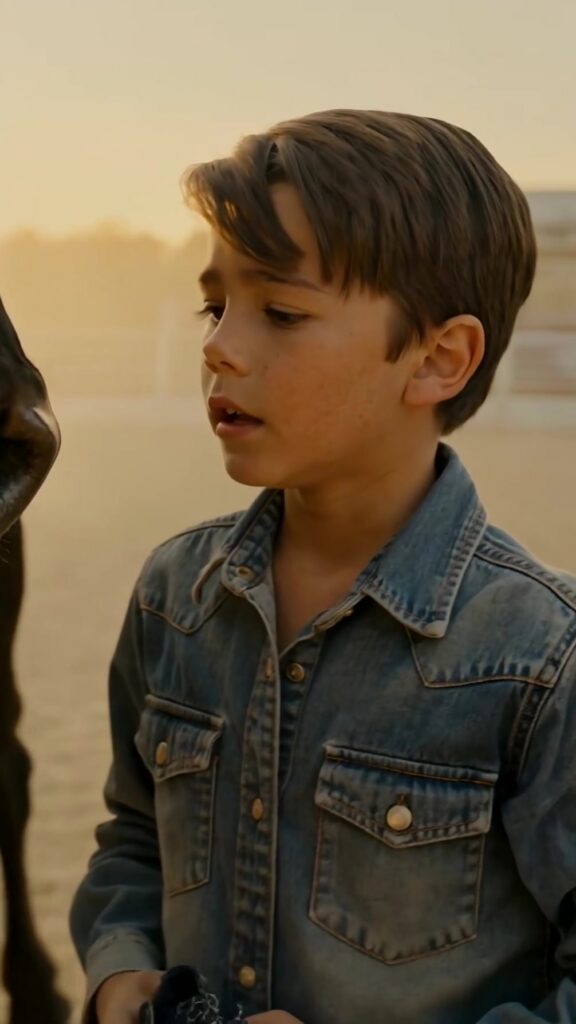
Up in the stands, a boy sat on the edge of his seat, fingers worrying the hem of his shirt. He couldn’t have been more than twelve. Too thin for his boots, hair cut close like he’d been forced to sit still for it. His eyes didn’t roam the arena the way other kids’ did. He stared at the gate where Ash King would burst out, like he was waiting for a person to arrive.
Beside him sat an older woman with hands roughened by work. She kept glancing down at the boy as if checking he was still there. “Eli,” she murmured once, low enough that the roar of the crowd swallowed it. “You promised.”
He nodded without looking at her. His palm was pressed into his pocket as if he were holding something fragile there.
The chute gate clanged. The bull’s rider climbed into position, legs tense around the animal’s barrel of a body. The man’s jaw was set, and yet his eyes flicked once toward the quiet bull, and something like doubt passed through.
“Eight seconds!” the announcer sang. “Just eight!”
The bell was about to ring when the boy moved.
At first it seemed like he was only stepping down to the aisle. That happened sometimes—kids ran to the rail for a better look, parents tugged them back, ushers scolded. The boy slipped past knees and coolers with an urgency that looked like determination wearing the mask of clumsiness.
Then he went over the side.
The metal rail was chest-high on him, and he climbed it with startling quickness, dropping into the dirt of the arena in a small puff of dust.
The sound that rose from the stands was not a cheer. It was the collective inhale of a crowd realizing the boundary between entertainment and catastrophe had been crossed.
“Hey! What is that kid doing?!” someone shouted, the words cracking with panic.
Boots pounded on the walkway. A rodeo clown froze mid-joke, head snapping toward the small figure. Down by the chutes, a handler cursed and reached for the gate latch, not to release the bull, but to keep everything from happening at once.
Eli stumbled in the soft dirt, caught himself on his hands, then pushed up again. He didn’t look back at the railing. He didn’t look for his grandmother. He walked straight toward the center of the arena, toward the line of light beneath the stadium lamps.
It could have been a mistake—an impulsive dare, a child’s confusion.
Then it didn’t look like a mistake at all.
Ash King had lifted his head.
In the chute, the bull shifted, slow and deliberate, as if he’d felt a change in the air. The rider’s posture tightened. “What’s going on?” he hissed to the men beside him. No one answered because everyone was watching the same impossible thing: the bull’s gaze tracking the boy through the gap in the boards.
The air seemed to thicken. The arena sounds—the announcer’s patter, the country song on the speakers—fell apart into fragments. Even the lights looked colder.
“Get him out of there!” a woman screamed from the stands. “Somebody!”
A rodeo clown started forward, then hesitated. There was something in the way Eli walked that made interference feel wrong, like interrupting a confession.
Eli stopped in front of the chute, close enough that the men behind the gate could have reached out and grabbed his shirt. His shoulders rose and fell with fast breaths. His face held a seriousness that didn’t belong to his age.
“Please,” he said, voice small but clear. “Look at me.”
Ash King’s nostrils flared. The bull’s body pressed against the wood, and one of the handlers flinched away from the gate as if bracing for impact.
“Son, move!” a voice called out—gravelly, urgent. It came from the man at the latch, a veteran with gray at his temples and hands scarred by rope burn. He looked like someone who had seen too many bodies carried out to risk another.
But Eli stayed.
His hand left his pocket. In his palm lay a faded bandana, once red, now softened into the color of dried rust. It was worn thin in the center, edges frayed from being tied and untied so many times it had learned the shape of a knot.
He lifted it toward the chute as if offering it to a priest at an altar.
“My dad said you’d know this,” Eli whispered.
The arena went still.
Not silent—there were still the restless clinks of metal and the distant hum of the generator—but the people stopped making noise. The older ones recognized the cloth. You could see it in the way their faces changed, memory sliding over their expressions like a shadow.
“That’s…” someone breathed. “That’s Ray’s.”
Ray Benton. A rider who’d been a favorite here before he stopped showing up. Before the accident on the highway that had made headlines for a day and then been replaced by the next tragedy.
Eli swallowed. His eyes never left the bull. “He loved you more than anything,” he said, and the words came out with a child’s blunt honesty, not understanding how strange it sounded to say it about an animal.
The handler’s hand trembled on the latch. He looked from the boy to the bandana to the bull, and for a moment his face held the expression of a man being asked to choose between rules and something older than rules.
Ash King stopped moving. His massive head lowered a fraction. Through the slats of the gate, his breath puffed, warm and damp in the cold light. The rider inside the chute shifted his weight, suddenly irrelevant, his bravado drained away.
Eli took one more step closer. Too close. Close enough that, if the gate opened, the bull’s first motion could have snapped him like a twig.
“If you remember him…” Eli’s voice broke. He blinked hard as if fighting something that had been building for months. “Don’t leave me too.”
The words hit the arena like a thrown stone. They weren’t about a bull. They were about the empty chair at the kitchen table, the boots that never came back to the porch, the way adults spoke in lowered voices like grief was a contagious illness.
The handler muttered, “Lord,” under his breath, and tightened his grip on the latch anyway, prepared to pull the boy back by force.
Ash King shifted.
The bull’s hooves scraped once, slow and heavy, a sound like a door closing. His body pressed forward, and with a reluctant creak the chute gate swung open—not flung by panic, but eased by hands that had decided to stop fighting what was happening.
In any other moment, the release would have been an explosion. Eight hundred pounds of fury bursting into open space.
Ash King stepped out like a shadow detaching itself from a wall.
Gasps tore through the stands. The clown started running, then stopped again, uncertain where to place his body between child and beast. The announcer’s microphone squealed with feedback, his voice lost, useless.
Eli didn’t flinch. He held the bandana up, arm trembling from the effort of staying steady.
Ash King walked toward him.
Slowly. Each step heavier than the last, not with rage but with the weight of something considered. The bull’s head stayed level, eyes fixed on the cloth, on the boy’s face, on whatever memory lived in scent and color and the subtle language of posture.
When the bull reached him, he stopped. Dust swirled around his hooves. Eli’s chest rose in a shuddering breath.
For a heartbeat, the arena balanced on the edge of disaster.
Then Ash King lowered his head and breathed on the bandana.
The cloth fluttered. Eli’s fingers curled tighter. The bull’s nose pressed, gentle as a nudge from a horse in a stall, and the boy’s arm dipped, his balance swaying under the unexpected softness.
Eli let out a sound that was not quite a sob and not quite laughter. “Hi,” he whispered, as if greeting someone at a door.
Ash King’s muzzle moved again, brushing Eli’s knuckles, then his wrist. The bull’s eyes half-lidded, and for the first time all night, he looked less like a weapon and more like an animal carrying a history no one had bothered to ask about.
In the stands, the grandmother pressed a hand to her mouth. Tears shone along the creases of her weathered face. She had tried to keep the boy safe with promises and rules, but grief had slipped through anyway, guiding him here like a compass needle pointing at pain.
The gray-templed handler took a cautious step forward, arms out. “Eli,” he said softly now, not shouting. “Come on, son. Let’s go.”
Eli didn’t move immediately. He lifted the bandana and, with a care that looked practiced, tied it to the fence post beside the chute, knotting it the way his father must have shown him, the way some gestures survive longer than people.
Then he turned, and for the first time he glanced back at the stands. His eyes found his grandmother, and something passed between them—fear, love, apology, a quiet defiance of the idea that death got the last word.
He took a step away from the bull.
Ash King didn’t charge. He didn’t toss his head. He simply watched, still and focused, as if waiting to see whether the boy would keep his own promise.
When Eli reached the handler, the man’s hands closed around the boy’s shoulders, firm but careful. He guided him toward the rail. The clown moved with them, body positioned to distract if needed, but Ash King stayed where he was, breathing slow.
The crowd remained hushed until Eli’s boots hit the grass outside the arena. Only then did sound return—first as murmurs, then as a wave of voices trying to explain what they’d just witnessed with the small vocabulary people have for the unplanned.
In the arena, Ash King turned back toward the chutes. The rider had slipped off him long ago, forgotten in the confusion, and now stood with his helmet in hand, eyes wide and humbled.
The handler reached for the gate, hesitated, and looked up at the bandana tied there. The cloth hung like a flag of truce in the harsh light.
“Ray,” he whispered, as if speaking to the air. “What did you do to that bull?”
Ash King stepped forward, and the handler opened the gate, guiding him inside with the careful patience of someone leading a grief-stricken friend home. The bull went without resistance, head low, as if the bandana had pulled a thread from deep inside him and loosened something that had been knotted for years.
Up in the stands, Eli leaned into his grandmother’s side, her arm tight around him. He stared at the empty arena where danger had been replaced, briefly, by something harder to name.
No one expected anything to go wrong. They had come for spectacle and controlled fear. Instead they witnessed a child walk into the place where monsters lived and find, beneath the muscle and menace, a memory answering back.
The rodeo would continue after a long, awkward pause. There would be apologies and stern talks, new rules about barriers and security. People would tell the story for years, embellishing it into legend.
But Eli would remember the truth: the moment the bull stepped closer, and the world didn’t end—because for once, something that should have broken simply stopped, recognized him, and stayed.