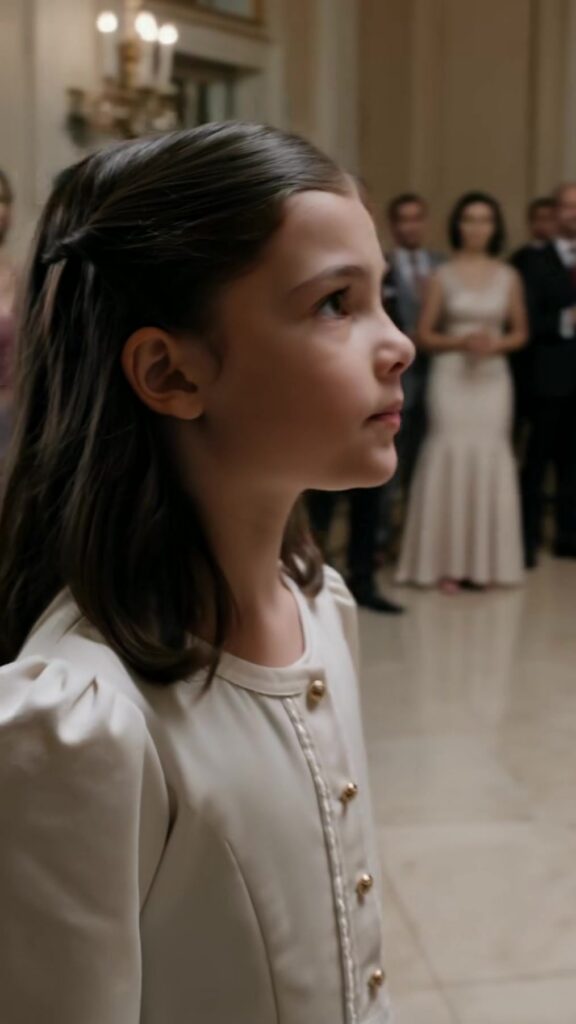
The music didn’t stop, even when the power faltered and the chandelier lights dimmed into a sickly amber. It kept playing with the stubbornness of a heartbeat—an old waltz piped through hidden speakers in the ceiling of the Whitaker Hotel ballroom. For an instant, that sound was the only proof time still moved.
Everything else did stop.
Glasses hovered inches from lips. Conversations froze mid-breath. On the dance floor, a couple held the last step of a turn as if a photographer had shouted for stillness. A server’s tray tilted, but the champagne flutes didn’t fall. All of them were caught in the same pause because someone had entered who didn’t belong.
She came through the double doors as if they were not guarded by money and reputation. She wasn’t in satin or black tie. Her dress was simple—dark, travel-wrinkled—and her hair was damp at the ends like she’d walked through rain. Her eyes didn’t roam the room in awe or intimidation. They fixed on one point and never wavered.
No fear. No hesitation.
Beyond the dance floor, near the dais where the mayor had been speaking just moments earlier, a boy sat in a wheelchair. The wheelchair was sleek and expensive, polished like an accessory meant to blend into the evening’s elegance. The boy himself was pale under the warm lights, his suit too sharp for shoulders that looked too tired to carry it. A silver bracelet hung from his wrist, catching the light when he shifted—restless, always restless.
The girl walked straight through the crowd.
People parted because they didn’t know how not to. In a room where everyone had spent years learning when to smile and when to look away, her directness was a kind of violence. The string of the waltz climbed into a high, trembling note and held there.
She stopped beside the boy as if that had always been her place. Her gaze dropped to his hands, then up to his face, and something softened in her expression—not gentleness, exactly, but recognition.
“I came for him,” she said.
The words weren’t loud, but they landed like a glass dropped on marble. The boy stared at her as though he’d been expecting her without knowing it was possible. His lips parted. A faint, incredulous sound escaped him—half breath, half laugh.
“…It’s you,” he said, before he even realized it.
That was when the room truly went silent, as if someone had finally found the switch that controlled the people instead of the music. The waltz kept spinning in the air, suddenly obscene in its cheerfulness.
At the edge of the dais, a woman in a pearl-gray gown moved with the slow authority of someone accustomed to owning every space she entered. Her hair was pinned into a perfect knot, her lipstick untouched. The Whitaker name had built wings on the city, and she wore it like a crown.
Silas Whitaker’s mother stepped forward.
Her eyes flicked over the girl—shoes, dress, posture—the quick inventory of social worth. Then they narrowed as if she had seen a ghost walk out of a locked room.
“That’s impossible,” she said, and the certainty in her tone was not for the girl. It was for herself.
The girl shook her head once. “No,” she replied. “You just never told him.”
A murmur shivered through the crowd, quickly swallowed. Silas’s fingers gripped the armrest of his wheelchair so hard his knuckles whitened. He looked from the girl to his mother, like a man watching a bridge burn from both ends.
“What is she talking about?” he asked. His voice was steady, but something inside it trembled, a note too long held.
His mother’s smile appeared—thin, practiced. “She’s confused,” she said. “Security will—”
“No,” the girl cut in, and for the first time her voice sharpened. “Don’t move him. Don’t touch him. Not now.”
The air tightened. Even the mayor, caught mid-toast, lowered his glass as if it were suddenly too heavy to hold. The waltz swelled, oblivious.
The girl’s hand rose to her throat.
She reached for something around her neck.
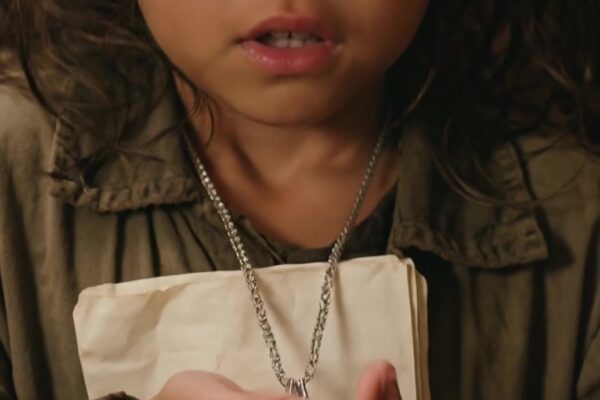
It was a chain, worn thin with years. From it hung a small oval locket, tarnished at the edges. Her fingers trembled as she unfastened it, not from fear but from the weight of finally doing what she’d rehearsed in her head for too long. She held the locket out to Silas.
“Open it,” she said.
Silas stared at the metal as though it might bite him. Then, slowly, he lifted a hand and took it. His fingertips brushed hers—warm, real—and he flinched at the contact like it confirmed the impossible.
The clasp resisted at first. Silas’s thumb worked it, and it clicked open with a tiny sound that felt louder than the orchestra.
Inside were two photographs. One was newer: the girl, younger by a few years, standing in front of a cracked mirror, holding the locket to show what it contained. The other was older, faded at the corners. It showed a woman with Silas’s eyes and smile—his mother’s eyes and smile—but the woman in the picture was laughing freely, her hair loose, her head tilted toward a man whose face had been torn away.
Silas’s breath caught. “That’s… that’s my mother,” he whispered, as if saying it softly could make it less dangerous.
The girl nodded. “Before the speeches. Before the donations. Before the story you were given.”
Silas’s mother reached for the locket as if she could snatch the past back into her palm. The girl stepped back, and Silas closed his fingers around it protectively.
“Who are you?” Silas asked. His voice cracked on the last word.
The girl swallowed. “My name is Mara,” she said. “I grew up in Rookery Row. The part of the city you drive past with the windows up.”
His mother’s jaw tightened. “This is an extortion attempt,” she said sharply. “A performance.”
Mara’s gaze did not flicker. “If I wanted money,” she said, “I’d have gone to the papers. I’d have sold your old life for a headline and watched you drown in it.” She took a step closer. “I didn’t come to ruin you. I came because he deserves to know why he’s been waiting for a shadow his whole life.”
Silas’s throat moved. “Waiting for what?”
Mara’s eyes glistened, but she did not let tears fall. “For the other half,” she said. “For the name they erased. For the reason you still wake up hearing music when the world goes quiet.”
Silas blinked hard. “I don’t—”
“Do you ever hear it?” Mara asked. “Like a song you can’t place. Like something that starts when you’re scared.”
Silas went still, every muscle locked. The color drained from his face. “Yes,” he admitted, a breath of confession. “Since I was a kid. I thought it was— I thought it was just me.”
Mara reached into her bag and pulled out a folded page—old, creased, protected in plastic. She held it up so Silas could see. It was a birth certificate copy, stamped and annotated, the original name scratched out and replaced with a new one. The handwriting in the margin was his mother’s—Silas recognized it from birthday cards, from notes left on his pillow when she traveled. Beside it, another name was written in a different hand: Elias Rook.
Silas stared until his eyes reddened. “Elias,” he repeated. The syllables tasted unfamiliar and yet, somehow, right.
His mother’s voice turned brittle. “That paper is forged.”
Mara’s gaze lifted to the woman in pearls. “Tell him about the clinic,” she said. “Tell him about the accident that wasn’t an accident. Tell him why the man in that photo has no face.”
The ballroom seemed to tilt. People shifted in discomfort, but no one stepped in. They were witnessing a private catastrophe dressed in public clothing.
Silas’s mother took a breath, and for a moment her composure slipped, revealing something raw underneath: fear, not of scandal, but of a door finally opening that she’d spent years barricading. “Silas,” she said softly, as if he were still a child she could soothe, “you don’t understand what it cost to keep you safe.”
“Safe from what?” Silas demanded, suddenly louder than the music. His hand tightened around the locket. “From him? From me? From the truth?”
Mara leaned closer, her voice low enough that it felt like a secret passed in a church. “From a man who loved you,” she said. “A man who wanted to take you back when you were three. A man your mother called a mistake until she convinced herself you were one too.”
A sharp inhale rippled through the crowd. Silas’s mother’s eyes flashed. “Stop,” she hissed.
Mara straightened. “I won’t,” she said. “Because tonight the music didn’t stop. And neither did the things you tried to end.” She looked down at Silas, and her face softened again into that fierce recognition. “He’s your father’s son,” she told his mother. “You can’t silence that forever.”
Silas’s hands trembled. “Why are you here?” he asked Mara, voice small again, stripped of outrage and left with the ache beneath. “Why come now?”
Mara hesitated, then pulled her sleeve back. On her wrist was a thin scar, curved like a crescent. “Because your father is dead,” she said. “And before he died, he made me promise you wouldn’t spend your whole life believing you were only what she said you were.”
The words landed with a finality that made even the waltz sound mournful. Silas closed his eyes, and when he opened them, something had changed—some internal lock undone.
He looked at his mother. “Did you tell him I was dead too?” he asked quietly.
His mother’s face crumpled, just for a second. “I did what I had to do,” she whispered.
Silas nodded once, as if filing the sentence away forever. Then he turned back to Mara, locket still in his fist like an anchor. “Can you prove it?” he asked. “Not to them,” he added, glancing at the frozen crowd. “To me.”
Mara reached into her bag again and pulled out one last thing: a small music box, its varnish chipped, its hinge worn. She placed it on his lap.
“He made this,” she said. “For you. Before everything broke.”
Silas’s fingers hovered over the crank. Then he turned it.
A different melody rose—thin, tinny, fragile, but unmistakable. It twined through the ballroom’s waltz like a truth threading through a lie. Silas’s breath hitched, and his eyes filled. He did not wipe the tears away.
“I’ve heard that,” he whispered, voice shaking. “In my dreams.”
Mara’s eyes shone. “Then you already know,” she said.
Across the room, his mother stood very still, watching the son she had renamed and rearranged begin to remember himself. The music from the ceiling kept playing, bright and oblivious, but now it sounded less like celebration and more like a warning: even when everything else stops, what’s buried doesn’t always stay quiet.
Silas lifted his gaze to the crowd, to the men in suits and women in jewels, to the life arranged around him like a stage set. Then he looked back at Mara.
“Take me out of here,” he said.
Mara placed her hand on the handle of his wheelchair, steady and sure. “I came for you,” she replied, and this time the words were not a declaration to the room but a promise to the boy who had finally heard the right song.
The waltz didn’t stop as she turned him toward the doors. But the spell of the ballroom did. People blinked, breathed, moved again—too late to pretend they hadn’t seen.
Behind them, Silas’s mother called his name, sharp with command and frayed with panic. Silas didn’t turn around. He clutched the locket and the music box like proof that his life had not started where she said it did.
The doors swung open. Cool night air rushed in, smelling of rain and river water and something like freedom. The music from the speakers faded with distance, but the little melody from the music box stayed, trembling between Silas and Mara as they crossed the threshold together.
The music didn’t stop.
It simply changed hands.