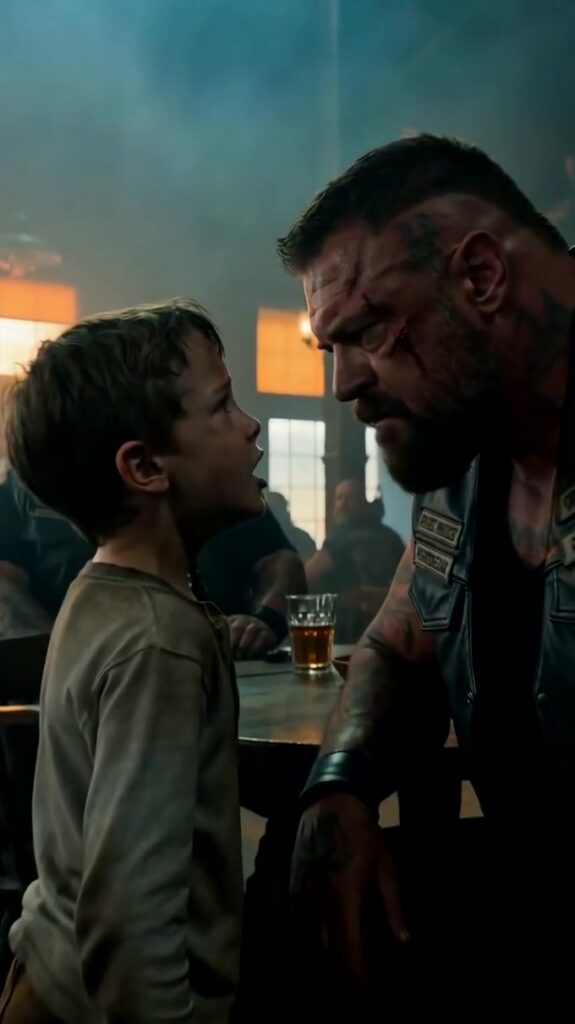
The saloon squatted beside a two-lane highway like a bruise that refused to heal—sun-bleached boards, a crooked neon sign that still insisted on being alive, and windows filmed with years of dust. Inside, the air smelled of fried grease and old whiskey, and the crowd was the kind that knew how to disappear without leaving. Leather vests hung off shoulders like flags. Boots scuffed the floor in quiet patterns. Every table held men who spoke softly, if at all, and wore their scars like jokes they didn’t want to explain.
The doors slammed open so hard the hinges shrieked. A little boy stumbled through as if he’d been thrown by the wind. He couldn’t have been more than ten. His hair was matted with sweat, his cheeks streaked with grime, and his chest worked like he was trying to breathe through a fist. He clutched the doorway to keep from falling. Behind him, outside, the daylight seemed sharper—too bright for what followed.
Three men appeared in the doorway a heartbeat later, silhouettes at first. Then the dust settled enough to show steel. The first wore mirrored sunglasses even indoors; the second had a shotgun low at his thigh like it was part of him; the third smiled the way a trap looks open. They didn’t hurry. They didn’t need to. Their confidence was a weight that pressed on the room.
At the bar, a biker with a gray braid poured himself a drink without glancing over. At the pool table, two men held their cues as if the game was all that mattered. No one wanted a child’s panic to become their problem. In places like this, mercy could get you buried.
The boy forced himself upright and took a step into the room. His voice came out thin at first, then steadier, as if his fear had a limit and he’d hit it. “Please,” he said, and swallowed. “My dad—my dad is John Wick.”
It wasn’t the name itself that made the room go quiet. Plenty of people used famous names when they were desperate; plenty of liars had died trying it. It was the way he said it—not like a threat he’d borrowed, but like a truth he’d lived inside. The gray-braided biker paused with his glass halfway to his mouth. The pool cues lowered. Somewhere in the back, a chair stopped scraping. Even the three men in the doorway shifted, the way dogs do when they hear something they weren’t expecting.
The boy’s small hand went to his neck. A cord disappeared beneath his shirt, and he tugged up a pendant that looked too old for him: tarnished metal, worn smooth around the edges, the kind of thing that had been held in clenched fists. His fingers trembled as he snapped it open. For a moment, the room caught only a glint. Then the pendant’s contents faced the light—two tiny halves of a coin, cut cleanly down the middle, etched with a pattern that most eyes would miss and the right eyes would never forget. A “marker” coin, broken, the kind used for blood debts that didn’t expire.
The gray-braided biker set his glass down with care, as though it might explode. His eyes weren’t on the boy’s face anymore—they were on the coin, on the impossibility of it. “Where’d you get that?” he asked. His voice wasn’t loud, but it carried.
“My mom,” the boy said. He blinked hard, refusing to cry. “She said if something happened to her, I had to go to the place with the dead longhorn over the bar and show them this. She said someone here would know what it means. She said they wouldn’t stop hunting me.” He lifted his chin toward the men at the door. “They killed her.”
The man with the shotgun stepped forward, bootheels scraping grit from the threshold. “Kid,” he called, a taunting softness in his tone, “you don’t know what you’re holding. Give it to me and we’ll make this easy.” He raised the weapon a fraction, not aiming yet, just promising. “Your father can’t help you.”
The room’s silence didn’t break. It deepened. The pool players backed away from their table without looking like they were backing away. One of the bikers, a woman with a shaved undercut and knuckles like stone, slipped her hand beneath her vest. Another man near the jukebox slid his chair aside to clear a line of sight to the door, his movements practiced. They weren’t frightened of the guns. They were calculating what the broken coin meant: a debt cut in two, a message that only a certain kind of person would send.
The gray-braided biker leaned closer to the boy, speaking as if the doorway men weren’t there. “What’s inside the other half?”
The boy’s fingers curled around the pendant as if it might bite him. “My mom said… it’s a promise,” he whispered. “A promise my dad made, before I was born. She said he broke it to keep me alive.” The words came out heavier than a child’s words should. “She said the other half is with someone who wants me because of what I know.”
The trap-smile man in the doorway exhaled through his nose. “That’s enough,” he said. He jerked his head, and the shotgun rose, no longer a promise but a decision.
Then the saloon’s doors shuddered as if struck by a giant fist—BOOM—and swung inward with a blast of hot air and road dust. Smoke crawled in low, thick and gray. The hunters hesitated, their attention snapping away from the boy. Footsteps entered the haze: unhurried, sure, each one landing like punctuation.
A man emerged from the smoke, framed by sunlight as if the world itself had outlined him. He wore a dark jacket that didn’t belong in the heat, and his hair was damp at the temples, as though he’d been running and still refused to look rushed. His face was calm in the way storms are calm from far away. In his hand was not a gun but a simple black case, the kind people used for instruments or tools, and he carried it like it contained both.
The three armed men didn’t recognize him at first. They saw only a stranger. But the bikers did. A low ripple moved through the room—chairs shifting, breath catching, the subtle readiness of people who had learned what it cost to be slow. The gray-braided biker stood, eyes fixed on the newcomer, and the tone of the entire saloon changed from indifference to reverence laced with dread.
The boy made a small sound, something between a sob and a laugh. “Dad?” he said, like the word was a rope he could grab.
The man’s gaze softened by a fraction when it met the child’s. He walked straight to him, never breaking stride, and put a hand on the boy’s shoulder—firm, anchoring. Only then did he look up at the doorway men. “Step away,” he said quietly. He didn’t raise his voice. He didn’t need to.
The shotgun man swallowed. “We’re under contract,” he managed, trying to sound brave. “You don’t understand—”
John Wick’s eyes flicked to the pendant, the broken coin, and something older than anger passed across his face—grief sharpened into purpose. “I understand,” he said. “You’re late.”
He opened the black case. Inside, nestled in foam, was a weapon that looked almost ordinary—until you noticed the careful modifications, the meticulous care. Wick’s hand closed around it as if greeting an old friend. The hunters’ confidence crumbled, replaced by frantic math. The bikers didn’t move to stop John. They moved to stop the hunters from escaping. Because whatever debt had been split in that pendant, whatever promise had been broken to protect a child, the room had just remembered a truth that made legends seem too small:
Some names weren’t threats. They were forecasts. And the storm had arrived.