It was just a ball—bright yellow, scuffed to the color of old butter, rolling slowly along the edge of the curb as if it had nowhere else to be.
Mara almost ran it over.
She braked late, tires hissing against wet pavement. Rain had been threatening all afternoon, teasing the city with dark clouds and impatient wind, and now it finally fell in thin, cold needles that ticked against her windshield. The ball wobbled to a stop under her front bumper, trapped between rubber and road.
“Seriously?” she muttered, irritation flaring hotter than it should have. She was already late. Her phone kept vibrating in the cupholder with messages she refused to read. She could almost hear her sister’s voice through the glass, sharp as tinfoil: You always disappear when it matters.
Mara killed the engine anyway. The street was narrow and empty, lined with maple trees that dripped rain like leaky faucets. In the rearview mirror, a black sedan sat half a block back, idling. Probably just another driver waiting for her to move, she told herself, and the thought made her annoyance spike. She shoved open her door and stepped into the rain.
The ball sat innocently at her feet. It wasn’t a child’s toy, exactly—not the kind with cartoon faces or glittery seams. It looked like an old practice ball, the kind used and forgotten at schoolyards. Still, it had managed to halt her in the middle of the road like a command.
She bent down, fingers closing around damp rubber.
And then she froze.
Because on the ball, in black marker that had bled a little from moisture, there was writing. Not a brand name. Not a team logo. A message, penned in a careful, adult hand as if someone wanted it to last.
Mara’s throat tightened.
She tried to tell herself it was nothing. Just a prank, a kid’s scribble, a weird neighborhood tradition. She forced her shoulders loose, lifted the ball like it weighed nothing, and turned toward the sidewalk.
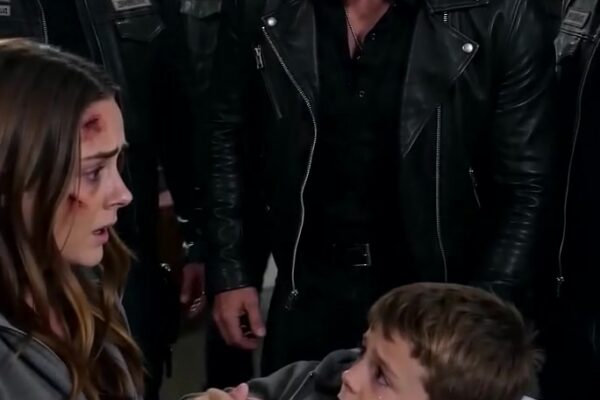
That was when she saw the boy.
He stood under a dripping oak, too thin for his oversized hoodie, rain darkening the fabric to near-black. He looked about ten, maybe eleven, with hair stuck to his forehead and eyes that didn’t blink often enough. He wasn’t crying. He wasn’t smiling. He was simply there, rooted, watching her with an intensity that made Mara feel like she’d stepped into someone else’s nightmare.
She held up the ball, trying for a casual tone that wouldn’t come. “Is this yours?”
The boy didn’t answer. His gaze stayed fixed on her hands.
Mara’s fingers tightened around the ball. The writing burned through her skin, through the years she’d spent trying not to remember. She tucked it against her hip like it was ordinary and started to step back toward her car.
“You recognize it,” the boy said, voice soft but steady. It wasn’t phrased like a question. It was a verdict.
Mara stopped. She could hear the sedan’s engine behind her, a patient purr. She could feel the driver’s attention like a hand at the back of her neck.
She forced a laugh that sounded like it didn’t belong to her. “It’s a ball,” she said. “Kids write on everything.”
The boy took a step closer into the rain. Water ran off his hood and down his cheeks, making it look like he’d been crying after all.
“Where did you get this?” Mara asked, and the question came out too sharp, like she was interrogating him. She softened it, tried again. “I mean… where did you find it?”
The boy glanced past her, toward the black sedan, then back. His mouth opened, closed. For a moment he looked like any other child deciding whether to tell on a friend. Then he leaned forward, as if the air itself might be listening, and whispered a name.
“Silas.”
Mara’s entire expression cracked. The rain could have been boiling, and she wouldn’t have felt it. The name hit her like a slammed door, a sudden darkness. She hadn’t heard it spoken aloud in years—not by anyone who had the right to say it.
Silas had been her brother. Once, he’d been the brightest thing in their house, a boy who believed a ball could make you fly if you threw it hard enough. Then there had been shouting, and a broken stair rail, and a night when the police lights painted their living room blue and red while Mara stood in the hallway and tried not to breathe too loudly.
He had vanished after that. That was the word everyone used because it was cleaner than disappeared, and less accusatory than taken. Their mother called it a tragedy. Their father called it an accident. Mara called it the thing she wasn’t allowed to ask about.
The ball pressed into her ribs, suddenly heavy. The writing on it blurred as the rain ran over it, but she could still read it. She didn’t want to, and yet she did, because it felt like proof that she hadn’t imagined him.
It said: IF YOU FOUND THIS, PLEASE BRING IT BACK.
Beneath that, in smaller letters: S. M.
Silas’s initials. And hers.
“Who are you?” Mara asked the boy. Her voice sounded like it belonged to someone older than thirty-two. Someone tired of running.
He hesitated, then reached into his hoodie pocket and pulled out something small and pale: a key on a fraying blue string. He held it up between them like an offering.
“He told me to watch,” the boy said. “He said you’d pretend you didn’t know.”
Mara’s mind flailed for explanations. A cruel joke. A neighbor’s kid repeating gossip. A delusion stitched from her own guilt. But the key—Mara recognized the chipped head of it, the way the metal had been chewed by years of use. It matched the spare key their mother kept hidden under the loose floorboard by the pantry.
A door in her memory opened, and cold air rushed out.
The sedan behind her made a sound—an abrupt, mechanical click as a door unlocked.
Mara turned slowly.
The driver’s side window slid down. For a beat, she saw only shadow, then a man leaned toward the opening. Rain dotted his dark hair. His hands were clenched so tightly on the steering wheel that his knuckles looked bleached.
He looked at the boy first, then at Mara. His face was composed in the way some faces were composed when the world demanded they remain unbroken. But his eyes—his eyes were raw.
And then, to Mara’s shock, he did not scowl or shout or demand they move. He did not even speak.
He put his forehead against the steering wheel and shook once, like his body had been struck from inside.
The sound that came out of him was not anger. It was not impatience. It was grief—sudden, uncontrollable, animal. The kind of sound a person makes when a secret is ripped out of them in the middle of the street.
Mara stared, rain blurring her vision. She knew that profile. She knew the shape of that jaw, the faint scar near the ear, the way his shoulders sat like he was bracing for impact.
Her father.
He lifted his head, and his eyes met hers through the wet air. There was fear there, yes, and something like pleading, but also a resignation that chilled her more than the storm.
The boy’s voice was very small beside her. “He’s still alive,” he said. “Silas is.”
Mara’s knees threatened to give out. She clutched the ball like a lifeline, like a verdict, like a weapon. The writing on it was smearing, but it didn’t matter—the message had already reached her.
Her father opened the car door, stepping out into the rain as if he’d been called to his own trial. He looked at the ball, then at the key in the boy’s hand, and finally at Mara.
“I didn’t think,” he began, voice breaking on the first word. He swallowed hard, rain sliding down his face as if the sky was trying to wash him clean. “I didn’t think anyone would ever bring it back.”
Mara’s irritation from minutes ago felt like a lifetime away. The street, the rain, the empty maples—all of it tightened around her into something narrow and unavoidable.
It was just a ball.
At least… that’s what everyone thought.
But now Mara understood what it really was: a summons.
And whether she wanted to or not, she was about to follow it.