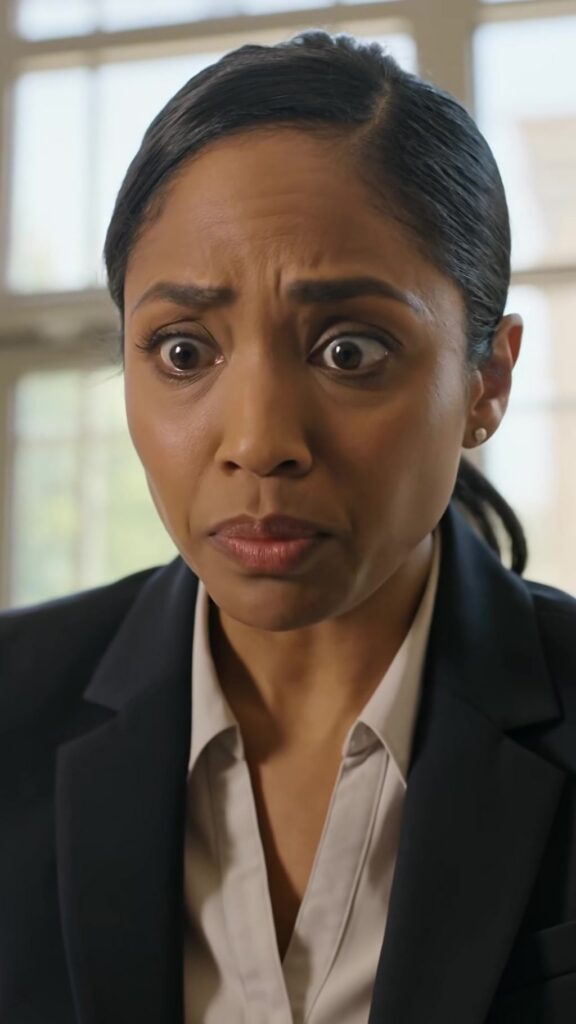
The sound cracked through the bank like a gunshot: cloth and paper and something heavier striking marble. A small duffel—too large for the hands that carried it—landed on the counter with a hard, sharp smack that didn’t belong in a room designed to swallow noise. Pens stopped scratching. A printer halted mid-whirr. Even the air-conditioning seemed to hold its breath.
Every head turned.
The boy who’d made it happen stood on the tips of his sneakers, chin barely cresting the level of the glass partition. His hair was combed neatly, as if someone had taken time with it, and his jacket was zipped all the way to his throat despite the warmth inside. He looked calm in a way that felt wrong—not carefree, not cheerful, but controlled. Like a child imitating an adult’s stillness.
“Hey!” the teller blurted, her voice too loud in reaction, too sharp with surprise. Her nameplate read MARIANNE KELLEY, and she had been having an ordinary morning—mortgages, cashier’s checks, small complaints about overdraft fees—until this. “What are you doing?”
The boy didn’t glance up at her. His eyes stayed on the duffel’s zipper. Slowly, carefully, he pulled it open.
The metallic rasp of the zipper seemed to scrape along everyone’s nerves.
Inside were bundles of bills, bound with paper bands. Not a few crumpled notes. Not a child’s piggy-bank savings. Stacks—neat, squared, packed so tight they made the duffel bulge like a brick. Green and orderly, a geometry of money that belonged in a vault, not on a lobby counter.
The room did something strange. It didn’t erupt; it emptied of sound. A man mid-step froze with his briefcase angled awkwardly. A woman holding her phone to her ear lowered it without speaking, the call forgotten. The guard by the entrance straightened, his hand hovering near his belt, his gaze sharpening as if he could will the situation into making sense.
“I need an account,” the boy said. He didn’t say it with a child’s eagerness. He said it the way a messenger delivers a line that is not his to change.
Marianne swallowed, her throat suddenly too dry. Her mind raced through protocols and alarms and the quiet panic that money—this much money—always brought. “Sweetie,” she began, then stopped. Sweetie sounded ridiculous. Patronizing. Dangerous, even. “Where did… where did this come from?”
The boy’s lashes lifted at last, and his eyes met hers through the glass. Dark, steady. “I’m supposed to bring it here,” he said. “If something happens.”
He reached into his jacket pocket and drew out a folded note. He smoothed it with both hands like he’d practiced. Then he laid it on top of the first stack, carefully centered.
Marianne’s gaze locked on the handwriting before she even picked it up. The loops, the way the letters leaned slightly right, the precise pressure on downstrokes. Her chest tightened as if someone had pressed a palm flat against her sternum.
No. Not here. Not now.
She knew that handwriting because it had once signed the back of every school fundraiser envelope, every holiday card taped to a coffee tin for office donations, every note slid under her door during the months she couldn’t get out of bed after her husband died. She knew it because the hand that wrote it had held Marianne’s wrist when her pulse raced and whispered, Breathe with me, Mari.
It was Lila’s handwriting.
Marianne’s fingers trembled as she reached for the paper. The boy watched her, his expression unreadable. Behind him, the guard shifted, reading the room, trying to decide whether he was looking at a robbery or a tragedy that hadn’t finished revealing itself.
Marianne unfolded the note.
At first her eyes refused to take the words in. She saw them without understanding, like reading a language you used to know.
Marianne—
Her throat tightened painfully. Lila hadn’t called in months. Lila had been “busy.” Lila had been “fine.” Lila had been the kind of friend who carried secrets as neatly as she carried herself, always a step ahead, always smiling like nothing could touch her.
Marianne’s eyes moved down the page.
If you are reading this, I couldn’t fix it in time.
A low hum started in Marianne’s ears, as if the bank’s fluorescent lights had turned into a swarm of insects. She forced herself to continue.
His name is Owen. He will come in calm. He will not cry. He is doing what I told him because I told him it would keep him safe.
Marianne’s gaze flicked to the boy—Owen—standing on his toes, hands resting lightly on the duffel as if to keep it from sliding away. Not crying. Not blinking much either. A child holding himself together by sheer instruction.
She read on, her fingers whitening on the paper.
Do not call my phone. Do not ask him questions. Do not tell anyone in the lobby who I am. If this note reaches you, then someone else may already be watching him.
Marianne’s heart slammed once, hard. Watching him.
She lifted her eyes, and for the first time the bank’s familiar geometry looked like a stage. The entrance. The cameras in the corners. The line of customers, faces turned. The guard, suddenly too stiff. The man in the suit by the brochures who had not moved since the bag hit the counter—his gaze fixed not on the money but on the boy’s hands.
Marianne’s scalp prickled.
She forced her eyes back to the page.
The money is clean enough to pass here. That is not the point. The point is that it buys time. Put it into an account in his name. Do it without making noise. Use the safe room if you have to. You once told me this bank has a place people can disappear for a minute when they’re breaking. Let him disappear there.
Marianne’s breath came shallow. The “safe room” wasn’t official. It was an old consultation office behind the teller line, a leftover from renovations. During the robbery two years ago, she’d hidden there with a coworker who’d started shaking so badly she couldn’t stand. The room had a lock, no window, and a phone that didn’t ring out into the lobby.
Marianne’s eyes kept moving, each line turning the ordinary morning into something with teeth.
They will say I stole. They will say I ran. They will say I am dead. Believe none of it until you hear my voice.
Her vision blurred for a second. She blinked hard, refusing tears. Tears were loud. Tears were time. She couldn’t afford either.
If I don’t make it, then you will be the last good decision I ever made.
The note ended with Lila’s signature: a decisive stroke under her name like a door closing.
Marianne held the paper a moment too long, as if sheer will could drag Lila back into the world. When she looked up, Owen was still there, still steady. Waiting for the next instruction.
“Ms. Kelley?” the guard called, voice cautious. “Is everything all right?”
Marianne made her face do something neutral. It felt like arranging a mask over a crack. “Yes,” she said, surprising herself with how firm it sounded. “It’s… it’s fine. We’re going to take care of him.”
The guard hesitated. “Do you need me to—”
“Not yet,” Marianne cut in softly. Then, to the boy, she leaned toward the microphone slot at the bottom of the glass. “Owen,” she said, tasting the name. “Can you do what I say?”
His gaze didn’t waver. “Yes.”
“Pick up the bag,” she said. “Hold it tight. And when I open the door, you walk straight through. Don’t look around. Don’t talk to anyone. Just follow me. Okay?”
Owen nodded once, like a soldier receiving an order.
Marianne’s hands moved on their own, training taking over. She pressed a button under her counter—one that did not trigger an alarm, but signaled the manager’s office with a silent light. Then she stood, opened the side gate, and came around into the lobby. The sound of her shoes on the tile seemed impossibly loud now.
The customers watched her approach the boy with the money. Their eyes were hungry for a story they could take home. Marianne refused to give them one.
“Excuse me,” she said to no one in particular, and placed herself between Owen and the room, shielding him with her body as much as she could without making it obvious. “We’re going to handle this privately.”
Owen lifted the duffel with both hands. It looked heavy enough to pull him forward, but he managed. He followed her as she led him behind the teller line, into the employee area where public eyes couldn’t reach.
As the door clicked shut behind them, the bank’s hush changed. It wasn’t polite silence anymore; it was the silence of people waiting for something to break.
In the corridor, Marianne’s voice dropped to a whisper. “You did good,” she said. “You did exactly what your mom asked.”
At the word mom, something flickered in Owen’s face—so quick Marianne might’ve missed it if she hadn’t been looking for any sign of childhood. His lower lip trembled once, then stilled as if he’d bitten down on it from the inside.
“Is she coming?” he asked.
Marianne’s chest tightened. She thought of Lila’s warning: someone may already be watching him. She thought of the man by the brochures who hadn’t moved. She thought of the money, the note, the careful instructions, the way Lila always had a plan even when she smiled.
Marianne didn’t answer with a lie. She answered with the only promise she could control.
“I’m going to keep you safe,” she said.
Owen nodded again, once. “Okay.”
Marianne reached the old consultation room and unlocked it. The stale scent of paper and dust drifted out. She guided Owen inside and closed the door, turning the lock. The sound was small, but it landed in her bones like a verdict.
She set the duffel on the table and faced him. “Owen,” she said. “Do you know why your mom told you to come to me?”
He looked down at his hands. For the first time, he seemed five. For the first time, he seemed tired. “She said you’d believe her,” he murmured. “Even if other people didn’t.”
Marianne’s eyes burned. She unfolded the note again, rereading the lines as if they might rearrange into something kinder. They didn’t.
Outside the room, faintly, she heard the murmur of the lobby returning to life—whispers turning into questions, questions turning into guesses. A distant phone rang. Somewhere, a printer restarted.
Marianne lifted the receiver of the room’s landline and pressed the internal extension for the manager. While it rang, she watched Owen, who stood in front of a fortune and looked like a child waiting at a bus stop.
“Tom,” she said when the line picked up, keeping her voice steady. “I need you in the back office now. And I need you to close the lobby doors. Quietly.”
There was a pause. “Marianne—what’s going on?”
Marianne stared at the note, at Lila’s signature, at the way the ink seemed darker where the pen had hesitated, as if even Lila had been afraid.
“Something happened,” Marianne said. And in the silence that followed, she realized the most frightening part wasn’t the money, or the watching eyes, or even the possibility that Lila was gone.
It was that the sound that had started all this—the bag striking the counter—had been a warning bell, and the echo of it was still rolling through the world, impossible to ignore.
When she hung up, Marianne knelt in front of Owen so they were eye level. “Listen to me,” she said. “No matter what you hear out there, you stay in here. If anyone knocks, you don’t open the door. Only me. Understand?”
Owen’s throat bobbed. He nodded.
“Good.” Marianne took a breath, then asked the question she’d been avoiding because she was afraid of the answer. “Owen… what did your mom say would happen?”
He stared at the money like it was a wall he couldn’t climb. His voice came out very small.
“She said,” he whispered, “that if the bad men came, I had to be louder than them. Just once. So people would look.”
Marianne’s skin went cold as she understood: the slam of the bag, the impossible sound, had not been an accident. It had been a flare.
A way to make sure the world witnessed him—so he couldn’t be taken quietly.
Outside, somewhere in the bank, the front door chimed again. Not the gentle, polite ding of a new customer. A sharper sound—like a bell struck too hard.
Marianne rose, folding Lila’s note and tucking it into her pocket like a weapon. She placed herself between Owen and the door, listening as footsteps approached down the corridor with the deliberate pace of someone who had no doubt they belonged there.
The handle rattled once.
Then came a knock, measured and calm, as if the person on the other side expected to be welcomed.
Marianne didn’t answer.
She pressed her palm against the locked door and held her breath, realizing that the impossible sound had done its job—everyone had looked.
Now it was her turn to make sure Owen didn’t disappear again.