The rain was falling so hard it blurred the whole graveyard into black umbrellas, wet stone, and grief. From the wrought-iron gate to the farthest angel statue, everything looked smudged—as if the world itself had been rubbed with a wet thumb. The priest’s words were swallowed by water. The flowers collapsed in their ribbons. Even the names carved into marble seemed to weep, inked over by the storm.
At the center of the crowd waited the casket: sleek, grey, too clean for the mud that clung to everyone’s shoes. It perched beside the open grave like a ship pausing at the edge of a dark sea. Men in dark suits stood with hands folded, their shoulders squared in practiced sorrow, while near them an elegant woman held her umbrella at a perfect angle so not one drop touched her hat. Her face was calm in the way porcelain is calm—beautiful, cold, and ready to shatter.
They called the dead man Mr. Vale, benefactor, visionary, the sort of person whose name you found on plaques in libraries and wings of museums. They spoke as if he’d been made of stone himself, steady and unchanging. But a few faces in the back row did not wear admiration; they wore unease. There were people here who owed him more than gratitude, and people who feared what he’d left behind.
From the edge of the cemetery path, a small figure hesitated under a yew tree. A girl—young enough that her black dress looked borrowed, old enough that her eyes held something older than her years. Her hair had come loose and stuck to her cheeks in dark ribbons. Rain ran off her chin in thin streams. She stared at the casket as if it were a door that might open if she dared to knock.
Then she moved. She broke from the tree’s shelter and ran straight into the sea of umbrellas, splashing across puddles that leapt up to stain her hem. Mourners turned, startled, umbrellas tilting like a flock of birds shifting in panic. In her fist she clenched something small and brass that caught the dim light like a stubborn ember. She ran as if she could outpace the funeral itself.
“Stop her!” the elegant woman snapped, her voice sharp enough to cut through the rain. A man in a dark suit stepped forward—broad-shouldered, the kind of security hired not to grieve but to prevent inconvenience. He reached out, and the girl slammed into his arm. Her momentum snapped into a sudden fall; she hit the wet stone hard, knees first, then palms, the sound lost but the impact obvious in the way her body recoiled.
A gasp moved through the crowd, a single breath passing from mouth to mouth. The girl did not get up. For a heartbeat she knelt there, stunned, rain and tears mixing until it was impossible to tell which was which. She cradled the brass object close to her chest with both hands, as though letting go would empty her ribs of air. The elegant woman strode closer with quick, precise steps, her expression still arranged—until it wasn’t. Something slipped behind her eyes. Not anger. Not impatience. Fear.
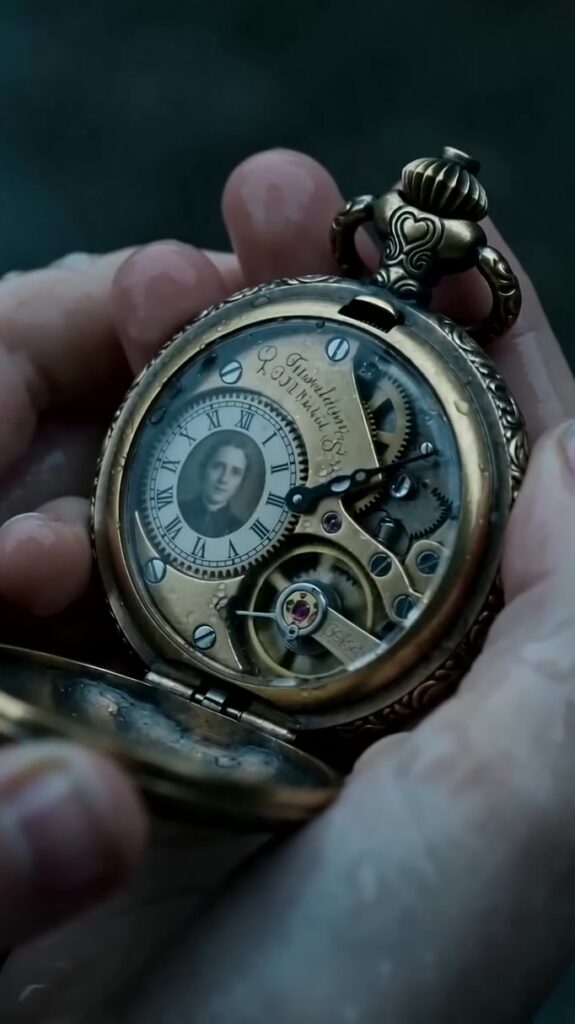
The girl’s fingers shook. She forced the brass locket open. It was older than her, older than anyone in the front row, its hinge worn smooth as if worried for years. Inside, instead of a photograph or lock of hair, tiny clockwork dials were set into velvet. They began to turn the moment the lid lifted, delicate gears waking with a faint, almost impossible tick beneath the drumming rain. A symbol surfaced as a tiny plate slid aside: an embossed crest—three interlocked circles around a star—clean and unmistakable.
The elegant woman’s breath caught. Her umbrella tipped, and water spilled down her sleeve, unnoticed. “Where did you—” she began, but the locket answered first. A whisper crackled out of it, thin as a strand of cobweb, broken by time and mechanism. A man’s voice—soft, strained, intimate—spoke as though it were trapped in the brass and had been waiting years for the air.
“My daughter,” the voice said.
The girl froze as if lightning had struck between her shoulders. Her eyes widened with a sudden terror that looked, strangely, like hope. She lifted the locket closer to her ear, then stared at the casket, her breath shattering in her chest. “He… he knew me,” she managed, voice turning raw. “He knew I existed.”
The elegant woman’s composure cracked in one clean line. For the first time, the mourners saw something beneath the polish: a face haunted by calculations and bargains. “That’s not possible,” she whispered, and the words were not for the crowd. They were for herself, for the years she’d spent folding secrets into silence. She lunged forward, gloved hand outstretched to snatch the locket away, but the mechanism inside clicked again—decisive, as if it had anticipated theft.
A second compartment began to open along the locket’s inner rim. A hair-thin latch released. The velvet shifted. The girl stared down, hypnotized, while the elegant woman reached with sudden desperation, umbrella forgotten, rain soaking her expensive coat. The crowd stirred; men glanced at each other, unsure whether to intervene. The priest stepped back, lips parted, prayer abandoned.
The compartment revealed a sliver of paper rolled tighter than a matchstick. The girl pinched it free with wet fingertips and uncurled it carefully, sheltering it with her body as though the rain might dissolve the truth. It was a miniature letter, written in a hand that looked rushed and angry and loving all at once.
“If you are hearing this,” the recorded voice continued, “then they have buried me. And if they have buried me, they have told the world a story that keeps them safe.” The gears ticked, patient. “I left proof. I left names. I left the key.”
The girl’s eyes moved across the tiny ink, lips forming words without sound. The elegant woman’s face drained to a pale that made her lipstick look like a wound. “Give me that,” she hissed, and there it was—the command she’d used all her life on people who were smaller, poorer, easier to frighten.
The girl looked up, rain streaking down her cheeks, her hand still clutching the paper like a pulse. “You knew,” she said, not loudly, but with the kind of clarity that turns a question into a verdict. “You knew he had a child. You knew he left me… somewhere.”
A tremor went through the elegant woman’s jaw. “You don’t understand,” she said, and for a moment it sounded like pleading. “You don’t know what that man was capable of.”
The girl’s gaze flicked to the casket, to the polished grey lid, to the void of the open grave. “Then tell me,” she said. “Tell me why he recorded his own voice inside a locket and hid it from you.”
In answer, the locket ticked once more—louder now, as if the storm had leaned in. A final piece shifted under the crest, and something heavy slid into the girl’s palm: a tiny brass key, warm as if it had been held recently. The elegant woman’s eyes followed it with naked dread.
“That key,” the woman whispered, and the crowd quieted, sensing blood in the water. “That key opens the north vault.”
The girl closed her fist around it, feeling the teeth bite into her skin. Behind her, thunder rolled like a door slammed somewhere far away. The recording crackled again, the man’s voice fraying but stubborn.
“Find the vault,” it said. “And when you do, do not trust the one holding the umbrella.”
The elegant woman lunged—too late. The girl shoved herself up from the stones and backed away from the grave’s edge, clutching key and letter and locket against her heart. Rain poured down between them like a curtain. The mourners watched, unsure whether they were witnessing grief or the beginning of an unburial. And in the muddy space beside the casket, the elegant woman stood trembling, not from cold, but from the sudden, terrifying idea that the dead man had left something behind that could still destroy her.
The girl turned and ran into the rain, carrying the sound of her father’s voice like a flame that refused to go out.