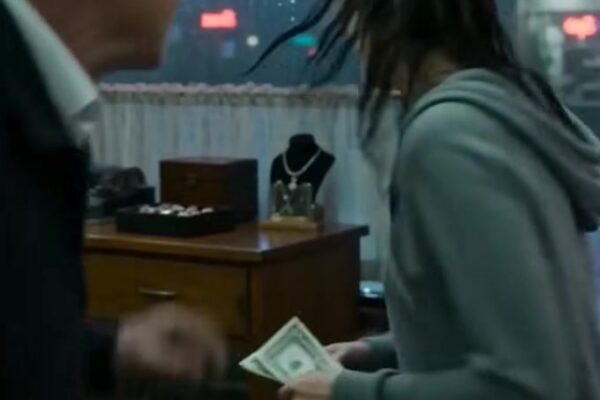
The street on Alder was dressed for celebration—golden bulbs strung from building to building, music leaking out of a bar that smelled of citrus and cheap beer, laughter moving in waves like a tide. It was the kind of night that used to make Mara feel safe. Tonight it only made her feel out of place, as if the city’s joy were a language she no longer spoke.
She walked quickly, trench coat cinched tight even though the air was mild. She kept her head down, counting cracks in the sidewalk, refusing eye contact, trying to outrun the sudden, sharp memories that came when she let her mind slow.
A tug caught her coat from behind—small, insistent, urgent.
Mara whirled. “Don’t—” The warning died in her throat.
A boy stood there, too thin for the weather, hair sticking up in uneven clumps as if he’d slept on a bench. Dirt stained his knuckles. His eyes were raw, not from the cold but from crying. He didn’t flinch at her tone. He only stared at her with a kind of grim certainty that didn’t belong on a child’s face.
Between his trembling fingers he held a tiny pin, gold shaped into a leaf with veins so fine they looked like threads. At the center sat a pale-blue stone, a sliver of sky trapped in metal. Under the streetlights it glowed like something alive.
“Um,” he said, voice thin as paper. “Is this yours?”
Mara’s chest tightened, as if the air had thickened. She knew the pin the way you know a scar you never see until it stings.
“No,” she managed, because the word was safer than the truth. “Where did you get that?”
The boy swallowed. His grip loosened and tightened again, as if he feared the pin might burn him. “My mom said it was from an angel,” he whispered. “She said angels leave things behind. Like… like proof.”
Mara took a step closer without meaning to. The world around them blurred—the music, the traffic, the laughter. All she could see was that leaf and its sky-blue heart.
“Your mother told you that?” Her voice sounded distant to her own ears.
The boy nodded once. Then, like a confession he’d been ordered to deliver, he added, “She said she got it off the baby they found down by the river.”
The sentence struck Mara like a slap. A river. A baby. A pin. Every bone in her body went cold.
She reached out, then stopped, afraid that if she touched the pin it would vanish and she would be left with nothing but the ache that had hollowed her for seven years.
“What’s your name?” she asked.
“Eli.” He blinked fast, fighting tears. “I’m not supposed to talk to strangers. But I had to. I had to find the lady who lost it.”
Mara’s throat worked. “Why?”
Eli’s voice dropped. “Because my mom’s scared. She keeps waking up and saying the river is in the house. She keeps checking the locks. And she told me if I ever saw the lady in the picture—” He stopped, eyes flicking over Mara’s face with frightened recognition. “—I should give it back and run.”
A picture. Mara’s heart hammered. “What picture?”
Eli hesitated, then slid a hand into his pocket and produced a crumpled newspaper clipping, soft at the folds from being opened too many times. Mara recognized her own face in black-and-white, older and emptier than she remembered. Beneath it, a headline about a missing infant and a mother who refused to stop searching.
The sounds of the street rushed back in a nauseating surge. Mara’s knees threatened to buckle. “Where is your mother now?” she asked, forcing the words out as if they were stones she had to lift.
He pointed down the block. “She works nights at the diner. She said not to bring trouble there.”
Mara stared past him at the glittering street, at the string lights that looked suddenly like a net. In her mind she saw a different night: rain, police sirens, the river swollen and loud. She remembered the tiny coffin, lighter than it had any right to be, and the pin she’d placed inside with shaking hands—her own mother’s pin, a family talisman, a promise. She remembered whispering, Stay with him.
But the pin was here. In a child’s fingers. Not in the ground where it belonged.
“Eli,” Mara said carefully, “I need you to tell me exactly what your mother said. Not the angel part. The truth part.”
Eli’s chin quivered. “She said… she was walking by the river that morning. Before the police came. She said she saw something in the reeds. She thought it was a doll.” Tears spilled over, hot trails on his dirty cheeks. “She said she didn’t want to look, but she did. And she took the pin because it was shiny and she needed money. She said she was sorry. She said she tried to forget it, but it wouldn’t let her.”
Mara’s hands clenched into fists so tight her nails bit her palms. Rage rose first—pure, blinding, animal. Then grief followed, heavier than rage, pressing her inward. The pin wasn’t a trinket. It was the last thing she’d given her son when she had nothing else left to give.
She forced herself to breathe. “Eli,” she said, “that baby was my son.”
The boy’s eyes widened, and for a moment he looked even younger. “Then you’re… you’re the lady,” he whispered.
Mara nodded once. “Yes.”
Eli stared at the pin as though it had become something dangerous. “She said it belonged to an angel because she couldn’t say his name,” he murmured. “She couldn’t say baby.”
Mara swallowed hard. The pin trembled between them, a small, merciless bridge.
“I’m not going to hurt your mother,” Mara said, surprising herself with the steadiness in her voice. “But I am going to speak to her. And I’m going to find out what really happened by that river.”
Eli flinched. “She said you’d call the police.”
“I might,” Mara admitted. “Or I might do something else. But not tonight. Tonight I just want the truth.”
Eli’s shoulders sagged, as if he’d been carrying a weight too big for his frame. He held the pin out fully now, arm extended like an offering. “Take it,” he said. “Please. It’s been making everything worse.”
Mara finally reached forward. The metal was cold, and the blue stone caught the light as if it held a small storm inside. When her fingers closed around it, she felt a jolt—not magic, not peace, but something sharp and real: the certainty that grief was not finished with her, and neither was the story the city had told her to accept.
She tucked the pin into her palm and closed her hand over it like a vow. The laughter on Alder Street continued, oblivious, while Mara looked down at Eli and made a decision that tasted like iron.
“Show me the diner,” she said. “And stay close to me. No running.”
Eli nodded, wiping his face with the heel of his hand. Then he turned and walked beside her, small steps matching her fast ones. Together they moved under the low-hung lights toward the end of the block, toward the woman who had taken a piece of the grave and tried to call it an angel—toward a truth that had been buried wrong.
In Mara’s fist, the leaf-shaped pin pressed a pattern into her skin. She welcomed the pain. It meant she was still here. It meant her son had not been reduced to a headline, a cold case, a story people stopped talking about. It meant the earth had been disturbed, and something long silenced was finally ready to speak.