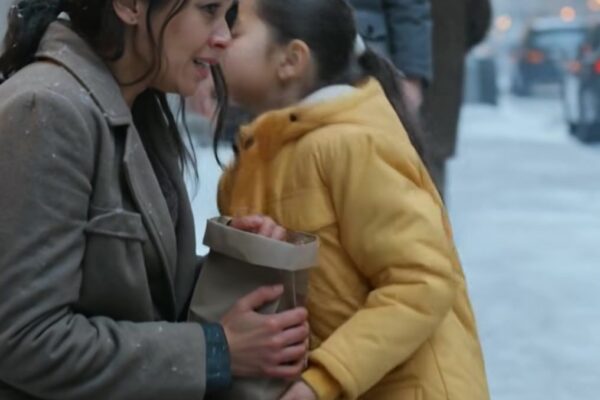
Snow fell in slow, patient flakes, softening the city’s hard edges the way time never managed to soften mine. I kept my collar up and my daughter’s mittened hand tucked in my palm as we crossed the plaza outside St. Brigid’s Hospital—an errand I told myself was ordinary, though nothing near that building ever felt ordinary to me.
“Do you think the pigeons get cold?” Lila asked, pointing at a puffed-up gray bird that looked like a worry with wings.
“They’ve got feathers,” I said. “They’re tougher than we are.”
She was six—bright-eyed, relentlessly kind, and dangerously unafraid of strangers. The kind of child who would smile at anyone, who would say hello first, who would offer a piece of herself without calculating the cost. I’d been trying to teach her caution without teaching her fear, a tightrope I never remembered choosing to walk.
My phone buzzed. Work. I hesitated, then answered, turning my body just enough to keep Lila in my peripheral view. “I said I’ll send the report tonight,” I muttered, staring past a line of parked cars as the wind pushed snow across the sidewalk like white ash.
It took only seconds—less time than it takes to lose something forever. When I ended the call and turned back, Lila was no longer beside me.
My heart lurched hard enough to make my vision stutter. “Lila?”
I spotted her near a bench half-buried in drifted snow. A woman sat there, bundled in mismatched layers, her posture folded inward as if she were trying to become small enough for the world not to notice. A paper-thin scarf covered most of her face; her hands were raw and swollen with cold. She looked less like someone resting and more like someone bracing for impact.
Lila stood in front of her with the solemn purpose of a tiny diplomat. In her hands was the small lunch bag I’d bought ten minutes earlier—sandwich, apple slices, the little chocolate milk she always insisted was “medicine for being brave.”
“Are you hungry?” Lila asked.
The woman’s head lifted, slow and reluctant. The lines around her mouth tightened, as if kindness were a language she no longer trusted. “I’m… I’m alright,” she said, but her voice was the sound of someone who hadn’t been warm in a very long time.
Lila extended the bag with both hands. “My dad got this for me. But you look like you need it more.”
The woman stared at the bag like it might vanish if she blinked. Her fingers hovered, trembling, then closed around it with careful reverence. “Thank you,” she whispered, the words catching as if they hurt.
I started toward them, rehearsing an apology in my head—something polite and quick, something that would end the interaction without making Lila feel scolded for being good. I was close enough now to see the woman’s eyelashes beaded with melting snow.
Then Lila spoke again, louder, clear as a bell in the cold.
“You need a home,” she said, and before I could interrupt, she added with the blunt certainty of childhood, “and I need a mom.”
My feet stopped as if the pavement had turned to glue. I felt the sentence strike the air between us like a thrown stone. Lila had never said it out loud that way. She asked questions sometimes—quiet ones at bedtime, ones I answered with stories and soft lies about angels and stars. But she had never offered the vacancy of our lives to a stranger.
The woman’s breath hitched. The bag slipped from her hands and fell into the snow, landing with a dull, final sound. For a moment, everything went silent—no traffic, no voices, only the hush of falling snow and my pulse beating in my ears.
The woman looked up.
Her eyes found Lila first, then traveled to me. When they met mine, her face tightened as if she’d taken a blow. Not confusion. Not gratitude. Recognition—raw and immediate, like a wound reopening.
She stood too fast, nearly stumbling. The scarf shifted, and I saw more of her: a bruise-yellow shadow along her jaw, the pallor of hunger, but beneath it… something familiar, something that did not belong on a stranger’s face.
“No,” she breathed. “No, that can’t…”
I stepped closer, my voice coming out rough. “Do I know you?”
Her eyes filled so quickly the tears looked like they’d been waiting. She looked at Lila, then back at me, and her mouth formed a name I hadn’t heard in six years except in my own head.
“Evan,” she said.
The world tilted. My knees threatened to buckle. “Don’t—” I started, because my mind refused the shape of what my eyes were telling it. “Don’t say that.”
Lila tugged my coat, puzzled. “Daddy?”
The woman’s hand lifted toward Lila, stopping short of touching her, fingers hovering in the air like a prayer. “She has your dimple,” she whispered. “And she hums when she’s tired. She…” Her voice broke. “She does that little thing with her shoulder when she’s embarrassed.”
My throat closed. I could barely breathe. “Mara,” I said, the name falling out of me like a confession. “Mara is dead.”
Her face crumpled. “They told you that.”
I stared at her, searching for trickery, for a con, for anything that would keep my grief safely in the past where it belonged. But the way she looked at Lila—like she was starving and here, suddenly, was food—couldn’t be performed.
“What are you saying?” I forced out.
She swallowed, eyes darting toward the hospital behind us, as if it were listening. “There was a complication,” she said, voice trembling with the effort of speaking. “They put me under. I woke up in a different room. A different name on the chart. And a woman—nurse, I think—she leaned close and told me my baby didn’t make it. She said my husband signed papers. She said I wasn’t… stable.”
My stomach turned to ice. “I signed nothing.”
“I tried to get to you,” she said, words coming faster now, as if the truth had been dammed up for years. “They said you’d moved. They said you didn’t want me. They moved me to a ‘rehab facility’ that wasn’t one. They kept me medicated. When I fought, they said I was hysterical. When I cried, they said I was delusional.”
I thought of the funeral I never saw—closed casket, hospital paperwork stamped and final, the doctor who wouldn’t meet my eyes. I’d blamed fate. I’d blamed God. I’d never blamed a system because it was too enormous to hold accountable, too convenient to believe.
Lila looked up at the woman, studying her face with a child’s unguarded intensity. “Do you know my daddy?” she asked.
Mara’s laugh turned into a sob. “I do,” she said. “And I know you.”
“I’m Lila,” my daughter offered, polite even now. “I’m in first grade. I like dinosaurs and strawberry toothpaste.” She paused, then pointed at Mara’s hands. “Your fingers are really red.”
Mara’s gaze softened, the way sunlight softens snow right before it melts. “I’m sorry,” she whispered to Lila, like an apology that had been building for six years. “I’m so sorry I wasn’t there.”
My mind raced, hunting for solid ground. “If you’re Mara,” I said, barely able to say it, “why are you here like this? Why didn’t you come home?”
She flinched. “Because I didn’t know where home was anymore,” she said. “And because every door I tried was locked from the inside. I escaped two months ago. I’ve been sleeping wherever I can. I came here today because I saw this place in a dream and thought maybe… maybe there would be a record. A clue. Something to prove I wasn’t crazy.”
The snow landed on her hair and melted instantly, leaving dark strands plastered to her forehead. She looked less like a ghost now and more like someone resurrected without permission.
I reached for Lila’s hand and held it tight, anchoring myself to the one truth I knew. “You’re telling me my wife has been alive,” I said slowly, each word a step across thin ice, “and someone took her from us.”
Mara nodded, tears slipping down her cheeks. “Yes.”
Lila squeezed my fingers and leaned toward Mara with fearless warmth. “If you’re my mom,” she said, “we have a blanket at home. It’s the soft kind.” She glanced up at me, as if seeking approval for generosity. “Can she come with us?”
I should have said no. I should have demanded proof, called the police, marched into the hospital and shouted until someone explained the unexplainable. I should have protected my daughter from a story too heavy for her small shoulders.
But Mara’s eyes were still on mine, pleading not for forgiveness yet—just for a chance to exist again.
Behind us, the hospital doors slid open, and a gust of warm air spilled out into the snow, carrying the smell of disinfectant and secrets.
“We’re going inside,” I said, my voice steadier than I felt. “All of us.”
Mara’s lips parted, fear flashing across her face. “Evan—”
“No more running,” I said. “Not from them. Not from the truth.”
Lila bent down, picked up the lunch bag from the snow, and pressed it back into Mara’s hands like a promise. “You can eat while we walk,” she instructed.
Mara clutched it, then did something so small it nearly shattered me: she nodded like she was taking orders from life again.
As we moved toward the doors, the snow thickened, erasing our footprints behind us. For six years I’d lived in a world where the past was a locked room. Now the lock had broken, and everything I’d buried was stepping out into the cold daylight.
And the most terrifying part wasn’t that Mara might be alive.
It was the certainty settling in my bones that someone had made sure she disappeared—and might not let her return without a fight.