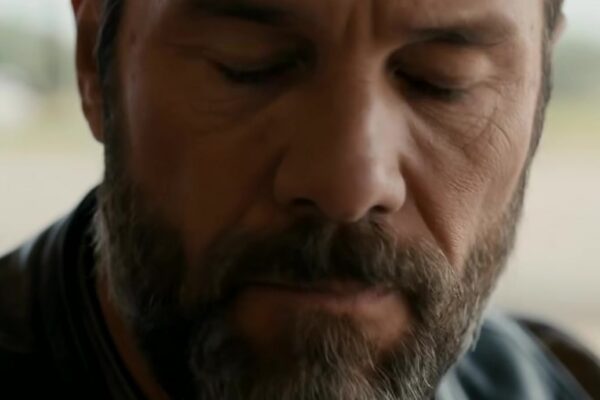
He had left the porch light on for himself, the way he always did when he promised to return before dawn. One night. A dinner with investors downtown, a stiff smile, a practiced laugh, a room too warm with money. He had kissed his daughter’s forehead and told her he’d bring back a chocolate croissant from the hotel buffet. She’d made him swear it like an oath, pinky linked to his.
The city had swallowed him and spat him out again before midnight. He drove home with his collar unbuttoned, thinking of the quiet he’d earned: the familiar dark hall, the soft breathing behind closed doors, the comfort of a house that held his name the way a shell held the sea.
But when his key turned and the door gave, the house did not greet him with silence. It exhaled a faint sourness—soap and something older, like wet wood left too long in shade. The lights were on in the living room.
His briefcase slipped from his hand before he knew he’d let go. It struck the floor with a dull thud, and in that sound he heard a child’s sob stutter into panic, as if she feared the noise had betrayed her.
His daughter was on her knees, the way children kneel in churches, except there was no altar—only a mess of foamy white spread across the floorboards, swirling in frantic circles where small hands worked a rag like a punishment. Her shoulders jerked with each breath. Her fingers were raw, their redness sharp against her pale skin.
“I’m doing it,” she gasped, words slipping between hiccups. “I’m doing it right. Please—please don’t—”
She didn’t finish the sentence. She didn’t have to. The way she said it wasn’t a plea for forgiveness; it was a line she knew by heart, practiced until it came out even while she was drowning in tears.
He stepped forward, his pulse battering his ears. “Sweetheart?” His voice broke on the word.
She looked up, and the sight of him did not ease her. Her eyes widened, wet and terrified, as if his presence might provoke something worse. The fear of the storm mattered more than relief at the umbrella.
Behind her stood his wife.
She wasn’t screaming. She wasn’t frantic. She was composed in a rich blue dress that belonged to a different evening than the one happening in their home. In one hand she held a glass of orange juice, the color bright and cheery against the tension, as if she’d chosen it to prove she could make a domestic scene look normal.
“Don’t miss the corners,” she said, her tone mild. “If anyone comes by, I won’t have them seeing streaks.”
He stopped breathing for a second, not from shock alone but from the unfamiliarity of her calm. “What is this?” he said, and heard his own voice turn colder than he’d meant. “What did I just walk into?”
His wife glanced at him like he was late to an appointment. “You’re home early,” she said. “Try not to make it dramatic.”
The child’s hands began to tremble harder. He watched her squeeze the rag until suds oozed between her fingers. He could not look at that and remain standing.
He dropped to his knees, abandoning dignity the way he’d abandon a burning coat. He wrapped his arms around his daughter and pulled her against his chest. Her sobs hit him like waves. She clung to him as though she couldn’t decide if he was real.
“Look at me,” he whispered, brushing hair from her face. “You’re not in trouble. You’re not—”
He reached for her hands and felt the heat of irritated skin. The red wasn’t just from soap. It was from effort, from fear, from time. He imagined her kneeling there long before he opened the door, and his stomach twisted.
His wife remained where she was, lifting the glass to her lips with a slow sip. There was no apology in her posture. No flinch. No shame.
On the floor beside the rag lay a wooden frame, its back snapped open like a broken wing. A shard of glass glinted near the baseboard. He picked the frame up with careful fingers and turned it over.
For a moment his mind refused to assemble what he saw. A family photo: himself, younger by a softness in his face, his daughter smaller, sitting on his knee. And beside him a woman with warm eyes and a smile that made his chest ache for reasons he could not name.
She wasn’t the woman standing behind them now.
He stared until the picture began to blur, and realized the blur was not tears but the strange sway of his own memory, as if someone had bumped it hard. He tried to pull up the name of the woman in the photo and found only a blank space, a locked door that should have opened into his past.
His wife’s voice cut through his scrambling thoughts. “That shouldn’t be out,” she said quietly. Not alarmed—annoyed. “I told her to put it away.”
His daughter made a choking sound. She saw the frame in his hand and fresh sobs spilled out of her, fierce and hopeless. She buried her face in his shirt, and her words came muffled, as though she were confessing a crime.
“She made me,” the child whispered. “She said… she said the face had to go. She said you can’t remember the first one.”
The air in the room thickened. The house seemed to lean inward, listening.
He held the photograph tighter until the wood creaked. “The first one,” he repeated. It wasn’t a question. It was a crack opening in a wall.
His wife set her glass down on the mantel with delicate care. “Don’t,” she said, a warning dressed in silk. “You’re tired. You had your dinner. You should sleep.”
He felt something shift behind his eyes, as if a curtain had been tugged. A smell—lavender and hospital disinfectant. A voice singing off-key in a kitchen. Fingers laced with his at the foot of a bed. A ring placed in his palm, warm from another hand. A memory that had been living under the floorboards, tapped once, twice, now pounding to be heard.
He looked at his daughter, at her scraped hands, her fear of being seen with him, and the pieces formed a picture uglier than the one in the frame. “How long?” he asked, his voice low. “How long has she been making you do this?”
The child’s eyes flicked toward the woman in blue, and the answer hid in that glance. Weeks? Months? Years? Time was another thing that could be scrubbed away if you worked hard enough.
His wife’s smile did not reach her eyes. “She’s sensitive,” she said. “Children exaggerate. Don’t let a mess on the floor turn you into a hero.”
He stood, lifting his daughter with him, her small arms locked around his neck. She clung as if gravity itself was not to be trusted. He cradled her against his shoulder and faced the woman he had called his wife.
“Where is she?” he asked.
“Who?”
He raised the photograph. “Her.”
Something flickered—irritation, calculation, a brief flash of something like triumph. “You don’t need her,” the woman said. “You didn’t, and you won’t. You have a life. You have a daughter. You have me. That other story is finished.”
His daughter’s breath hitched against his neck. He kissed her hair, tasting soap and salt. “No,” he said, and the word felt like an anchor thrown into deep water. “That story isn’t finished. You just buried it.”
His wife stepped closer, the skirt of her dress whispering over the clean parts of the floor. “Careful,” she murmured. “You’re confused.”
He backed toward the hallway, keeping his daughter between himself and that calm, and his gaze caught the mirror by the coat rack. In its reflection he saw a man holding a child and, behind them, a woman in blue who looked like she belonged in a different life entirely—an intruder who had learned the lines and practiced the smile.
He reached into his pocket for his phone, fingers steady now, and felt his daughter’s hand press into his shoulder as if to stop him—not from calling, but from making noise that might awaken something worse. He whispered into her ear, “I’m here,” and believed it like a vow. “I’m not leaving again.”
Behind them, the woman’s voice hardened. “If you call anyone,” she said, “you’ll regret it.”
He looked down at his daughter’s inflamed hands, at the smear of soap that still glistened like a forced erasure, and he knew regret was already in the room. It had been there waiting, dressed in velvet, drinking juice as though it were ordinary.
He pressed the call button anyway, because a promise to be home before breakfast meant nothing if home was no longer safe. And as the phone rang, he stared at the photograph until the woman’s face in it became not a stranger, but the beginning of a name forming at the back of his throat—one he would not let be scrubbed out again.
One night, he had thought. One dinner, one hotel, one return. He had been wrong. He wasn’t walking into a quiet house.
He was walking into the ruins of his own memory—and he was going to pull it, piece by piece, from the hands that had been washing it away.