The rain had teeth that afternoon, biting through wool and bone. Rosa Alvarez stood at the foot of the black iron gate, her fingers wrapped around a plastic bag that held nothing but a small jar of pickled mangoes and a knitted scarf she’d begun months ago and finished only because a mother’s hands don’t know how to stop working.
The house beyond the gate looked like it belonged to another country—white walls, warm lights, the tidy hush of money. Rosa had walked the last mile because the bus had stopped running when the storm turned the streets into rivers. She had rehearsed her words under the hood of her coat: I brought you something. How are you? Are you eating? The simplest things were the hardest to say when pride was standing guard on the other side.
The gate buzzer crackled. A pause. Then the latch clicked, and the gate swung open just enough for her son to appear.
Mateo looked taller than she remembered, though he hadn’t grown in years. It was his posture—straight, stiff, as if he were bracing against something. Water streamed from his hair onto his collar. He did not step outside. He did not offer an umbrella. He did not say, Come in.
Behind him, framed by the doorway like a painting, stood a younger woman in a pale blouse, dry and unbothered. Her arms were folded. She watched Rosa the way people watched stray dogs near expensive restaurants: with calculation, with impatience, with a fear that pity might be mistaken for permission.
Mateo lifted a burlap sack—heavy, tied with rough twine—and pushed it through the opening. The coarse fabric scraped Rosa’s wrists as she caught it. It smelled of grain and storage and all the times she had measured meals by handfuls.
His voice came out clipped, almost rehearsed. “Take it and go, Mom.”
Rosa felt the words land as if he’d thrown a stone into her chest. For a second she did not understand. Then she understood everything at once: the woman behind him, the neighborhood, the clean driveway, the gate that separated their lives like a border.
Mateo wouldn’t meet her eyes. He stared at the sack as if it were the only safe thing to look at. The rain ran down his face, making it hard to tell what was weather and what was something else.
Rosa wanted to ask if he was sick. Wanted to ask why he looked so tired. Wanted to say his name the way she used to when he was small—softly, as though it could protect him. But her throat locked. A mother learns early that begging for tenderness can bruise a child’s pride.
So she nodded, once. “All right.”
She turned away before her face could betray her. The sack pulled at her arms, dragging her shoulders forward. She walked back down the street with the rain flattening her hair and soaking her coat until it clung to her like another skin. She did not look back. She could not stand the idea of seeing the gate close.
Her apartment was three blocks behind the market, above a shuttered tailor shop, where the stairs smelled of damp concrete and old cooking oil. Inside, the single bulb in the ceiling flickered. The room was cold enough that even the walls seemed to shiver.
Rosa set the sack on her kitchen table, a wobbly thing with one leg shortened by years of dragging. She dried her hands on her skirt and began untying the twine slowly, as if caution could spare her from more humiliation. She thought of Mateo at thirteen, pretending not to know her when she came to the school gate with lunch in a reused container. She had understood then, too. Shame had always been a language he spoke fluently.
The knot gave way. She folded back the rough fabric and stared at the rice—white grains piled like an offering. She reached in to scoop a handful, already calculating how many days it would last.
Her fingers hit paper.
Rosa froze. She dug carefully, as if she might break something fragile. Between the grains was a white envelope sealed with clear tape, the corners softened by movement. Her name was written on it in Mateo’s handwriting—sharp and hurried, the way it had looked on the permission slips she used to sign for him when her own letters felt too slow.
She pressed the envelope to her palm as though it could warm her. Then she opened it.
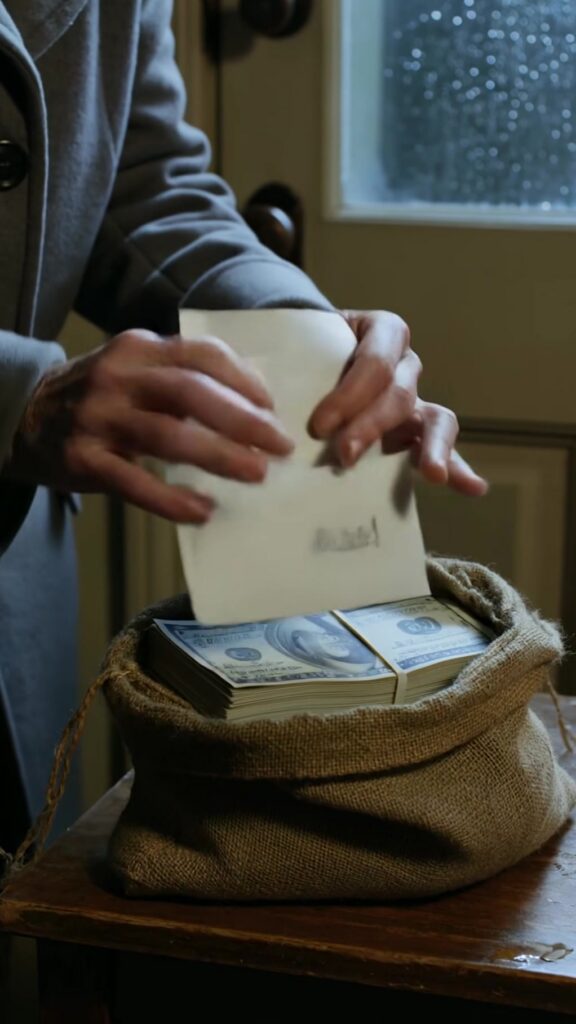
Inside was a thick stack of bills. More money than she’d held at once since before the hospital, before the debts, before she’d learned to stretch soup with water and hope. A note lay on top.
Mom, I’m sorry. I couldn’t say it in front of her. Don’t come back to the gate. Use this for your rent and medicine. I’ll bring more when I can. Please don’t hate me.
Rosa’s breath broke apart. The sound that came from her was not a sob at first but a small, broken exhale, as though her body had been holding air for years and finally released it. She sat down hard on the chair and read the note again and again until the words blurred. She held the paper to her chest, rocking slightly, the way she used to rock Mateo when thunder made him cry.
“My son,” she whispered into the empty room. “My boy.”
Her tears were hot, sudden, humiliating in their own way. But this humiliation was private; it belonged only to her and the cracked ceiling and the steady drumming of rain on the window.
When she finally lowered the note, something slid from the envelope and fluttered onto the table. A second piece of paper, folded tight. It had not been there a moment before—or perhaps it had been hidden behind the money, tucked with intention, waiting to be found only when she was softened by relief.
Rosa unfolded it.
The handwriting was not Mateo’s. The letters were narrow and impatient, pressed hard enough to leave dents in the paper.
If you tell him what really happened to his father, I will destroy him too.
Rosa felt the room tilt. The rain outside seemed to quiet, as if the world itself leaned in to listen.
Her fingers went numb around the paper. She read it once. Twice. Each time the words stabbed deeper, not because of the threat to her, but because of the certainty in it. Whoever wrote this knew there was a story Mateo didn’t have. Whoever wrote it believed Rosa was still holding the truth like a knife she might pull at any moment.
Rosa closed her eyes and, in the dark behind her lids, she saw another gate—rusted and cheap—outside the factory where her husband had worked. She saw the crowd. She smelled smoke and metal. She heard the shout of a supervisor and the sickening silence after.
Mateo had been a boy then, sleeping with his mouth open, his cheek pressed to Rosa’s shoulder. She had promised herself that night that her son would never carry the weight of how his father had really vanished from their lives. She had told him a simpler version, a kinder one, a lie shaped like protection. It was the kind of lie mothers learn to build quickly, like a shelter in a storm.
Now someone else had built a lie too—and theirs had teeth.
Rosa looked down at the money, at Mateo’s apology trembling on paper, and then at the threat that sat beside it like a blade on a dinner plate. The contrast made her stomach twist. Her son had hidden love in rice. Someone else had hidden war in an envelope.
She rose and moved to the window. Across the street, a neon sign flickered over a closed pharmacy. The gutters overflowed. People hurried under umbrellas, their faces turned away from the weather and from each other.
Rosa pressed the second note against the glass until her knuckles whitened. “Destroy him too,” she repeated, tasting the words like poison.
Mateo had stood at that gate and pretended not to care. But he had also risked sending her money. He had risked sending her a confession of weakness, of guilt. He was trapped between the life he’d built and the mother he came from, between the woman behind him and the truth behind Rosa’s ribs.
Rosa folded the threat carefully, as if it were evidence. She slid it back into the envelope and then tucked both notes into the tin box beneath her bed where she kept her marriage certificate, her late husband’s watch, and the hospital receipts that never stopped multiplying.
Then she sat at the table again, staring at the rice as though it were no longer food but a message. Each grain seemed to whisper the same question: How much love could be hidden before it started to rot?
Outside, the rain kept falling, relentless, washing the streets clean without ever touching what was buried underneath. Rosa wiped her cheeks with the heel of her hand. Her face had stopped shaking, but something inside her had begun to move—slowly, dangerously—like an old door finally opening.
“All right,” she said to the empty room, her voice steady now. “If they want to threaten me, they should remember who taught him how to survive.”
She reached for a pot, measured out a cup of rice, and set it to boil. The ordinary act anchored her. But her eyes stayed hard, fixed on the tin box under the bed, where the truth had been sleeping for years—waiting for the day someone tried to use it as a weapon.
And somewhere behind a black iron gate, her son thought his apology was safe, hidden among grains no one would think to search. He didn’t know yet that rice could carry more than comfort. It could carry a reckoning.
The storm raged on, and Rosa waited for the moment she would have to choose between silence and saving the boy who once believed his mother could hold back thunder with her hands.