The street didn’t care about him. It never had.
It was the kind of street that chewed through names and spit out nicknames—Penny Lane, Widow’s Cut, South Tenth—depending on who you asked and how many years they’d survived on it. The pavement wore its scars openly: tar seams like sutures, oil slicks like bruises, a constellation of broken glass that glittered every time a bus sighed past.
Cars passed. People passed. Life streamed around the boy as if he were a missing tile in a mosaic that no one wanted to fix. A courier swerved around him without slowing. A woman in heels stepped wide, eyes forward, pretending there wasn’t a barefoot kid standing dead center between the faded lane markings. A man carrying a sack of laundry muttered something about “strays” under his breath. Nobody stopped long enough to look at him the way you look at a person.
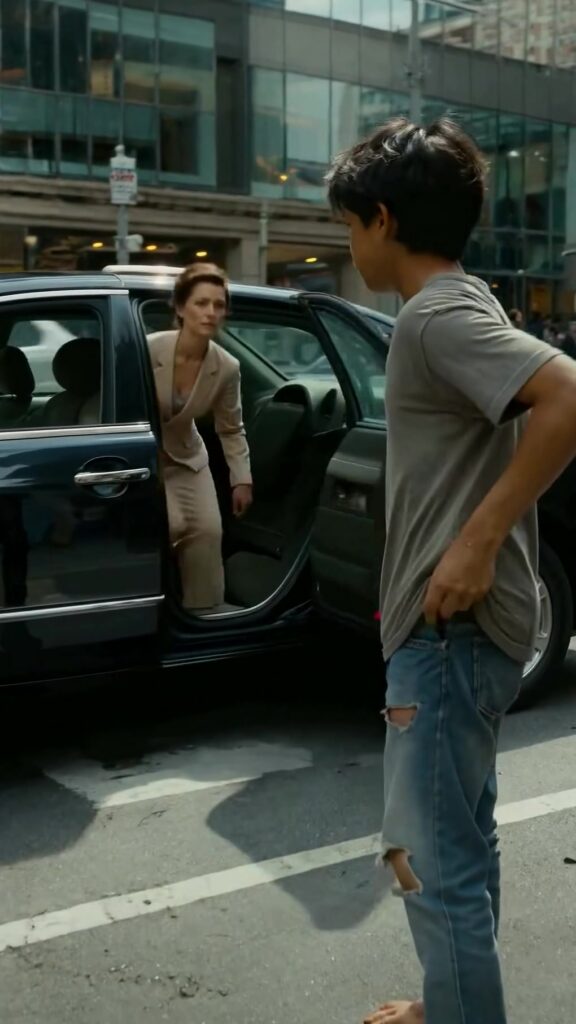
He stood still, shoulders thin under a shirt that had lost its color. His hair was clipped short at the sides as if someone had once tried to make him presentable, then given up halfway through life. His feet were bare, soles darkened by the city’s dirt, toes curled slightly as if gripping the earth so it couldn’t take him too.
His eyes were open, fixed on a point that wasn’t a point. Not daydreaming. Not pleading. Waiting had a shape in his face, like a held breath. If you watched him for long enough, you’d start to feel that the street had rearranged itself around him—traffic bending, pedestrians streaming—because it had decided he was a permanent obstacle, like a toppled sign no one bothered to stand back up.
In his palm, half hidden by curled fingers, he held a watch.
It was old, its leather strap cracked into scales. The glass over the face had a spiderweb fracture that caught the light in sharp lines. The hands were frozen at ten past two, and the crown was missing, leaving a small dark wound in the metal. It looked worthless. It looked like something found in a gutter, kept only because throwing it away would feel like admitting something you couldn’t bear to say out loud.
He wasn’t begging. He wasn’t trying to sell it. He was simply holding it the way people hold a key when they’re locked out, convinced that if they clutch it tightly enough the door will remember them.
The noon sun flashed against windshields. Horns snapped. A siren wailed somewhere far off, like a warning meant for someone else. The boy didn’t flinch. The street didn’t care.
Then the black car came.
It appeared at the far end like a shadow that didn’t belong to the day—too clean, too polished, too expensive for this patch of city. Its paint swallowed reflections instead of throwing them back. Even its tires were quiet, rolling over cracked asphalt as if it were freshly laid.
It should have barreled through like everything else. It should have treated the boy as the street treated him: as air, as a stain, as a problem that would solve itself.
Instead it slowed.
The boy’s chin lifted a fraction. Something in him tightened, as if a cord inside his chest had been pulled. The car drifted closer, hesitating, the way a predator hesitates when it senses something unfamiliar. The driver’s side window was tinted. No eyes visible. The engine purred with money and distance.
The boy stepped forward.
He didn’t raise his fists. He didn’t shout. He didn’t lunge with anger like everyone expected street kids to do. He extended his hand and touched the hood with two fingers.
Tap.
Not violence. Not threat. A signal—like knocking on a door you once lived behind.
The car stopped.
For a moment, the street held its breath with him. A bus idled at the curb. A cyclist glanced over his shoulder, then slowed as well. Even the man with the laundry paused as if he’d found a show worth watching. The boy’s fingers remained resting on the warm metal.
The rear door opened.
A woman stepped out, the kind of woman who looked as if she’d never been touched by weather. Her hair was smooth and pinned back. Her coat fit like it had been tailored around her temper. She moved with the controlled irritation of someone whose schedule had just been interrupted by something she considered beneath it.
She shut the door, the sound sharp in the street’s noise.
“What are you doing?” she asked.
Her voice wasn’t loud. It didn’t have to be. People like her carried volume in their certainty.
The boy didn’t answer.
Silence stretched between them like a wire. The woman’s eyes tracked him—his bare feet, his dirt-streaked knees, his hand on her car as if he had a right to touch it. Her mouth tightened.
“Move,” she said, and that single word contained a lifetime of being obeyed.
Still nothing.
Instead, the boy opened his fist and lifted the watch.
It sat on his palm like a dead insect, small and broken, ridiculous next to the woman’s gleaming jewelry. She glanced at it the way you glance at trash in a doorway, ready to step around it without thinking.
Then she looked again.
The change was so subtle that anyone else might have missed it: the stiff line of her shoulders losing its rigidity, her pupils narrowing, her lips parting as if they’d forgotten what to do. The street noises dimmed in the air around them. A horn honked and sounded very far away.
She took one step closer. Her breathing altered. Not anger now. Not annoyance.
Confusion first. Then recognition, like a hand closing around her throat.
Fear arrived last, quiet and absolute.
“Where did you get that?” she whispered.
The boy’s face didn’t change. He didn’t soften. He didn’t brighten with hope. He held the watch steady, forcing her to see it, forcing her to admit she had seen it.
The woman leaned in as if the air had thickened. Her gaze traced the cracked glass, the frozen hands, the missing crown. Something inside her cracked—something that had been held together by money and distance and time. Her perfectly composed expression faltered, revealing the raw shape beneath it.
She said something then, softer than before. A name, perhaps. A question. A confession. The street swallowed it before anyone else could hear.
The boy froze.
It wasn’t the stillness of waiting anymore. It was the stillness of impact—like his body had been struck by a truth and didn’t know how to move around it. His fingers twitched. His eyes sharpened, then dulled, as if the answer he’d carried inside him for years had finally been spoken aloud, and it was worse than not knowing.
The woman reached toward him, a hand hovering at the edge of touching his wrist. Her nails were neat. Her rings flashed. She looked, suddenly, not powerful but desperate, like someone standing on a ledge trying to talk a ghost back into the world.
“Please,” she murmured, and the word sounded foreign in her mouth.
The boy’s hand slackened.
The watch slipped.
For a heartbeat it hung in the air, turning slowly, catching sunlight in its fractured face. Then it hit the pavement.
Crack.
It was too loud for such a small thing. The sound cut through traffic, through conversation, through the city’s constant shrug. Heads turned. The bus driver stared. The cyclist stopped completely.
The boy stared down at the watch as if it had been a fragile world and he had just watched it break apart for the second time.
He didn’t kneel to pick it up.
He didn’t curse, didn’t cry, didn’t rage. There was no dramatic collapse, no plea for explanation. He simply turned.
And walked away.
Not fast. Not scared. Not running from her or toward anything else. Just… done. Each step was measured, bare feet slapping softly against the road, as if he had finally accepted what the street had been telling him all along.
Life moved around him again. Cars rolled forward. People resumed their paths. The street reclaimed its rhythm, indifferent as ever.
But the woman stayed still.
She didn’t chase him. She didn’t call out. Her hand remained half lifted, fingers trembling as if she could still feel the weight of the broken watch on his palm. She looked after him with an expression that didn’t belong on her face—something small, stripped of the armor she wore so well.
The camera—if there had been one—would have lingered on her then. The expensive car idling behind her. The flawless coat. The city’s grime refusing to respect any of it.
For the first time, she looked like someone the street might chew up too.
And beside her, on the asphalt, the watch lay shattered, hands still pointing forever at ten past two—marking the moment when waiting ended, and whatever came after began.